

FactCheck Q A: Has confidence in the media in Australia dropped lower than in the United States?
- Written by: Alexandra Wake, Senior lecturer, RMIT University
The Conversation fact-checks claims made on Q&A, broadcast Mondays on the ABC at 9:35pm. Thank you to everyone who sent us quotes for checking via Twitter using hashtags #FactCheck and #QandA, on Facebook or by email.
Excerpt from Q&A, March 20, 2017.I’ve seen various surveys right around the world showing that confidence in media has dropped in recent years. In fact, I saw a survey recently that showed actually in Australia it had dropped and it’s lower than in the United States. Obviously, there will be different indexes. – Assistant Minister for Social Services and Multicultural Affairs, Zed Seselja, speaking on Q&A, March 20, 2017.
In a wide-ranging Q&A discussion on misinformation, disinformation and trust in media, the assistant minister for social services and multicultural affairs, Zed Seselja, said that surveys showed confidence in media has fallen around the world. In Australia, he said, it has dropped lower than in the US.
Is he right?
Checking the source
The Conversation asked Seselja’s office for sources to support his statement but didn’t hear back before deadline.
Nevertheless, there is at least one recent source supporting his statement about “confidence” in the “media”.
The 2017 Edelman Trust Barometer
The 2017 Edelman Trust Barometer report, released by global public relations firm Edelman in January this year, concluded Australians are less trusting of the media than their US counterparts, when asked if they trusted the media to do the right thing.
The data in the report is drawn from more than 33,000 respondents to an online survey conducted in 28 countries in 2016. They looked at trust in various institutions among the “informed public” (defined as highly-paid, college-educated, people who read or watch the news and actively follow public policy) and also among the general population.
Respondents were asked to indicate how much they trust various institutions (including the media) to do what is right. The chart below, taken from the report, shows trust in media in Australia is indeed lower than in the US, as Seselja said. The figure for Australia is 32% among the general population, while for the US trust in media is at 47% among the general population.
 2017 Edelman Trust Barometer report
Edelman Australia’s chief executive Steven Spurr said at the time:
A real standout this year was Australians’ loss of trust in media. Among informed publics (from a 54% trust level last year), media now sits at 40%, a whopping 14-point decline. Among the general population, trust in media at 32% is among the lowest levels globally, 11 points below the global average of 43% and a 10 point drop from 2016.
Edelman’s 2017 report recorded a drop in trust globally in government, business, media and non-government organisations between 2016 and 2017. The decline in trust had been accelerated by the state of the local media industry, the proliferation of fake news and growing trust in search engines over journalists, Spurr said.
Other sources
As Seselja also correctly pointed out, there are different indexes, and different ways of looking at confidence and trust in the media and journalism.
Oxford University’s Reuters Institute for the Study of Journalism publishes a Digital News Report each year, which measures general trust in news media. Its most recent report was released in June 2016.
The research was conducted using an online questionnaire of more than 50,000 people in 26 countries in January and February 2016. Around 2000 people were surveyed in each of the participating countries.
The Australian results were compiled by academics at the University of Canberra – and those tell a different story about “trust” and “journalism” to the Edelman survey.
In 2016, the Reuters report found that general trust in news media had Australia was low compared to most OECD countries – but above the United States.
The US had general news trust at 33%, Australia at 43%, Ireland at 50%, UK at 50% and Canada at 55%, as this chart from the report shows:
2017 Edelman Trust Barometer report
Edelman Australia’s chief executive Steven Spurr said at the time:
A real standout this year was Australians’ loss of trust in media. Among informed publics (from a 54% trust level last year), media now sits at 40%, a whopping 14-point decline. Among the general population, trust in media at 32% is among the lowest levels globally, 11 points below the global average of 43% and a 10 point drop from 2016.
Edelman’s 2017 report recorded a drop in trust globally in government, business, media and non-government organisations between 2016 and 2017. The decline in trust had been accelerated by the state of the local media industry, the proliferation of fake news and growing trust in search engines over journalists, Spurr said.
Other sources
As Seselja also correctly pointed out, there are different indexes, and different ways of looking at confidence and trust in the media and journalism.
Oxford University’s Reuters Institute for the Study of Journalism publishes a Digital News Report each year, which measures general trust in news media. Its most recent report was released in June 2016.
The research was conducted using an online questionnaire of more than 50,000 people in 26 countries in January and February 2016. Around 2000 people were surveyed in each of the participating countries.
The Australian results were compiled by academics at the University of Canberra – and those tell a different story about “trust” and “journalism” to the Edelman survey.
In 2016, the Reuters report found that general trust in news media had Australia was low compared to most OECD countries – but above the United States.
The US had general news trust at 33%, Australia at 43%, Ireland at 50%, UK at 50% and Canada at 55%, as this chart from the report shows:
 Reuters Institute for the Study of Journalism, Digital News Report 2016
The same report found that Australians trusted news organisation more than individual journalists. A total of 39% trusted news organisations and 32% trusted journalists, as this chart from the report shows:
Reuters Institute for the Study of Journalism, Digital News Report 2016
The same report found that Australians trusted news organisation more than individual journalists. A total of 39% trusted news organisations and 32% trusted journalists, as this chart from the report shows:
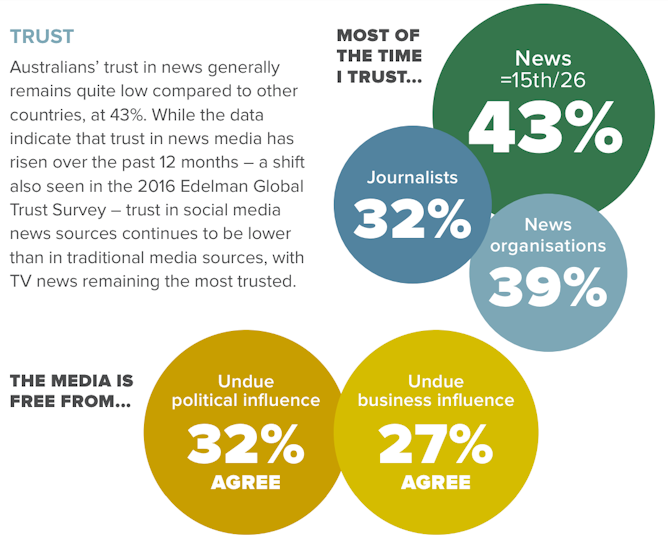 Reuters Institute for the Study of Journalism, Digital News Report 2016
It will be interesting to see if the Reuters Institute’s 2017 results, which are due to be released in July, accord with the 2017 Edelman report’s findings.
Verdict
Zed Seselja was right: “various surveys right around the world” have shown declining confidence in media in recent years, while at least one recent survey (the 2017 Edelman Trust Barometer report) shows that confidence in the media Australia has dropped and is lower than in the United States.
The minister also correctly noted there are different indexes of trust in the media and journalism, which have different methods (and reach different conclusions). For example, the 2016 Digital News Report found that general trust in news media had Australia was low compared to other OECD countries, but above the United States. – Alexandra Wake
Review
This is a sound analysis of the varying global indices that can get us closer to understanding different levels of confidence in the media in the US and Australia. At face value, Zed Seselja’s comments can be supported and the analysis above shows this.
The very recent work of University of Canberra scholar Caroline Fisher in her recent Communication, Research and Practice journal article gets to the heart of why the question of media trust is a tricky topic for several reasons.
First, there is no agreed definition on the measure of “trust” (or confidence) in the media. Different survey questions get different answers depending on how respondents think about “media”.
When some people think of media they might be referring to news media like ABC TV news, but for others, media could be the Herald Sun, or even for some, it might mean Facebook.
Another consideration is the inference about what low levels of public trust in the media actually means. It can’t necessarily be assumed to be a bad thing (although it could be). For example, empirical evidence outlined in Jan Müller’s book on media trust shows that the highest levels of media trust are in authoritarian regimes, not democracies.
Finally, academic Thomas Hanitzch, who studies media trust, warns that levels of public confidence in the media have developed differently depending on contextual factors and thus comparing two countries can be quite misleading. – Andrea Carson
Reuters Institute for the Study of Journalism, Digital News Report 2016
It will be interesting to see if the Reuters Institute’s 2017 results, which are due to be released in July, accord with the 2017 Edelman report’s findings.
Verdict
Zed Seselja was right: “various surveys right around the world” have shown declining confidence in media in recent years, while at least one recent survey (the 2017 Edelman Trust Barometer report) shows that confidence in the media Australia has dropped and is lower than in the United States.
The minister also correctly noted there are different indexes of trust in the media and journalism, which have different methods (and reach different conclusions). For example, the 2016 Digital News Report found that general trust in news media had Australia was low compared to other OECD countries, but above the United States. – Alexandra Wake
Review
This is a sound analysis of the varying global indices that can get us closer to understanding different levels of confidence in the media in the US and Australia. At face value, Zed Seselja’s comments can be supported and the analysis above shows this.
The very recent work of University of Canberra scholar Caroline Fisher in her recent Communication, Research and Practice journal article gets to the heart of why the question of media trust is a tricky topic for several reasons.
First, there is no agreed definition on the measure of “trust” (or confidence) in the media. Different survey questions get different answers depending on how respondents think about “media”.
When some people think of media they might be referring to news media like ABC TV news, but for others, media could be the Herald Sun, or even for some, it might mean Facebook.
Another consideration is the inference about what low levels of public trust in the media actually means. It can’t necessarily be assumed to be a bad thing (although it could be). For example, empirical evidence outlined in Jan Müller’s book on media trust shows that the highest levels of media trust are in authoritarian regimes, not democracies.
Finally, academic Thomas Hanitzch, who studies media trust, warns that levels of public confidence in the media have developed differently depending on contextual factors and thus comparing two countries can be quite misleading. – Andrea Carson
 The Conversation FactCheck is accredited by the International Fact-Checking Network.
The Conversation’s FactCheck unit is the first fact-checking team in Australia and one of of the first worldwide to be accredited by the International Fact-Checking Network, an alliance of fact-checkers hosted at the Poynter Institute in the US. Read more here.
Have you seen a “fact” worth checking? The Conversation’s FactCheck asks academic experts to test claims and see how true they are. We then ask a second academic to review an anonymous copy of the article. You can request a check at checkit@theconversation.edu.au. Please include the statement you would like us to check, the date it was made, and a link if possible.
The Conversation FactCheck is accredited by the International Fact-Checking Network.
The Conversation’s FactCheck unit is the first fact-checking team in Australia and one of of the first worldwide to be accredited by the International Fact-Checking Network, an alliance of fact-checkers hosted at the Poynter Institute in the US. Read more here.
Have you seen a “fact” worth checking? The Conversation’s FactCheck asks academic experts to test claims and see how true they are. We then ask a second academic to review an anonymous copy of the article. You can request a check at checkit@theconversation.edu.au. Please include the statement you would like us to check, the date it was made, and a link if possible.
Authors: Alexandra Wake, Senior lecturer, RMIT University


 Daily Bulletin


