

PolicyCheck: the government's new child care plan
- Written by: Robert Breunig, Professor of Economics, Australian National University
The government’s new child care plan has passed the Senate, subject to last minute amendments passed by independent Senator Derryn Hinch. The bill, known officially as the Family Assistance Legislation Amendment (Jobs for Families Child Care Package) Bill 2016, will now return to the lower house. It is expected to pass, and implementation to begin in July 2018.
This new law will change the way that families are given assistance with paying for child care.
The main changes include:
Replacing the Child Care Benefit and Child Care Rebate with a new Child Care Subsidy. The new subsidy will have eligibility rules and be subject to means testing. Total Child Care Subsidy payments will be capped at A$10,000 for wealthy families and there will be zero subsidies for families earning more than A$350,000.
Introducing an hourly fee cap on the subsidies that governments will pay in an attempt to control child care price increases.
A new activity test, meaning that families will be eligible for either 36, 72 or 100 hours of subsidised care per fortnight depending upon the combined hours of work, training, study or other recognised activity undertaken. Both parents must work or study at least eight hours a fortnight to receive the new subsidy.
A new A$1 billion Child Care Safety Net aimed at helping families on less than A$65,710 who do not meet the activity test. These families will be able to get up to 24 hours per fortnight of subsidised care.
Before: two complicated payments
Families in Australia currently receive two types of support for child care: the Child Care Benefit and the Child Care Rebate (originally called the Child Care Tax Rebate).
The Child Care Rebate covers 50% of families’ out-of-pocket costs of childcare up to A$7,500 per child – after you hit the A$7,500 threshold, you don’t get any more rebate.
The Child Care rebate is not means tested but the Child Care Benefit is.
How much Child Care Benefit you get depends on whether children are school-aged or pre-school aged, on the family’s current year income, the number of children in care and on the hours of care used.
Child care providers typically charge anywhere between around A$100 and around A$150 per day per child.
Now: a single payment
Under the new plan, the old Child Care Rebate and Child Care Subsidy will be rolled into a single new payment called the Child Care Subsidy.
Instead of a flat 50% rebate rate on what they pay, families with a household income of up to A$65,710 will get up to 85% of what they pay. The rate tapers down from there.
Families receiving more than A$185,710 in household income will also be subject to a cap of $10,000 on total Child Care Subsidy payments.
 Department of Education and Training
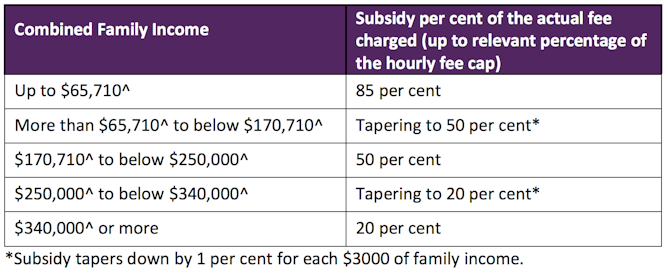 Department of Education and Training
New hourly fee cap
An additional layer of complexity is added by the new policy’s fee caps – an attempt by the government to prevent higher subsidies from leading directly to increased prices.
The new child care subsidy rate will not apply to what families actually pay but rather to the new hourly fee caps. The fee caps will be indexed to the consumer price index (CPI). Over the last 12 years, child care prices have grown much more rapidly than inflation. That’s due mainly to increased demand and the National Quality Framework, which meant higher-skilled staff and smaller classes.
Department of Education and Training
New hourly fee cap
An additional layer of complexity is added by the new policy’s fee caps – an attempt by the government to prevent higher subsidies from leading directly to increased prices.
The new child care subsidy rate will not apply to what families actually pay but rather to the new hourly fee caps. The fee caps will be indexed to the consumer price index (CPI). Over the last 12 years, child care prices have grown much more rapidly than inflation. That’s due mainly to increased demand and the National Quality Framework, which meant higher-skilled staff and smaller classes.
 Chart by the ANU Centre for Social Research and Methods, using Australian Bureau of Statistics data.
It is very hard for governments to control prices in any market. These hourly price caps, given the price increases associated with quality improvements in child care, may end up creating a two-tiered market, with high-end providers charging what the market will bear and low-end providers tying themselves to the subsidy rate.
This two-tiered system of high- and low-priced childcare centres already exists to some extent in most urban areas in Australia. The gap between these may be exacerbated by the attempt to control prices.
As many child care providers currently charge daily rates, and have the power to determine how many hours of care are provided in any given day, it’s unclear how the new system of hourly fee caps will work in practice.
Which families will get more and which will get less?
It is clear that wealthy families will receive less money. Those earning over A$350,000 – who, under the old scheme, could get as much as A$7,500 per child – will now receive nothing. This increases the effective marginal tax rates on second earners in wealthy households.
The policy effect on other income groups depends on household income, whether the hourly price of the care they currently use is more expensive than the fee cap, and whether they are affected by the new activity test.
Most, though not all, families earning over A$250,000 will be negatively affected. Those that will be better off are those who work long hours and use relatively inexpensive childcare and are near the A$250,000 threshold.
A substantial fraction of households earning less than the A$65,710 will be worse off, mostly because they will fail to meet the activity test.
How might the new plan affect workforce participation and productivity?
It’s not clear what effect all this will have on workforce participation. On average, women from the wealthiest families will work less.
On average, women from less well-off families may end up working more in response to the new policy.
One might expect an overall positive impact on total female labour force participation but this depends greatly upon the economy’s ability to deliver jobs. This will vary greatly by geographic region.
Female labour force participation is already widespread, so this policy will not generate a huge new pool of workers. It will have small positive effects on willingness to work and working hours, but these will be small compared to macro-economic effects such as global commodity prices or the performance of the Chinese economy.
Long-term productivity should be higher because experts think better and more early childhood education and care will produce better long term outcomes.
Overall, the policy seems tilted towards less expensive child care for families, which is good. However, it may work against improving quality child care, which is expensive.
Policymakers have to decide whether there are more productivity gains to be had in increasing women’s workforce participation or, in the longer term, in investing in higher quality child care.
Chart by the ANU Centre for Social Research and Methods, using Australian Bureau of Statistics data.
It is very hard for governments to control prices in any market. These hourly price caps, given the price increases associated with quality improvements in child care, may end up creating a two-tiered market, with high-end providers charging what the market will bear and low-end providers tying themselves to the subsidy rate.
This two-tiered system of high- and low-priced childcare centres already exists to some extent in most urban areas in Australia. The gap between these may be exacerbated by the attempt to control prices.
As many child care providers currently charge daily rates, and have the power to determine how many hours of care are provided in any given day, it’s unclear how the new system of hourly fee caps will work in practice.
Which families will get more and which will get less?
It is clear that wealthy families will receive less money. Those earning over A$350,000 – who, under the old scheme, could get as much as A$7,500 per child – will now receive nothing. This increases the effective marginal tax rates on second earners in wealthy households.
The policy effect on other income groups depends on household income, whether the hourly price of the care they currently use is more expensive than the fee cap, and whether they are affected by the new activity test.
Most, though not all, families earning over A$250,000 will be negatively affected. Those that will be better off are those who work long hours and use relatively inexpensive childcare and are near the A$250,000 threshold.
A substantial fraction of households earning less than the A$65,710 will be worse off, mostly because they will fail to meet the activity test.
How might the new plan affect workforce participation and productivity?
It’s not clear what effect all this will have on workforce participation. On average, women from the wealthiest families will work less.
On average, women from less well-off families may end up working more in response to the new policy.
One might expect an overall positive impact on total female labour force participation but this depends greatly upon the economy’s ability to deliver jobs. This will vary greatly by geographic region.
Female labour force participation is already widespread, so this policy will not generate a huge new pool of workers. It will have small positive effects on willingness to work and working hours, but these will be small compared to macro-economic effects such as global commodity prices or the performance of the Chinese economy.
Long-term productivity should be higher because experts think better and more early childhood education and care will produce better long term outcomes.
Overall, the policy seems tilted towards less expensive child care for families, which is good. However, it may work against improving quality child care, which is expensive.
Policymakers have to decide whether there are more productivity gains to be had in increasing women’s workforce participation or, in the longer term, in investing in higher quality child care.
Authors: Robert Breunig, Professor of Economics, Australian National University
Read more http://theconversation.com/policycheck-the-governments-new-child-care-plan-75046


 Daily Bulletin


