

Live fast, die young: a massive 'dead red' galaxy seen for the first time
- Written by: Karl Glazebrook, Director & Distinguished Professor, Centre for Astrophysics & Supercomputing, Swinburne University of Technology
The discovery of massive galaxy that stopped making any new stars by the time the Universe was only 1.65 billion years old means we may have to rethink our theories on how galaxies formed.
The galaxy, known as ZF-COSMOS-20115, formed all of its stars (more than three times as many as our Milky Way has today) through an extreme starburst event.
But it stopped forming stars to become a “red and dead” galaxy mot much more than a billion years after the Big Bang. Such galaxies are common in our Universe today but not expected to have existed at this ancient epoch. Galaxies turn red when they stop forming stars due to the resulting absence of hot, blue stars that have very short lifetimes.
This discovery by our team sets a new record for the earliest massive red galaxy, with details published in Nature this month.
It is an incredibly rare find that poses a new challenge to galaxy evolution models to accommodate the existence of such galaxies much earlier in the Universe.
An earlier discovery
To put this discovery in context, I’d like to give a short, personal history of research on early massive galaxies.
In 2004 I wrote an uncannily similar Nature paper about the existence of massive, old galaxies in the early Universe that were discovered in deep near-infrared surveys. At that time we were peering back across space to 3 billion years after the Big Bang.
These were a challenge for the models of galaxy formation that scientists were working with at the time, the start of a period where our pictures of how galaxies formed were rapidly being rewritten.
At the time, a picture of galaxies forming by lots of mergers in hierarchical assembly was in vogue. The problem was that this meant that today’s massive galaxies were in little bits billions of years ago.
But significant changes were made – driven in part by observations of the abundance of early massive galaxies, the observations of large gas-rich disk galaxies at these epochs and the discovery of “red nuggets” – extremely compact massive elliptical galaxies which stopped forming stars early on.
We moved to a picture where most galaxy growth and formation was driven by the formation of stars within the galaxy itself, from cosmic gas coming in to the galaxy.
This gas is fed into galaxies along the cosmic web by cold streams that are effective early on and allow us to grow massive galaxies more quickly in the computer modelling.
Many, many astronomers contributed to these developments and it was fun to play a minor role.
The new discovery
So what about this new discovery? This stems from the ZFOURGE survey, a deep near-infrared imaging survey we have been conducting on the Magellan telescopes in Chile, since 2010.
Back in 2013, one of our students, Caroline Straatman of Leiden University, discovered a population of pale red dots in the ZFOURGE survey.
These dots were bright in the near-infrared but very faint in the 35 other wavelength bands we observed. This peak suggested the presence of roughly 500 million year old stars but at a huge cosmic redshift.
In the local Universe this peak appears in blue light, so the redshift points to a time around 1.5 billion years after the Big Bang. The light suggested that no young stars were present, and the near-infrared brightness suggested these were massive objects (1011 solar masses).
To put this in context, our Milky Way has been growing continuously for 12 billion years but is 3-5 times less massive.
Even more remarkably, the galaxies looked like ellipticals and were almost point sources, even with high-resolution Hubble Space Telescope observations. They were less than 5,000 light years across. Extremely dense red nuggets at an earlier time than anyone had suspected.
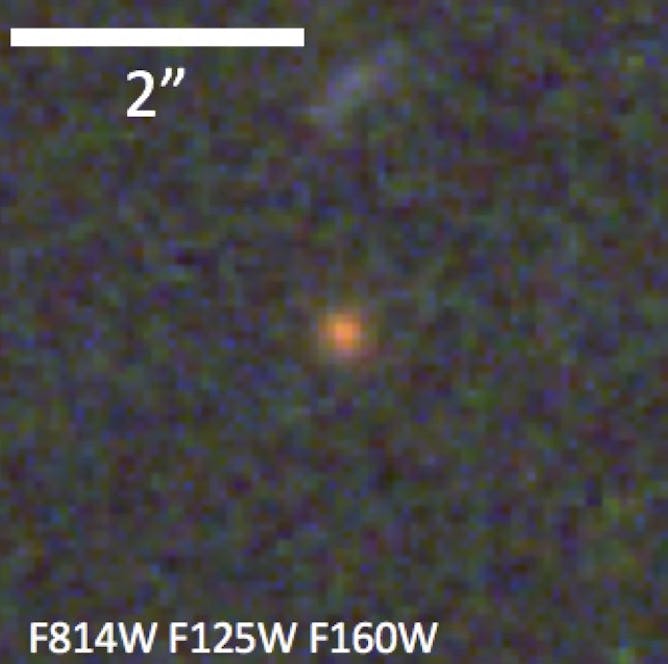 This is what ZF-COSMOS-20115 really looks like (compared to the artist’s impression, top) in a close-up view. Even with Hubble’s 0.2-arcsec spatial resolution the object appears barely resolved due to its extreme compactness.
Author provided
This is what ZF-COSMOS-20115 really looks like (compared to the artist’s impression, top) in a close-up view. Even with Hubble’s 0.2-arcsec spatial resolution the object appears barely resolved due to its extreme compactness.
Author provided
Lines in the spectrum
In 2012 a powerful new near-infrared spectrograph was commissioned on the W M Keck telescopes in Hawaii. Last year we used it to get a two-night exposure on some of these objects.
We were amazed when we got a spectrum of the brightest (and most massive). They showed the distinct signature of Balmer absorption lines of stars around 500 million years old. Importantly there was no sign of current star-formation.
This galaxy was already massive and between 500 million and 1 billion years old.
It must have formed extremely fast, and then its star formation died quickly. This extreme behaviour could require significant rewriting of our pictures of galaxy formation in the first billion years of cosmic history.
Why? Well, we think galaxies form in the centres of halos of cold dark matter. Dark matter particles is not made of ordinary atoms, and particle physicists are still trying to detect these in the laboratory.
These halos can form very early and act as seeds for galaxy formation giving it a kick start. Without dark matter it would be difficult to form any galaxy.
The problem is at this early time there are barely enough massive dark matter halos to accommodate such massive galaxies. As a consequence in simulated Universes we don’t find this population of non-star forming galaxies so early, nor do we find the massive ancestors with extreme star-formation rates a billion years earlier.
So, do we need two recipes for galaxy formation where some form extremely quickly and the rest take 12 billion years?
Time will tell. The history of this field has shown that the theoretical community has a very strong record of postdiction (as opposed to prediction), and I expect a slew of papers will turn up in the next few weeks to explain this object!
Teasing of theorists aside, galaxy formation is a very difficult field to work in; the astrophysics are complex and it is very much driven by new observations which is why it is so much fun to work in.
Meanwhile our groups are pursuing the quest for massive galaxies to even earlier times. We have designed new filters to identify these and hope to start a new survey using the Gemini telescopes this year. Theorists, get your predictions in now.
Authors: Karl Glazebrook, Director & Distinguished Professor, Centre for Astrophysics & Supercomputing, Swinburne University of Technology


 Daily Bulletin


