

Feeling helpless about the Great Barrier Reef? Here's one way you can help
- Written by: Justin Marshall, ARC Laureate Fellow, The University of Queensland
It is easy to feel overwhelmed when confronted with reports of the second mass bleaching event on the Great Barrier Reef in as many years. But there is a way to help scientists monitor the reef’s condition.
CoralWatch is a citizen science program started at The University of Queensland 15 years ago, with two main aims: to monitor the environment on a vast scale, and to help people get informed about marine science.
These goals come together with coral health monitoring. Divers, snorkelers or people walking around reef areas during low tides can send us crucial information about coral bleaching, helping us to build detailed pictures of the health of different reefs.
Participants can use a colour chart, backed up through the CoralWatch app or website, to measure accurately the colour and type of coral they see. The chart covers 75% of known corals, and can be used with no prior training.
We also ask people to enter the type of coral (branching, boulder, plate or soft), the location, and the weather. This allows scientists to identify the location and extent of any problems quickly (and is an excellent way to learn more about our reefs).
In fact, you don’t even have to go to a reef to participate and discover through CoralWatch; we have classroom and virtual reef systems, and just talking the problem through can help.
 CoralWatch chart. Volunteers match the colour and four basic coral types: branching, boulder, plate and soft.
CoralWatch
CoralWatch chart. Volunteers match the colour and four basic coral types: branching, boulder, plate and soft.
CoralWatch
The graphs shown below are samples of CoralWatch data from the northern and southern reef during 2016’s catastrophic mass bleaching event, while the pair of graphs further down the page show data from just a few days ago at Lady Elliot Island and the very remote North Mariana Islands in the West pacific.
The Heron Island graph shows a healthy reef, as the southern areas of the reef escaped the worst of the bleaching last year. In contrast, Monsoon Reef (which lies off Port Douglas) and many others in the north bleached badly, or in some cases simply died.
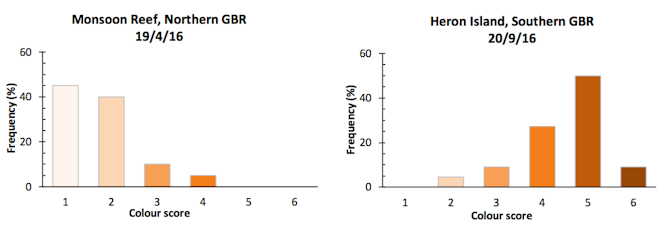 These graphs show the contrast between a healthy and unhealthy reef. The bars represent observed coral matched to the colours (1-6) on the CoralWatch card and how frequently each were seen. Scores averaging between 4-6 are normal.
CoralWatch, Author provided
These graphs show the contrast between a healthy and unhealthy reef. The bars represent observed coral matched to the colours (1-6) on the CoralWatch card and how frequently each were seen. Scores averaging between 4-6 are normal.
CoralWatch, Author provided
Scores averaging between four and six are normal and represent good levels of symbiotic algae, which generate nutrients for the coral. Scores below three signify that coral is in distress.
The impact of this year’s mass bleaching is still being quantified. However, reefs in the middle section and far south of the reef – such as Lady Elliot Island – are now showing varying degrees of bleaching, from light to severe. Many of the remaining corals in the north are also showing signs of bleaching again.
What seems certain is that we will lose many more corals, along with the fish and invertebrate life they support, again this year.
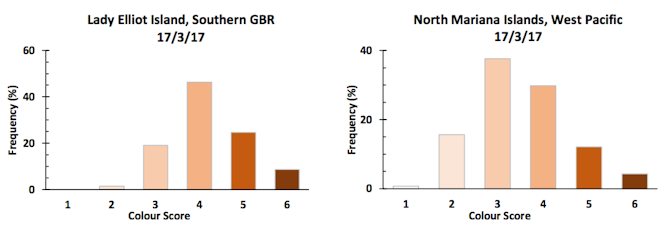 Coral health at Lady Elliot Island and the very remote North Mariana Islands, from March 2017.
CoralWatch, Author provided
Coral health at Lady Elliot Island and the very remote North Mariana Islands, from March 2017.
CoralWatch, Author provided
The results for the North Mariana Islands, from a CoralWatch survey conducted last week, shows mid-level coral bleaching and demonstrates that even very remote reefs are not climate-proof.
Australians increasingly believe the government needs to act on climate change, and some of this change in opinion is likely fuelled by continued reports of coral bleaching.
CoralWatch doesn’t only help build a detailed picture of reef health. Like other citizen science projects, such as Reef Check, it can help speed up our fatally slow response to climate change. There are three key benefits.
First, we need to improve mutual understanding between scientists and the public. The CoralWatch mantra is: tell me and I’ll forget; teach me and I may remember; involve me and I’ll learn. Citizen science is a natural fit for everyone, no matter your level of education or knowledge.
Children are the citizens of the future, and helping them to understand their changing world is a moral and social imperative. CoralWatch works closely with schools and groups like the Marine Teachers Association of Queensland, and is used in more than 75 countries worldwide.
 A coral health chart being used in the field.
CoralWatch, Author provided
A coral health chart being used in the field.
CoralWatch, Author provided
Second, we need to encourage lifestyle change. Many people, as they become more engaged in citizen science, will naturally adopt more environmentally friendly habits. Getting involved in protecting the Great Barrier Reef – and other citizen science projects – can be a great dose of perspective on our place in the natural world.
However, as personally rewarding as they can be, individual lifestyle choices alone won’t deliver the rapid and widespread change we need to save our reefs. That’s why we need to bridge the disconnect between what most of Australia wants and the politicians who ultimately have the power to fast-track change. Citizen scientists are also informed voters and consumers, who can demand better policies from companies and governments.
The future of the Great Barrier Reef is in the hands of Australians, and it will take all of us to preserve it for our children.
Authors: Justin Marshall, ARC Laureate Fellow, The University of Queensland


 Daily Bulletin


