

Why does the Carmichael coal mine need to use so much water?
- Written by: Ellen Moon, Researcher in Geochemistry, Southern Cross University
From accidental water spills into coastal wetlands, to proposed taxpayer-funded loans, Adani’s planned Carmichael coal mine and the associated Abbot Point coal terminal can’t keep out of the news at the moment.
Last week, the granting of an unlimited 60-year water licence to the Carmichael mine, in Queensland’s Galilee Basin, rattled environmentalists, farmers and community groups alike.
In a region experiencing prolonged drought conditions, the provision of unlimited water for one of the largest mining operations in the Southern Hemisphere seems like a commitment at odds with current climate predictions. The decision has also prompted a raft of wider questions about the industry’s water use.
Why do coal mines need so much water?
Underground coal mines rely on water to reduce the hazard of fires or explosion, by using it to cool the cutting surfaces of mining equipment and prevent coal dust from catching fire.
Water also helps to manage dust produced during the processing stage, when coal is crushed and ground. Coal is then transported through pipelines as a water-based slurry for further processing.
Mines also need water for things like equipment maintenance, and for consumption by the mining communities themselves.
In total, about 250 litres of freshwater are required per tonne of coal produced. This freshwater makes up around a quarter of the total water demand during coal production, the rest being “worked” (recycled) water.
What other industries use lots of water?
The Great Artesian Basin is one of the largest underground water reservoirs in the world. It underlies 22% of Australia’s land area, beneath the arid and semi-arid parts of Queensland, New South Wales, South Australia and the Northern Territory.
Its aquifers supply water to around 200 towns or settlements, most of which are allowed to draw between 100 and 500 million litres (ML) per year.
 The Great Artesian Basin covers almost a quarter of Australia.
Tentotwo/Wikimedia Commons, CC BY-SA
The Great Artesian Basin covers almost a quarter of Australia.
Tentotwo/Wikimedia Commons, CC BY-SA
The Great Artesian Basin underpins A$12.8 billion of economic activity annually, according to a 2016 report commissioned by the federal government. Almost all of this is from mining and coal seam gas (A$8 billion) and livestock farming (A$4.7 billion).
In Queensland, mining and industry hold just over 1% (by number) of the water licences linked to the Great Artesian Basin but account for 10% of the water extracted. Coal seam gas accounts for a further 22% of water, with no licensing required. In contrast, livestock production accounts for 88% of water licences but just 46% of the extracted water.
The Carmichael mine’s 12,000ML forecasted use (equivalent to 4% of the water extracted from the Great Artesian Basin in Queensland last year) would put it alongside the biggest annual users of Great Artesian Basin water, such as the Olympic Dam copper and uranium mine in South Australia, which currently draws 10,000ML each year.
Why does Adani need unlimited water anyway?
According to the company’s own modelling, the Carmichael mine’s annual freshwater use is projected to peak at just over 12,000ML – or roughly 13 Olympic swimming pools per day.
Despite these estimates, the water licence granted to Adani puts no limit on the water it can take from the Great Artesian Basin. However, it calls for regular monitoring of water levels, quality and flow in each aquifer that is tapped.
Unlike other controversial Queensland mining projects, such as the New Acland coal mine, Adani’s water licence application was exempted from public scrutiny, courtesy of a November 2016 amendment to the existing laws.
Water licences usually specify the total amount, and/or the daily rate, of groundwater that can be taken. Changes to a water licence to increase the amount of water must be assessed like a new application and pass public scrutiny. But with an unlimited licence, there is no need for Adani to apply for a new licence if they need more water than originally predicted.
What are the environmental effects of industrial-scale water usage on the basin?
Despite a net yearly decrease of 286,000ML in the water stored within the Great Artesian Basin, it is in no danger of running dry. The past 120 years of exploitation have used up less than 0.1% of the water stored.
The real issue is water pressure. Flows from artesian bores are now roughly half what they were in 1915. Since then, the water level in some bores has fallen by as much as 80 metres, and a third of bores have stopped flowing altogether. This directly affects the human, plant and animal communities that rely on artesian water.
Because of their isolation, the natural springs of the Great Artesian Basin are home to many unique plant and animal species. Desert springs are particularly vulnerable to declining water pressure, and many spring habitats have been irreversibly damaged by invasive species, excavation, livestock, industrial activity and even tourists.
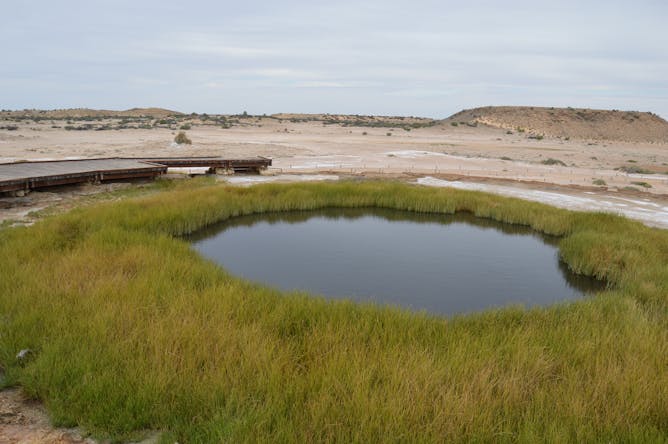 An oasis in South Australia’s arid interior.
Tandrew/Wikimedia Commons, CC BY-SA
An oasis in South Australia’s arid interior.
Tandrew/Wikimedia Commons, CC BY-SA
Can mining industries be more water-wise?
Recycled water is an integral part of coal mining, but it contains salt, added in the dust-management stage, which can leave the water unusable for certain processes. Nevertheless, a recent study suggests that Queensland coal mines could cut their freshwater use by 62% simply by using recycled water for processes that are not sensitive to salt levels. Diluting salty recycled water could also reduce freshwater use by 50%, and cut water costs by 40%.
Untreated seawater is perhaps the most sustainable water of all, although transporting it from coast to mine costs energy and therefore money. Its saltiness also creates chemical challenges during coal and uranium processing.
Another option to address climate-induced water challenges might be for mines to share water allocations.
Where do we go from here?
Understandably, there is significant concern that Adani’s unlimited licence will allow the mine to draw more water than predicted. Should the mine go ahead, it is important that the research community continues to scrutinise the regular water quality and usage reports that Adani is required to provide. Water licences can, after all, be revoked.
We should also be concerned about industries like coal seam gas that currently do not require water licensing, but nevertheless use huge amounts of artesian water.
Although water is an important issue, it is vital not to lose sight of the numerous other environmental impacts of the Carmichael mine. For example, an estimated 4.7 billion tonnes of greenhouse gas emissions will result from the mining and burning of Carmichael coal. Climate warming will impact Australia on multiple fronts, including bleaching of the Great Barrier Reef, increasing the intensity of tropical cyclones, causing more heat-related deaths, diseases and droughts.
Authors: Ellen Moon, Researcher in Geochemistry, Southern Cross University
Read more http://theconversation.com/why-does-the-carmichael-coal-mine-need-to-use-so-much-water-75923


 Daily Bulletin


