

Crop probiotics: how more science and less hype can help Australian farmers
- Written by: Susanne Schmidt, Professor - School of Agriculture and Food Science, The University of Queensland
Australian farmers are at risk of missing out on a global boom in “crop probiotics”, because lax regulations make it less likely the supplements they buy to boost their crops will actually work.
Similar to the probiotics that offer health benefits for humans, certain natural bacteria can make crops healthier, hardier and more productive, by increasing their resilience to pests, pathogens and environmental stresses and improving access to soil nutrients.
But our research has found that the quality of products sold as “biostimulants” in Australia (which includes crop probiotics) varies wildly, with many available that do not deliver the promised benefits.
This potentially deprives our farmers of genuine products developed and tested with scientific principles. It muddies the waters, as companies selling effective products compete with those peddling “snake oil”. It also raises concerns about biosafety: importers can simply tick a few boxes and claim there aren’t pathogens in the bottle, without hard proof.
How do crop probiotics work?
Bacterial biostimulants naturally form a mutually beneficial bond with plants. One of the better known examples involves legumes, like clover and soybeans, which have rhizobia bacteria living in their roots. Rhizobia absorb nitrogen from air and deliver it as a natural fertiliser to their plant host in a symbiotic exchange.
As well as helping the plants thrive, farmers can use legumes to replenish nitrogen in soil, reducing the use of man-made nitrogen fertiliser. This symbiosis has been researched for over a century, and is well understood.
 Examples of the benefits that crop beneficial bacteria can provide to crops. Click image to enlarge.
© Shelby Berg, Author provided
Examples of the benefits that crop beneficial bacteria can provide to crops. Click image to enlarge.
© Shelby Berg, Author provided
While we know less about other crop-beneficial bacteria, our understanding is growing. Microbes have been found that make crops more resistant to heat, waterlogging, drought and certain diseases.
But although the effects have been studied extensively in laboratories, it’s a big step to translate fundamental science to farm-relevant application.
Many factors, including the particular crop, soil and climate, influence the effectiveness of crop probiotics. The bacteria must survive transport and storage, and have to associate effectively with crops in the presence of many potentially competing microbes.
The communication between beneficial bacteria and crops is finicky as both partners have to produce mutually understandable chemical signals. We listened in on the conversation between beneficial Burkholderia bacteria and sugarcane, confirming that both undergo complex change to accommodate the partnership.
Finding the right microbes and making them work with crops in field settings remains difficult. Each group of useful microbes has many species and subtypes, and only few generally convey benefits, and often only in certain situations. Scientists are working to address these constraints.
Bold claims, inconsistent results
While crop probiotics offer an ecologically friendly option for farmers looking to improve and protect their harvests, the Australian market is far from reliable.
Our research group was asked to evaluate commercial crop probiotics. Over a year of experimentation on a sugarcane farm, we tracked the supposedly beneficial bacteria and fungi of two Australian probiotics products from soil to crop.
DNA analysis didn’t detect changes in root-associated bacteria, but the composition of root-associated fungi changed. Whether these changes are meaningful is unclear, as the manufacturers didn’t specify how the products work and which changes are to be expected. Clearly, studies over multiple years and sites are needed to confirm if and when products are beneficial.
The problem isn’t that biostimulants don’t work in principle. Many laboratory experiments have shown bacteria can help plants grow faster, stronger and bigger. But the real world is messy, with plenty of variables. Manufacturers who aren’t pushed by legislation can take shortcuts, and nebulous marketing is common.
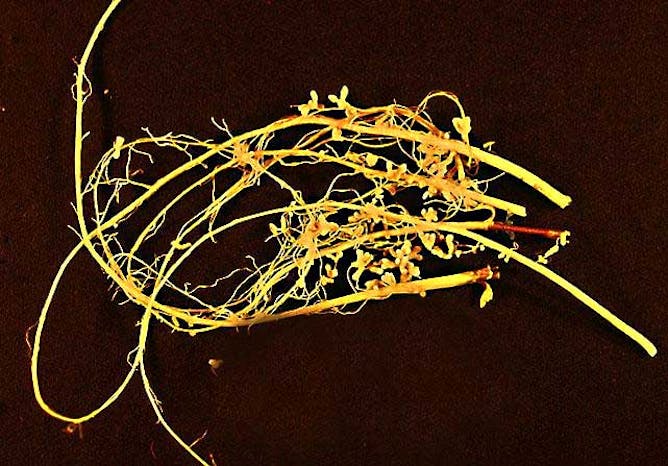 Soybean root nodules, containing billions of nitrogen-fixing rhizobia.
via Wikimedia commons
Soybean root nodules, containing billions of nitrogen-fixing rhizobia.
via Wikimedia commons
Our second investigation involved a commercial seedling nursery. The international manufacturer of the probiotic didn’t provide instructions for dosage, leaving us to guess at the correct application rate. In the first round of experimentation, the seedlings died. Feedback from the manufacturer was quick: we had used the wrong dose.
The next round of research used a lower dosage, per the manufacturer’s advice, that did not improve seedling growth. In its absurdity, this example highlights the need for tighter market regulation.
Since the benefits of currently available biostimulants are imprecise, many people are divided on their use. Better regulations would promote certainty, and prevent farmers wasting money on unreliable products.
The future of crop probiotics
Currently Australian regulations emphasise flexibility, offering multiple options for manufacturers to prove their crop probiotics work. But this leaves the door open for ineffective products.
Crop probiotics are currently regulated under the umbrella of pesticides (although they’re often marketed as providing other benefits). The Australian Pesticides and Veterinary Medicines Authority guidelines say “up to 10 field trials may be required depending on the crop’s economic importance”, making it difficult to tell how many trials are expected. One industry partner we spoke to said that, while he has chosen to do field trials, he didn’t have to supply that data to the APVMA to get his product registered.
Companies have to prove their products are “effective as per the label claims”. But as we found in our research, this doesn’t help when manufacturers exclude crucial information from their labels.
Manufacturers can sell probiotics that have been tested overseas, although studies “should be done under conditions that are typical of Australian climatic conditions”. However, because they’re not automatically required to retest in Australia, different soils, climates and crop types can render them essentially useless.
Consequently, many products exist on the Australian market which don’t have clear label instructions for effective use, claim to work on an outlandish number of crops and don’t even touch on the topic of which soils they work effectively in.
Australia contrasts with the European Union, which demands multi-step scientific testing of products. For a product to be permitted for use in agriculture, EU legislation requires 10 or more field trials, conducted over two growing seasons in different climates and soil types. Delivery methods and dosage must be evaluated and effects confirmed. Crop trials have to ensure statistical validity. The EU has created an online database of detailed reports and standards that can be easily searched by the public.
These regulations have an impact on which biostimulants reach the market. European products often contain only one type of active microbe, as it’s otherwise difficult to meet the strict criteria. On the other hand, many biostimulants sold in Australia contain multiple microbes that are not clearly classified on labels.
This makes it more difficult to tell what’s actually in a product, how useful it will be under different conditions, or if it contains bacteria that are beneficial for certain crops but harmful for others.
We recommend that Australia adopts the EU model of a regulated biostimulant market to encourage investment. Scientifically rigorous, multi-year studies are also needed, to test and develop effective products.
There is much research expertise in Australia, but currently farmers must rely on marketing rather than science.
Authors: Susanne Schmidt, Professor - School of Agriculture and Food Science, The University of Queensland


 Daily Bulletin


