

Dark Mofo's slaughtered bull and the ethics of using animals in art
- Written by: John Hadley, Senior Lecturer in Philosophy, Western Sydney University
In a three-hour show scheduled at Hobart’s Museum of Old and New Art in June, Austrian artist Hermann Nitsch plans to use the blood of a slaughtered bull to explore ancient ritual and spiritual sacrifice. Nitsch is hoping to serve the meat of the animal to the audience at the Dark Mofo festival following the performance.
The plan has met with criticism from animal rights activists, the RSPCA, and the broader community. But it is far from the first, or worst, use of animals for art and human satisfaction.
MONA founder David Walsh’s defence of Nitsch’s work in response to the controversy seems to be based on two ideas: the function of art is to raise challenging questions, and it’s legal for people to eat animals, suggesting hypocrisy in a willingness to eat them but reject their use in art.
Walsh is right, up to a point; but this “social role plus legality” defence has its limits. So how are we to navigate the ethical minefield of hurting or killing animals in the name of art?
The (ab)uses of animals
In his 2000 installation artwork, Helena, Chilean artist Marco Evarsitti displayed 10 water-filled blenders, each containing a live goldfish, and invited visitors to push the on-button. And at least one visitor to Denmark’s Trapholt Art Museum pushed it.
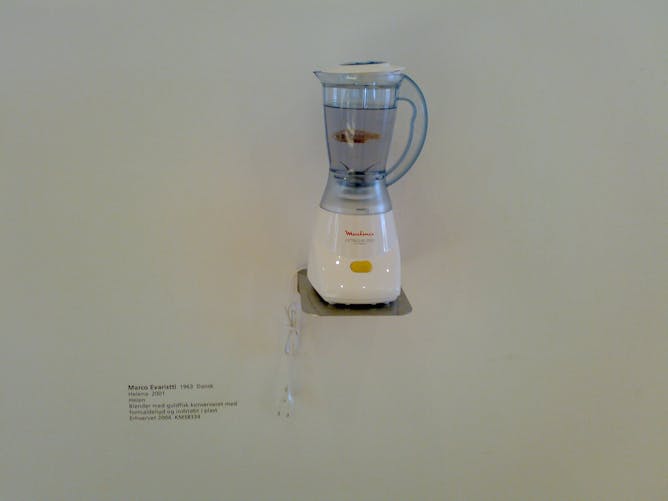 Marco Evaristti’s Helena.
malouette/Flickr, CC BY-SA
Marco Evaristti’s Helena.
malouette/Flickr, CC BY-SA
In 2013, meanwhile, Nicaraguan artist Guillermo Vargas tethered a stray dog, without food and water, to a gallery wall. Vargas was, apparently, making a point about the plight of homeless people.
There is, importantly, a big difference between Evarsitti and Vargas’s works, and Nitsch’s. No animals will suffer in his show, which is called 150.Action, because we are assured the bull - which is earmarked for slaughter regardless - will be killed in accordance with humane Australian standards.
For art’s sake?
Whether it is a question of economics, gustatory gratification, or artistic impulse, using animals for human purposes requires making value judgements about the importance of their lives and well-being.
And however we dress it up, when we do things to animals that we wouldn’t do to human beings, we act in step with a hierarchical order of value first laid down in ancient Greece and taken up by the Abrahamic religious traditions.
It is true that Nitsch’s work draws attention to that tradition, but as Walsh has pointed out, Nitsch has been at it since the 1960s. Isn’t it about time that artists made their point about human domination without themselves asserting dominance over animals?
The problem with Nitsch’s work is an implicit value judgement: animals are an appropriate source for artistic materials. It is the presumption of human superiority behind such a judgement which has elicited the outrage of the animal protection community.
A question of values
The RSPCA responded to Nitsch’s work by claiming it “fails to respect” animals. Failing to respect animals means treating them like objects or playthings to be manipulated for our purposes. Respecting them requires treating them in a way that acknowledges that they have a kind of value that is independent of their usefulness to humans.
As philosophers such as Peter Singer and Tom Regan have pointed out, as rule of thumb we respect animals when we leave them be.
 An alternative to animal art? Body parts made from felt in work by Dutch artist Marjolein Dallinga in Italy.
John Hadley
An alternative to animal art? Body parts made from felt in work by Dutch artist Marjolein Dallinga in Italy.
John Hadley
Walsh is right to decry the hypocrisy of people who express outrage at Nitsch’s work yet continue to support the suffering and death of animals through their dietary choices.
Still, without expecting Nitsch and Walsh to be moral saints, I’d argue they have not drawn the line in a moral way. Yes, it might be legal to do what Nitsch is doing, and yes, people around the world eat animals, but legality does not equal morality.
One wonders what kind of performance art would’ve been acceptable in Nazi Germany, Apartheid South Africa or antebellum United States if we are supposed to read morality only from the laws of the land at a particular historical moment.
From an animal protection perspective, it is dispiriting when the choices of the supposedly edgy elements of artistic community fall in lock-step behind the mainstream society, which values animal lives as less than human. Far better to direct one’s creative energies producing works that don’t use animal blood as paint.
While Nitsch does not use a live animal, the concern is that 150.Action gives comfort to people who do because it reinforces a view of animals as ours to use.
Authors: John Hadley, Senior Lecturer in Philosophy, Western Sydney University
Read more http://theconversation.com/dark-mofos-slaughtered-bull-and-the-ethics-of-using-animals-in-art-76504


 Daily Bulletin


