

Who goes to MONA? Peering behind the 'flannelette curtain'
- Written by: Kate Isabel Booth, Lecturer in Human Geography (Planning), University of Tasmania
“I’ve never been with so many bogans in my life. Aren’t they fantastic!” cried an enraptured guest at the 2011 opening of Hobart’s Museum of Old and New Art.
The general opening party debauchery (despite rumours of an impending orgy) quickly faded. Alive and kicking, though, is the idea that the museum attracts a broad cross section of the community.
As multimillionaire founder and owner David Walsh has pointed out, MONA has been very generous to Tasmania and Tasmanians. Recognition of this generosity feeds the widespread and often uncritical reception to its art, events and development proposals.
 Visitors at MONA.
Steven Penton, Flickr, CC BY
Visitors at MONA.
Steven Penton, Flickr, CC BY
Located within Glenorchy, MONA is in one of the most disadvantaged municipalities in Tasmania. Entry to this must-see tourism destination is free for locals (everyone else pays). Entertainment and novelty abound, with the building, exhibits and festivals entangling the weird and wonderful.
But Greater Hobart (in which Glenorchy sits) is a divided city. Most of the region’s arts and cultural activity occurs to the south of Glenorchy, in the more middle class and privileged Hobart municipality. The boundary between Hobart and Glenorchy is colloquially known as the flannelette curtain. (Before their appropriation by hipsters, “flannies” were worn by working class men.)
So who goes to MONA? A survey of 6,411 visitors shows that, despite its geographical location, most are middle class, tertiary educated and hold highly skilled jobs.
Another survey of 188 Glenorchy residents shows that those who have visited MONA are more likely to be tertiary educated and in professional or managerial occupations. Levels of cultural engagement also matter: those who frequent other galleries and engage with local art initiatives such as the Moonah Arts Centre and GASP! are also more likely to visit MONA.
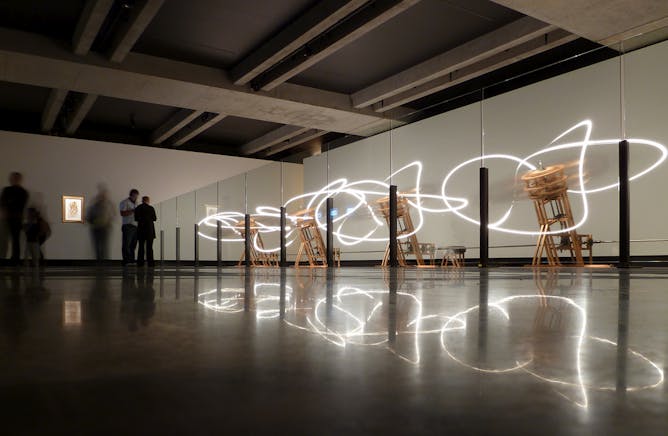 Loop System Quintet by Conrad Shawcross - a 2011 exhibition at MONA.
Fraser Mummery, Flickr, CC BY
Loop System Quintet by Conrad Shawcross - a 2011 exhibition at MONA.
Fraser Mummery, Flickr, CC BY
Even the free entry for locals does not necessarily break these familiar patterns. In an interview conducted as part of this research, local resident Brendan described how the cost of MONA’s food serves as a marker for economic and social exclusion:
They didn’t have prices up or anything, so I just said ‘we’ll have a meal’ and when they said the price, it was $68 something, and I went ‘What? Hang on, you’re trying to attract people here?’ And especially if you’re trying to attract people that belong here, there’s not that many with that kind of money … it’s just way too expensive … just not possible for a lot of people out here …
Even if entry is free, the high costs of food, drink, and items in the gift shop, and other signs of the institution’s wealth can act to tell low socioeconomic visitors and those with lower cultural capital, that these places are not for them. Thus, the close ties between art and wealth are not easily denied.
A feeling of wonder and intrigue does draw some locals down into MONA’s gallery. Here, the deliberate move to make cultural institutions more entertaining becomes apparent. Once inside the museum, some report “switching channels” as they pass by art pieces as if they were watching TV. They do not feel bound to liking or understanding art on someone else’s terms.
As one interviewee, Terry advised:
The main thing when you do go is if there is anything that sort of makes you feel uncomfortable just move on because there’s so much to see.
Said another, Fran:
Yeah, like TV.
The explicit artwork at MONA was a cause for concern for many of the local residents we interviewed. For instance, this was part of an exchange about the show Cunts…and Other Conversations:
Dave: Why would they have a wall of the female thingamajigy? Why would they have a wall? That’s not art!
Later in the discussion:
Carol: I didn’t hear about that before I went in. I was gobsmacked, quite disturbed actually walking in a room and going…
Dave: Look at them. It wasn’t just one.
Being entertained or challenged at MONA does not necessarily bring about cultural and social change, and preconceptions can be reinforced rather than unsettled.
Most people interviewed were of the view that what is on display at MONA is not art. However, some people did report a “mind-broadening” experience in understanding how others think about art. This finding warrants further attention.
Still, there remains a persistent belief in cultural research and practice that if you build it, curate it and exhibit it, cultural and social change is a fait accompli. This expectation is not supported by empirical research, here or overseas.
Without careful deliberation and planning, culture-led urban regeneration can amount to nothing more than an enhanced city image. Though even this is not evident for Glenorchy.
Rather, as this study has found, MONA’s local legacy is more tempered. This is sobering thought for those pursuing (or leveraging) arts and culture for urban renewal and social transformation.
Authors: Kate Isabel Booth, Lecturer in Human Geography (Planning), University of Tasmania
Read more http://theconversation.com/who-goes-to-mona-peering-behind-the-flannelette-curtain-73369


 Daily Bulletin


