

A new literary portrait of Helen Garner leaves you wanting to know more
- Written by: Jen Webb, Director of the Centre for Creative and Cultural Research, University of Canberra
How remarkable that, after some 40 years of books and essays, stories, articles and movies, there have been so few major publications on the life and works of Helen Garner. The National Library of Australia catalogue lists discussion notes; a study (in Mandarin) by Zhu Xiaoying; and Kerryn Goldsworthy’s excellent 1996 monograph. Bernadette Brennan’s A Writing Life goes a considerable way to filling out this slender collection.
 Text Publishing
Brennan offers a detailed account of Garner’s writing life, tracing the influences and obstacles; psychological and emotional affordances and constraints; her research and craft; and the critical and popular reception of her books. This is a valuable contribution about a major contemporary Australian writer who has delighted, infuriated, confused, charmed and frustrated readers, and whose experimental practice has galvanised ways of writing and thinking about writing.
I arrived in Australia late in 1990 and, enrolling in a local university to study Australian culture, found myself in the unfamiliar waters of Australian fiction. The views offered by the lecturers and tutors on Australian writing, and its contexts, meanings and values, were fairly uniform until we reached Monkey Grip (1977). Then emotions were heightened, and attitudes hardened along gender lines.
The (male) professors generally derided the novel as “self-pitying”, as “women’s writing about trivialities”; the (women) tutors discussed the freshness of the perspectives of a time, place and pattern of life familiar to many young Australians.
Like the tutors, I fell in love with the book, identified strongly with it, and fiercely defended it. So, a little over a decade later when I was teaching creative writing, I set The First Stone (1995) for a class on contemporary genres. As with Monkey Grip, the readers were divided, but this time along generational lines. The older students — both men and women —generally found it incisive, courageous and honest. The younger students generally found it self-obsessed, and oblivious to structural and systemic inequities.
Text Publishing
Brennan offers a detailed account of Garner’s writing life, tracing the influences and obstacles; psychological and emotional affordances and constraints; her research and craft; and the critical and popular reception of her books. This is a valuable contribution about a major contemporary Australian writer who has delighted, infuriated, confused, charmed and frustrated readers, and whose experimental practice has galvanised ways of writing and thinking about writing.
I arrived in Australia late in 1990 and, enrolling in a local university to study Australian culture, found myself in the unfamiliar waters of Australian fiction. The views offered by the lecturers and tutors on Australian writing, and its contexts, meanings and values, were fairly uniform until we reached Monkey Grip (1977). Then emotions were heightened, and attitudes hardened along gender lines.
The (male) professors generally derided the novel as “self-pitying”, as “women’s writing about trivialities”; the (women) tutors discussed the freshness of the perspectives of a time, place and pattern of life familiar to many young Australians.
Like the tutors, I fell in love with the book, identified strongly with it, and fiercely defended it. So, a little over a decade later when I was teaching creative writing, I set The First Stone (1995) for a class on contemporary genres. As with Monkey Grip, the readers were divided, but this time along generational lines. The older students — both men and women —generally found it incisive, courageous and honest. The younger students generally found it self-obsessed, and oblivious to structural and systemic inequities.
 Bernadette Brennan.
Murray Harris
I recount these two anecdotes because they seem to me emblematic of Garner’s long writing career: one that slips and slides between genres and forms; one that frequently polarises readers. It is difficult to be ho-hum about Garner’s writing; though at times I have been repulsed by the narrative voice or perspective, I keep returning to her, buying each new book, expecting to be moved either to disappointment or delight.
Brennan is clearly also an eager follower, but unlike me she has closely investigated the contexts of Garner’s practice and tracks her career in this elegantly written account. Based on sound scholarship, the book nonetheless avoids the arcanity of critical literary analysis. The tone remains warm and admiring, and the narrative is highly accessible.
This is no easy task: biography is a difficult form, and there are many cases of offended subjects causing trouble for their biographer. Brennan, I suspect, need have little fear of this: Garner provided access to her private papers, and also shared “two years of conversations” with her biographer. What a privilege; not least because it must have helped Brennan to make sense of the “I” that weaves through Garner’s publications.
Of course the “I” is always a problem: though all social beings necessarily “prepare a face to meet the faces that they meet”, a writer of prose probably prepares more faces than average, because they construct and inhabit both narrators and characters in their works. It can therefore be difficult to determine where the author’s living being ends, and the narrator’s or character’s paper being begins.
For Brennan, the “I” is fictional, but this is a little difficult to accept given how consistent that “I” is in Garner’s fiction and nonfiction; and Garner’s own commentary suggests that it is she herself, filtered through her diary entries and other notes, who is represented.
This, for me, constitutes an absence in an otherwise excellent book: why not take on more directly the issue of a writer who insists on telling her readers what she is thinking? After all, writers need not be explicit: like the old saw goes, “show, don’t tell”. We have language and literary techniques to convey our perspectives and obsessions, and to ensure readers hear our voice, and see things — to quote another difficult and extraordinary writer, Joan Didion — from our point of view.
Garner’s decision to place herself at the centre of the story can also become a distraction from the story itself, and can leave the writer sounding didactic. Novelist Marian Halligan writes about The First Stone,
The book is not a piece of journalism, it’s a novel whose main character is Garner, acting out the role of journalist.
Bernadette Brennan.
Murray Harris
I recount these two anecdotes because they seem to me emblematic of Garner’s long writing career: one that slips and slides between genres and forms; one that frequently polarises readers. It is difficult to be ho-hum about Garner’s writing; though at times I have been repulsed by the narrative voice or perspective, I keep returning to her, buying each new book, expecting to be moved either to disappointment or delight.
Brennan is clearly also an eager follower, but unlike me she has closely investigated the contexts of Garner’s practice and tracks her career in this elegantly written account. Based on sound scholarship, the book nonetheless avoids the arcanity of critical literary analysis. The tone remains warm and admiring, and the narrative is highly accessible.
This is no easy task: biography is a difficult form, and there are many cases of offended subjects causing trouble for their biographer. Brennan, I suspect, need have little fear of this: Garner provided access to her private papers, and also shared “two years of conversations” with her biographer. What a privilege; not least because it must have helped Brennan to make sense of the “I” that weaves through Garner’s publications.
Of course the “I” is always a problem: though all social beings necessarily “prepare a face to meet the faces that they meet”, a writer of prose probably prepares more faces than average, because they construct and inhabit both narrators and characters in their works. It can therefore be difficult to determine where the author’s living being ends, and the narrator’s or character’s paper being begins.
For Brennan, the “I” is fictional, but this is a little difficult to accept given how consistent that “I” is in Garner’s fiction and nonfiction; and Garner’s own commentary suggests that it is she herself, filtered through her diary entries and other notes, who is represented.
This, for me, constitutes an absence in an otherwise excellent book: why not take on more directly the issue of a writer who insists on telling her readers what she is thinking? After all, writers need not be explicit: like the old saw goes, “show, don’t tell”. We have language and literary techniques to convey our perspectives and obsessions, and to ensure readers hear our voice, and see things — to quote another difficult and extraordinary writer, Joan Didion — from our point of view.
Garner’s decision to place herself at the centre of the story can also become a distraction from the story itself, and can leave the writer sounding didactic. Novelist Marian Halligan writes about The First Stone,
The book is not a piece of journalism, it’s a novel whose main character is Garner, acting out the role of journalist.
 Good reads
Does it matter if a work is fiction cast as journalism? For Halligan, yes, because Garner “is a superb writer and story teller, so the book has a lot of power”. “A lot of power” matters in questions of literary representation, particularly if a work is marketed as nonfiction, which presents as having the authority of actuality. If such a work is more truly fiction, or essay, and if it is also superbly written, it can persuade readers that the author’s personal sociopolitical views are a kind of “truth”, which can leave them feeling either convinced or betrayed.
A second aspect of Garner’s extraordinary career that I would have liked to see developed is the nature of her relationships with others, and her ethical writing practices.
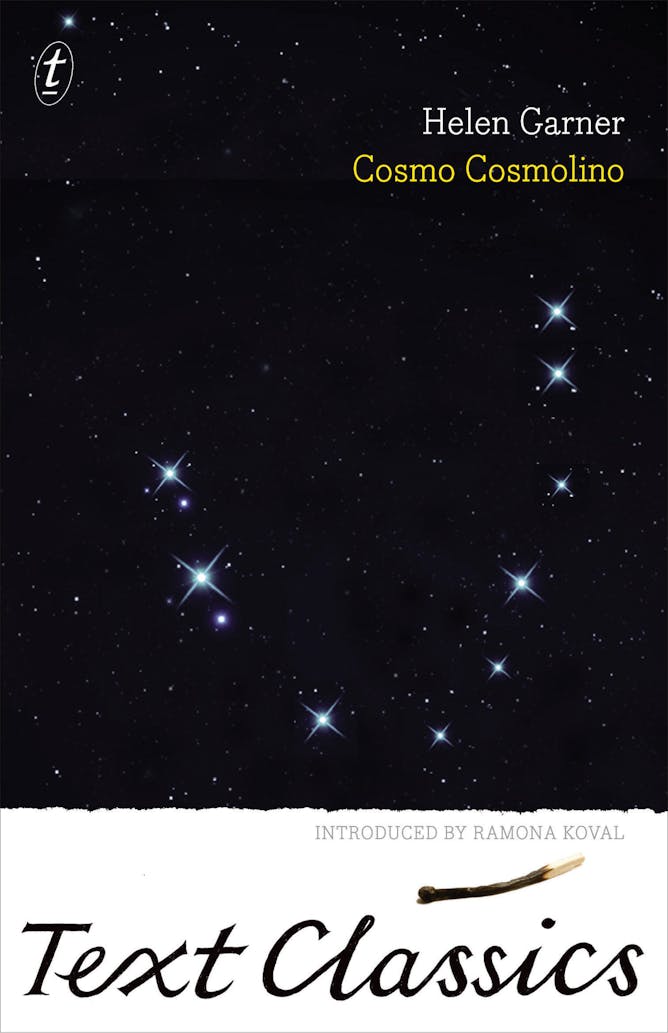
Brennan does not hesitate to describe the sometimes startling cruelty with which Garner treats those close to her: her irritation and impatience with her dying friend in The Spare Room; her remarkably ungenerous characterisation of the women students in The First Stone; her appropriation of the lives of others, such as using her friend Axel Clark’s surgery for brain tumours to generate the story Recording Angel, which was included in Cosmo Cosmolino.
Good reads
Does it matter if a work is fiction cast as journalism? For Halligan, yes, because Garner “is a superb writer and story teller, so the book has a lot of power”. “A lot of power” matters in questions of literary representation, particularly if a work is marketed as nonfiction, which presents as having the authority of actuality. If such a work is more truly fiction, or essay, and if it is also superbly written, it can persuade readers that the author’s personal sociopolitical views are a kind of “truth”, which can leave them feeling either convinced or betrayed.
A second aspect of Garner’s extraordinary career that I would have liked to see developed is the nature of her relationships with others, and her ethical writing practices.
Brennan does not hesitate to describe the sometimes startling cruelty with which Garner treats those close to her: her irritation and impatience with her dying friend in The Spare Room; her remarkably ungenerous characterisation of the women students in The First Stone; her appropriation of the lives of others, such as using her friend Axel Clark’s surgery for brain tumours to generate the story Recording Angel, which was included in Cosmo Cosmolino.
 Text Publishing
Yes, we all know Faulkner’s perspective that “the Ode on a Grecian Urn is worth any number of old ladies”, but is it? And if it is, what are the ethical principles at stake in consuming old ladies for the sake of another Ode?
I can’t help trying to fill in these gaps in the portrait, particularly because Brennan also describes (and many people in the writing community have experienced) Garner’s generosity and compassion. No doubt to some extent, the hard-edged Garner is so visible first, because she puts herself in the work, and next because she seems not to have the sort of filter many of us operate – the one that keeps our more troubling or savage thoughts private.
Garner lays herself bare in what is often a deeply troubling way, and it fascinates me that a writer should expose themselves thus to a reader’s potentially cold and unforgiving eye.
I wish Brennan had found herself able to dig a little more deeply into these tricky and even unsavoury aspects of her subject, and offer a more nuanced portrait of this difficult, fascinating writer.
But all writing is a matter of making choices, and it is hardly fair to criticise a writer for not having fully satisfied my own desires: particularly when this is an absorbing, informative and engaging read.
Bernadette Brennan’s A Writing Life: Helen Garner and Her Work is published by Text Publishing.
Text Publishing
Yes, we all know Faulkner’s perspective that “the Ode on a Grecian Urn is worth any number of old ladies”, but is it? And if it is, what are the ethical principles at stake in consuming old ladies for the sake of another Ode?
I can’t help trying to fill in these gaps in the portrait, particularly because Brennan also describes (and many people in the writing community have experienced) Garner’s generosity and compassion. No doubt to some extent, the hard-edged Garner is so visible first, because she puts herself in the work, and next because she seems not to have the sort of filter many of us operate – the one that keeps our more troubling or savage thoughts private.
Garner lays herself bare in what is often a deeply troubling way, and it fascinates me that a writer should expose themselves thus to a reader’s potentially cold and unforgiving eye.
I wish Brennan had found herself able to dig a little more deeply into these tricky and even unsavoury aspects of her subject, and offer a more nuanced portrait of this difficult, fascinating writer.
But all writing is a matter of making choices, and it is hardly fair to criticise a writer for not having fully satisfied my own desires: particularly when this is an absorbing, informative and engaging read.
Bernadette Brennan’s A Writing Life: Helen Garner and Her Work is published by Text Publishing.
Authors: Jen Webb, Director of the Centre for Creative and Cultural Research, University of Canberra


 Daily Bulletin


