

The great Australian plays: sex, poetry and The Chapel Perilous
- Written by: Julian Meyrick, Professor of Creative Arts, Flinders University
When she died in 2002, The Age hailed Dorothy Hewett as “the grande dame of Australian literature” and gave a thumbnail sketch of her remarkable life as poet, dramatist, novelist, Communist Party activist and serial lover. Calling her a free spirit doesn’t come close to capturing the turbulent, at times self-destructive energy that marked Hewitt’s relationships and her work.
In Wild Card (1990), an autobiography written at the prompting of another theatre maverick, Hal Porter, Hewett gave a taste of her feisty existence as a young woman working on the factory floor in the 1950s:
I was sacked from the Alexandria Spinning Mills for being eight months pregnant, but before I left I managed two quixotic gestures. I stood up at the annual meeting of the Textile Workers’ Union and demanded equal pay for woman workers. There was a bit of furore, they moved a point of order, and that was the end of it. [And] I organized the Redfern Branch of the Communist Party to [copy] and distribute a bulletin called “Bobbin Up” outside the mill. The leading article began with Les Flood’s immortal words: “There’s a name for a man who lives off a woman”.
It is important to recall Hewett’s life when considering her work because no other Australian playwright has infused their plays with so much autobiographical matter, to the point where they become one, self-revelatory, expressive act.
A very personal play
Seeing or reading Hewett is a very personal encounter, a communicative exchange of great potency, intimacy and candour. Her passionate personality frequently got her into trouble with family, friends and colleagues. Such things pass without comment in other (usually male) writers. With Hewett, one feels, the world forgave neither her transgressions nor her virtues. She was held to higher account, often unreasonably so.
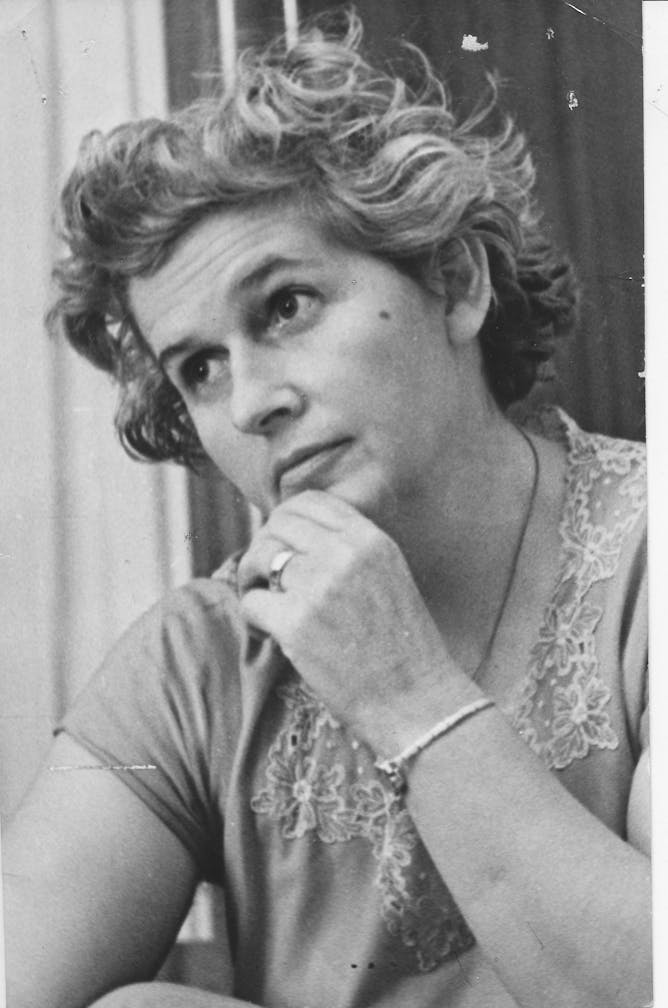 Dorothy Hewett in 1965.
University of Western Australia archives.
Dorothy Hewett in 1965.
University of Western Australia archives.
Hewitt was her own most withering critic. The creative pay-off was not only that she transmuted the tidal wave of a tumultuous life into art, but that she was searching and truthful in doing so. An absence of self-pity, self-justification and self-congratulation pushes her plays out of the confessional category, and turns them into brilliantly illuminated self-immolations.
The Chapel Perilous (1971), one of her earlier works, is an expressionist drama that follows the emotionally epic journey of Sally Banner “a rebel in word and deed” from young, uncompromising schoolgirl to older, still uncompromising thirty-something woman.
In no way is it naturalistic, though the narrative does have a chronological beginning, middle and end. The stage setting described at the start of the play hints at the progression of dream-like scenes to come:
Upstage against the cyclorama is the outline of a school chapel with a stained-glass window discovered later to contain a figure of Sally Banner. Three shallow steps lead to the chapel and … [i]n front … are three rostrums and an altar on a platform. Large masks of the Headmistress, the Canon and Sister Rose remain constant throughout the play, standing on the three rostrums and large enough to hide an actor behind each. Three loudspeakers are prominently placed. The three masked figures play the roles of judges of the action against the landscape of the profane chapel. Sometimes they play themselves, sometimes they step from behind the masks into the body of the play and become other characters.
Poetry on stage
It is impossible to briefly summarise the plot of The Chapel Perilous, as its form is too disjunctive and unpredictable. But two things stand out. First, it is deeply, iridescently poetic. Songs, doggerel, hymns and dance numbers jostle with snatches of verse – some quotations, some Hewett’s own – to create an acoustic patchwork of heightened meaning.
 Like her protagonist in The Chapel Perilous, Hewett spent her childhood in rural Western Australia.
Wheatbelt image from www.shutterstock.com
Like her protagonist in The Chapel Perilous, Hewett spent her childhood in rural Western Australia.
Wheatbelt image from www.shutterstock.com
By approaching playwriting in this way, Hewett reconnects Australian drama with Australian poetry: with James McCauley, Max Harris, Kenneth Slessor and above all Douglas Stewart, whose verse dramas Ned Kelly (1942) and Fire on the Snow (1944) gesture towards a marriage between the two art forms, where the spoken word achieves sacred power.
Here’s a sample of Hewett’s mix of alliterative deftness and vernacular force:
The voices of the AUTHORITY FIGURES come through the amplifier.
AMPLIFIER [HEADMISTRESS’s voice] Sally Banner was one of my girls who went on to university. Many of the old girls came back to see me. I waited but she didn’t come back. When France fell I cried before my class. Not one of them understood why.
[SISTER ROSA’s voice] Atheist, pacifist, communist, blasphemer, she whored her youth away and there was no peace in our time.
[CANON’s voice] I will give her a reference, because, as far as I know, she is a clean-living Christian girl.
… An ABC INTERVIEWER enters with a microphone.
INTERIVEWER: And everyone’s talking about Sally Banner’s grand slam: first, second and third in the Jindyworobak Poetry Competition. Mrs Banner, I believe Sally was wild – er, a live-wire in her university days?
MOTHER: Well, no more than most really. They were unsettling times. The Americans were here, lacing our daughters’ milk shakes with Spanish Fly. It turned their heads. We all worried about our daughters. What decent mother wouldn’t? [ASIDE] She was a real trollop. She’d lie down anywhere and do it like a dog. It was as if she wanted to punish us for something. Why, what had we done? We only loved and protected her. (Act 1)
Symbolising the sexual revolution
The second feature of The Chapel Perilous is the sexuality that flows through it from opening line to final moments like molten clinker. Nothing is directly shown and erotic talk is minimal. Yet despite this – or perhaps because of it – the pursuit, practice and passion of sex drenches the action of the play at every turn.
From Sally’s childhood in 1920s rural Western Australia, to her first boyfriends, swept away by World War II, to her days Sydneyside as a Communist Party organiser and straying wife, she is looking for sex, and the love that comes with the sex, and the sex that is love’s best expression and reward.
More than the many portrayals of male libido that can be found in other New Wave plays, Sally Banner symbolises the Sexual Revolution in its purest and most interesting form. For Sally, sex is rebellion, a quest for authentic human connection that is, alas, unmet by the creeps, shits, evaders, woman-haters and thugs she seems to fall in love with.
Men do not come out well from The Chapel Perilous. Women don’t come out much better either. Yet Sally outlives all the humiliations, betrayals and pratfalls, to emerge a girl of yearning heart, looking for love, hungry for life.
SALLY: I passed my love on the street today,
He looked through my head and he looked away.
When I searched in the dust I could only find
A man with his lips and his eyes gone blind,
And all that we were, and all that we knew,
Has gone with the wry, dry dust that blew
O where has he gone? O where has he gone,
My love on whom the good sun shone? (Act II)
The fluidity, inventiveness and momentum of The Chapel Perilous is spectacular. There are five named parts and a chorus of unspecified size. Between them they enact dozens of characters and moments in Sally’s big river of a life. There is no rest, only change, and the end of the play is a temporary halt rather than a resolution. Sally still has so much more to give and to get.
Like August Strindberg, a playwright she admired, Hewett treated her own life as an experiment. She was the opposite of a celebrity. She was a gifted poet who sought to express universal experience; or more precisely, to elevate her experience to a universal level, where it might burst forth in meter and image to touch other people, and in some way change them.
Bob Carr called her an authentic working class voice, one of the last Australian playwrights to do factory labour. Hewett fits no easy category. She was a feminist with few illusions about women, a one-time Communist with few illusions about men, and a lover with few illusions about love, either with men or women.
The Chapel Perilous, like Sally Banner herself, is a force of nature. That the play is not often revived is deeply regrettable given its richness and imaginative force. It cries out for the skills and resources of a modern director, someone who will interpret it with the right mixture of audacity and fidelity.
When that day comes Hewett will take her rightful place in the Australian repertoire as one of our most original and daring dramatic voices.
Authors: Julian Meyrick, Professor of Creative Arts, Flinders University
Read more http://theconversation.com/the-great-australian-plays-sex-poetry-and-the-chapel-perilous-76799


 Daily Bulletin


