

Naracoorte, where half a million years of biodiversity and climate history are trapped in caves
- Written by: Liz Reed, Research Fellow, University of Adelaide
In 1857, guided by the flickering light of a candle deep in a cave at Naracoorte in South Australia, the Reverend Julian Tenison-Woods stumbled across thousands of tiny bones of rodents and small marsupials buried at the base of crystal columns.
Without knowing it, Woods had found a time machine of sorts – a record of biodiversity and environment spanning more than half a million years.
Now Naracoorte Caves are known as one of the world’s best fossil sites, a place where marsupial lions, enormous kangaroos and giant monitor lizards met their deaths and were preserved by layers of sand.
But the caves captured more than just giants. Clues to Naracoorte’s past environment are also preserved in plant fossils, sediments and calcite formations.
Big marsupials with bite: Australia’s megafauna
Global scientific attention first focused on Naracoorte after 1969, when cave explorers entered relatively inaccessible limestone chambers. After squeezing their way through an impossibly tight gap in Victoria Cave, they discovered the palaeontological equivalent of King Tutankhamen’s tomb.
Scattered across the red sediment floor of a vast chamber were countless skulls and jaws of Australia’s lost giants, the megafauna.
 Pitfall megafauna fossil assemblage in the Upper Ossuary, Victoria Fossil Cave Naracoorte.
Steven Bourne, Author provided
Pitfall megafauna fossil assemblage in the Upper Ossuary, Victoria Fossil Cave Naracoorte.
Steven Bourne, Author provided
The find created a buzz worldwide and set the stage for a scientific journey of discovery that has unfolded over the past four decades.
Preserved within the deposits are fossils from a suite of megafauna species including heavyweight plant eaters such as Zygomaturus trilobus, short-faced leaf-eating kangaroos such as Procoptodon goliah, and the five-metre snake Wonambi naracoortensis. The most famous of these is the marsupial lion Thylacoleo carnifex. The most spectacular fossils from this king of the Pleistocene forests have come from Naracoorte.
The reign of these amazing animals came to an end around 45,000 years ago, with the precise cause for their extinction still a hot topic for debate.
 Fossilised skull from Thylacoleo- a carnivorous marsupial that lived in Australia around 50,000-1.5 million years ago.
Steven Bourne, Author provided
Fossilised skull from Thylacoleo- a carnivorous marsupial that lived in Australia around 50,000-1.5 million years ago.
Steven Bourne, Author provided
How the underground archives formed
The Naracoorte Caves formed around one million years ago within the Gambier Limestone, itself dated to around 37 million to 12 million years old and formed during the late Eocene or Miocene epochs.
Overlying the limestone, a series of ancient sand dunes preserve records of the changing coastline over the past few million years.
Over time, holes opened up in the limestone, connecting the caves to the land surface. Sand and soil was transported into these cave entrances by water and wind, forming deep layered deposits spanning at least the last 500,000 years of the Quaternary period (2.6 million years to present).
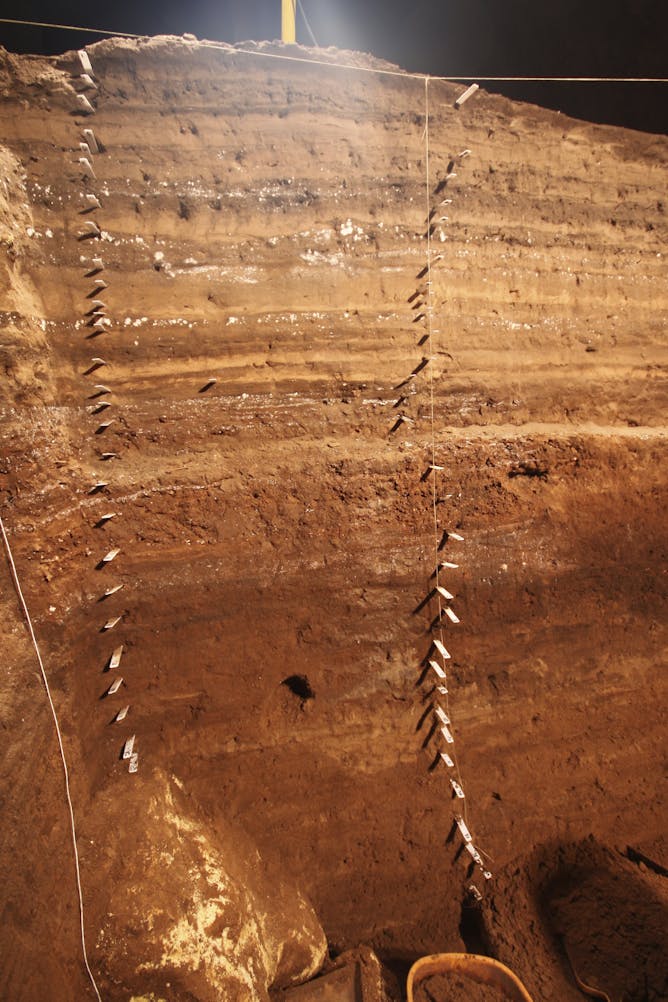 Deep, layered fossil deposits in Blanche Cave, Naracoorte. Each layer represents a window in time. The tags mark individual layers.
Steven Bourne, Author provided
Deep, layered fossil deposits in Blanche Cave, Naracoorte. Each layer represents a window in time. The tags mark individual layers.
Steven Bourne, Author provided
At the same time as the sediments were deposited, many types of animals lived in the landscape surrounding the caves. The remains of these animals accumulated in the caves and became buried and preserved in the sediment layers.
Some species, such as bats and possums, lived and died in the caves. Predators used the caves as roosts and dens, leaving behind the bones of their prey. Owls accumulated vast deposits of small vertebrates, such as the ones discovered by Woods in 1857.
Larger species fell victim to concealed cave entrances that acted as pitfall traps for the unwary. Kangaroos were particularly susceptible to entrapment, being fast-moving and active at night, dusk or dawn. Even the gigantic megafauna species succumbed to these traps.
With all of these ways for animals to accumulate, it is unsurprising that the caves preserve many deposits and tens of thousands of individual animals.
Why are these deposits so significant?
The fossil deposits preserve diverse vertebrate species, including more than 135 different examples of amphibians, reptiles, birds and mammals.
Nearly 20 species of megafauna are preserved, including nine species of extinct kangaroos. The preservation of the fossils is exceptional, with the finest details retained.
Naracoorte’s record is relatively young geologically (around 500,000 years to less than 1,000 years before now), making it representative of modern ecosystems. This is why it offers value in addressing questions relevant to present and future conservation such as extinctions and adaptation to climate change and human impacts.
Unlike most localities where single sites are preserved, the Naracoorte Caves have multiple sites in many adjacent caves. This provides a unique opportunity to compare and correlate observations across related sites over a long, continuous time span.
 It’s a little bit squeezy in here. A film crew working with researchers at Naracoorte Caves.
Steven Bourne, Author provided
It’s a little bit squeezy in here. A film crew working with researchers at Naracoorte Caves.
Steven Bourne, Author provided
Recent research has revealed that the deposits contain much more than bones, with fossil plant material, pollen, fossilised algae and even DNA. This allows scientists to build a comprehensive picture of the environment during this time period. It is this incredible wealth of preserved materials that makes Naracoorte stand out.
Associated calcite formations (such as stalagmites) have preserved critical information on past climate. For example, past rainfall can be determined by studying the fine growth layers within the formations.
 Alexandra Cave, Naracoorte Caves National Park.
Steven Bourne, Author provided
Alexandra Cave, Naracoorte Caves National Park.
Steven Bourne, Author provided
World heritage significance
International recognition came to Naracoorte in December 1994, when the caves were World Heritage listed as part of the Australian Fossil Mammal Sites (along with Riversleigh in northwestern Queensland).
The fossil records of Naracoorte and Riversleigh reveal the evolutionary history of Australia’s unique mammals over much of the past 25 million years. The Naracoorte deposits encompass the latter part of this record, covering important events such as megafauna extinction and the arrival of humans in Australia.
The caves are managed by the South Australian government, which oversees tourism, conservation and research. The park is an established visitor attraction, and vital to the economy and culture of the Naracoorte district. The caves add to the wealth of other geological attractions in the Limestone Coast region, including volcanoes and some of the world’s largest sinkholes.
Moving forwards, new funding has just been announced on a project to establish benchmark data on past ecological and environmental change that is trapped in the structures at Naracoorte Caves. Working with colleagues at University of Adelaide and other Australian universities, museums, government and industry partners, we expect our next phase of research will have applications for biodiversity conservation, climate change, and building capacity for regional communities to share the stories of their unique heritage.
 Large roof window entrance in the spectacular Blanche Cave, Naracoorte. It is in this cave that the first fossil bones were discovered by Woods in 1857.
Steven Bourne, Author provided
Large roof window entrance in the spectacular Blanche Cave, Naracoorte. It is in this cave that the first fossil bones were discovered by Woods in 1857.
Steven Bourne, Author provided
Authors: Liz Reed, Research Fellow, University of Adelaide


 Daily Bulletin


