

Tall turkeys and nuggety chickens: large 'megapode' birds once lived across Australia
- Written by: Elen Shute, PhD candidate, Flinders University
The Pleistocene epoch (2.5 million years ago to 12,000 years ago) was a time of ecological upheaval in Australia. The climate fluctuated between warmer/colder and wetter/dryer periods, humans made their entrance around 50,000 years ago, and many giant marsupials became extinct for reasons that are still being debated.
In our new paper, we describe five related species of extinct megapodes – a group of stocky, medium-large chicken-like birds with small heads and large feet – from various parts of Australia. We think at least one of these bird species was still around when humans arrived in Australia around 50,000 years ago.
All were chunky relatives of living megapodes such as the shy Malleefowl and the bold-as-brass Brush-turkey. They were heavy, ranging from three to eight kilograms, while a modern Malleefowl only weighs around two kilograms.
Two were long-legged species in the genus Progura – the “tall turkeys”, and two were short-legged, stout-bodied species in the genus Latagallina – the “nuggety chickens”. There aren’t enough remains of the fifth species, in the genus Garrdimalga, to know how it was built.
Unlike some other large extinct birds like the dodo, all five of the large megapodes had a strong flight apparatus, and they probably flew into trees to roost and to escape danger as living megapodes do.
One of the “tall turkeys”, Progura campestris, had an upturned pygostyle – the tail bone that sits inside the “parson’s nose” – indicating it sported a large, ornamental tail. This species also had a long, narrow tip to its beak, while Latagallina and Garrdimalga had wide, wedge-shaped beaks, so perhaps they were adapted to different diets.
Widespread fossils
The bones we studied come from widespread sites in Australia – from the Darling Downs in south-eastern Queensland, to caves in eastern New South Wales, the Naracoorte Caves in south-eastern South Australia, Curramulka Quarry on South Australia’s Yorke Peninsula, the Warburton River in northern South Australia, to the Thylacoleo Caves on the Nullarbor Plain, Western Australia.
It seems megapodes once thrived in diverse climatic and habitat zones.
 Map of megapode fossil sites.
E. Shute, Author provided
Map of megapode fossil sites.
E. Shute, Author provided
The largest fossils, belonging to the eight kilogram “tall turkey” Progura gallinacea from Queensland, were first described in 1888 by naturalist Charles De Vis, who thought they belonged to a giant ancestral pigeon.
Fossils belonging to the “nuggety chicken” Latagallina naracoortensis, come from various sites, but most of its remains – around 500 bones – are from the Naracoorte Caves. Originally described in the 1970s as a slightly smaller relative of Progura gallinacea, and later considered to be the same species, our analysis instead shows that these bones belong to a bird in a separate new genus.
The Thylacoleo Caves, beneath the Nullarbor Plain, have yielded two brand new species, Progura campestris and Latagallina olsoni. While their fossils are fewer in number, they include two near-complete associated skeletons of individual birds – more treasures from this remarkable site.
The remains of Garrdimalga mcnamarai from Curramulka Quarry are somewhat scrappy by comparison – but are well enough preserved to show that this was a fifth large species different from all the others.
Extinctions
The five extinct megapodes lived during the Pleistocene, alongside Australia’s extinct “ice age” giant marsupials such as diprotodon, marsupial lions and short-faced kangaroos.
We also know that they lived alongside the Malleefowl that are still alive today, because we have found ancient fossilised Malleefowl bones in the Naracoorte Caves and the Thylacoleo Caves, in the same sediment layers as bones of the extinct giants.
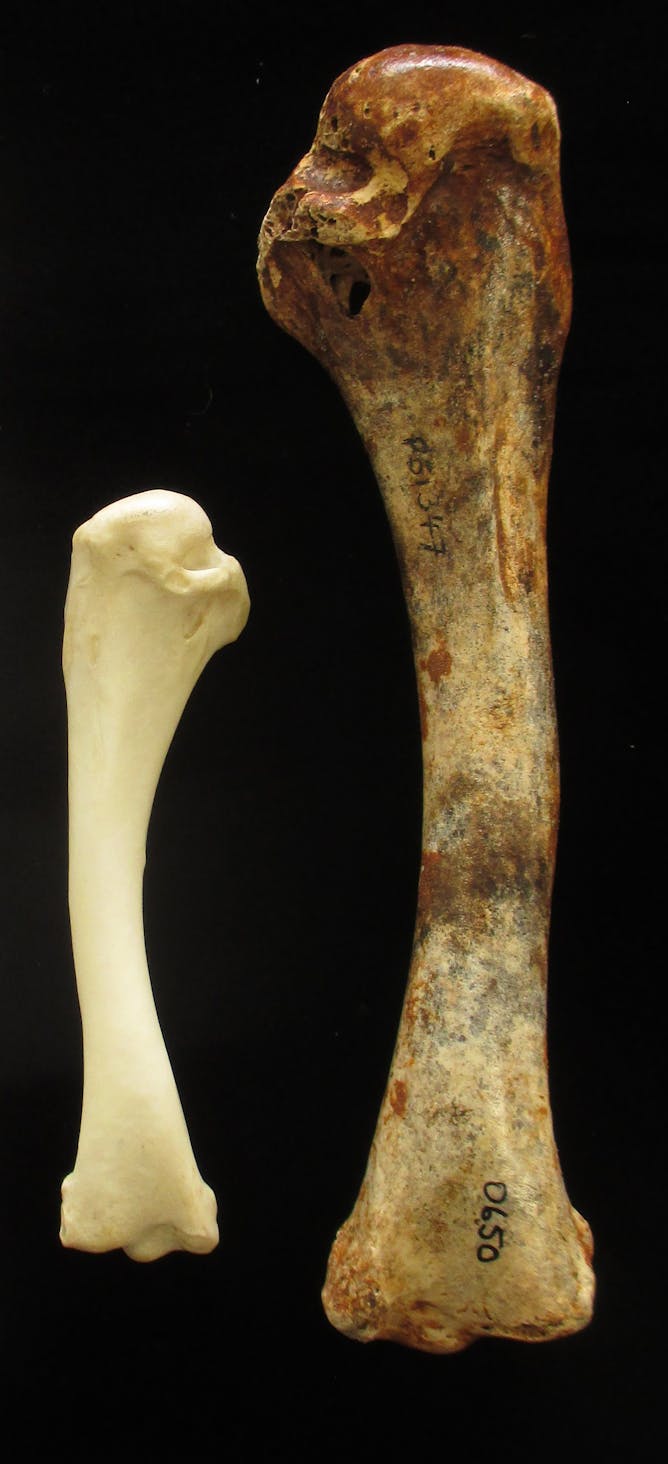 Wing bone of a living Brush-turkey Alectura lathami (left) versus that of an extinct giant megapode, Latagallina naracoortensis
E. Shute, Author provided
Wing bone of a living Brush-turkey Alectura lathami (left) versus that of an extinct giant megapode, Latagallina naracoortensis
E. Shute, Author provided
Why did the large megapodes die out along with the marsupial megafauna while the smaller birds survived?
We don’t know for sure, but larger animals usually reproduce more slowly than smaller ones, making them vulnerable to changes in climate or to new predators.
There is circumstantial evidence that at least one of these large megapodes was still around by the time people arrived on the continent, only to go extinct within a few thousand years of their arrival.
Fossil eggshell has been discovered in sandy environments in various parts of Australia, and microscopic analysis shows it matches the structure of megapode eggshell. Scorch marks show that the eggs, which were larger than those of living megapodes, were cooked and eaten by people, perhaps contributing to the demise of the birds.
The short, deeply curved claws of the extinct megapodes show that they were not specialised for raking together huge nest mounds like Malleefowl and Brush-turkeys.
Rather, they probably scraped a hole in the sand or soil, and laid their eggs directly in the warm ground like the Maleo from the Moluccas. This would explain how the fossil eggshell accumulated in sandy places.
Dropping off the twig
Our phylogenetic analysis shows that the “tall turkeys” and the “nuggety chickens” were each other’s closest relatives, and were also some of the most recently-evolved species of megapode.
While they belong to the same major branch of the megapode family tree as Malleefowl and Brush-turkeys, they weren’t ancestral to any living species.
Rather, they were an unlucky side branch that was forever pruned from the tree. How many birds species died out in Australia during the late Pleistocene extinctions? Perhaps more than we thought. All the more reason to protect what’s left.
Authors: Elen Shute, PhD candidate, Flinders University


 Daily Bulletin


