

Huge restored reef aims to bring South Australia's oysters back from the brink
- Written by: Dominic McAfee, Postdoctoral researcher, marine ecology, University of Adelaide
The largest oyster reef restoration project outside the United States is underway in the coastal waters of Gulf St Vincent, near Ardrossan in South Australia. Construction began earlier this month. Some 18,000 tonnes of limestone and 7 million baby oysters are set to provide the initial foundations for a 20-hectare reef.
The A$4.2-million project will be built in two phases and should be complete by December 2018. The first phase is the 4-hectare trial currently being built by Primary Industries and Regions South Australia; the second phase will see the reef expand to 20 hectares, led by The Nature Conservancy.
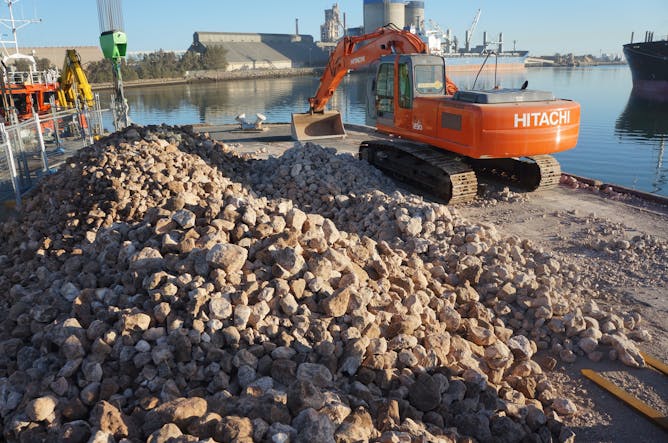 Some of the 18,000 tonnes of limestone destined for the seafloor.
D. McAfee
Some of the 18,000 tonnes of limestone destined for the seafloor.
D. McAfee
Just 200 years ago the native mud oyster, Ostrea angasi, formed extensive reefs in the Gulf, along more than 1,500km of South Australia’s coastline. Today there are no substantial accumulations of mud oysters anywhere around mainland Australia, with just one healthy reef remaining in Tasmania.
This restoration project aims to pull our native mud oyster back from the brink of extinction in the wild, and restore a forgotten ecosystem that once teemed with marine life.
More than just seafood
Oysters played a large role in Australia’s colonial history. When European settlers first arrived they had to navigate a patchwork of oyster reefs (also called shellfish reefs) that filled the shallow waters of our temperate bays. These enormous structures could cover 10 hectares in a single patch, providing an easily exploited food resource for the struggling early settlers. Oyster shell was burned to produce lime, and the colony’s first buildings were built with the help of oyster cement.
Collectively, these pre-colonial oyster reefs would have rivalled the geographic extent of the Great Barrier Reef, covering thousands of kilometres of Australia’s eastern and southern coastlines.
The history goes back much further too. For thousands of years oyster reefs fed and fuelled trade among Aboriginal communities. Shell middens dating back 2,000 years attest to the cultural importance of oysters for coastal communities, who ate them in abundance and used their shells to fashion fishhooks and cutting tools.
 Health oyster reef in Tasmania.
C. Gillies
Health oyster reef in Tasmania.
C. Gillies
The insatiable appetite of the newly settled Europeans for this bountiful resource was devastating. Not only were live oysters harvested for food, but the dead shell foundations that are critical for the settlement of new oysters were scraped from the seabed for lime burning. Armed with bottom-dredges a wave of exploitation spread across the coast, first overexploiting oyster reefs close to major urban centres and then further afield. The combination of the lost hard shell bed and increased sediment runoff from the rapidly altered coastal landscape saw oyster populations crash within a century of colonisation.
Today oyster populations are at less than 1% of their pre-colonial extent in Australia. This is not a unique story – globally it is estimated that 85% of oyster habitat has been lost in the past few centuries, making it one of the most exploited marine habitats in the world.
Today, across much of Australia’s east coast you will see Sydney rock oysters encrusting rocky shores, creating a thin veneer around the edge of our bays and estuaries. On the south coast you occasionally see a solitary mud oyster clinging to a jetty pylon. Many Australians don’t realise that this familiar sight represents a mere shadow of the incredible and largely forgotten ecosystems that oysters once supported.
Oysters are an unsung ecological superhero, with the capacity to increase marine biodiversity, clean coastal waters, enhance neighbouring seagrass, reduce coastal erosion, and even slow the rate of climate change. When oysters cement together, their aggregations form habitat for a great diversity of other invertebrates. A 25cm-square patch of oysters can host more than 1,000 individual invertebrates from a range of different biological groups, in turn providing a smorgasbord for fish.
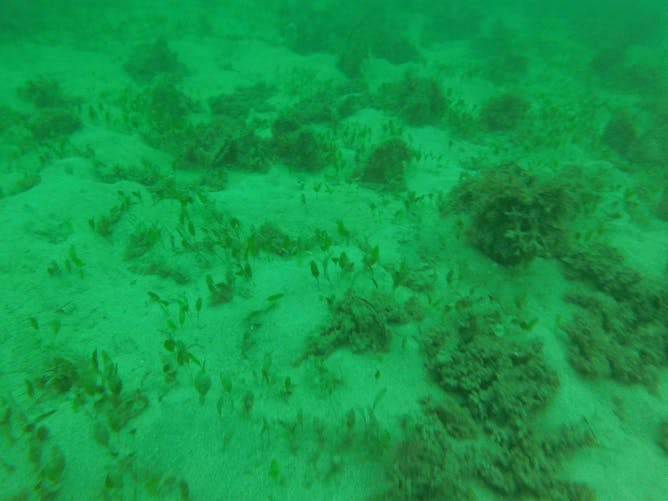 Restoration site, formerly covered with dense oyster habitat.
D. McAfee
Restoration site, formerly covered with dense oyster habitat.
D. McAfee
A solitary oyster can filter about 100 litres of water a day, which means that en masse they can function as the “kidneys” of our bays, filtering excess nutrients from the water and depositing them on the seafloor. In doing so, they encourage seagrass growth, while their physical structures help to dissipate wave energy and thus reduce the impact of storm surges.
As if all that weren’t enough, oysters are also a carbon sink, building calcium carbonate shells that are buried in the seafloor after death and eventually compacted to rock, thus helping to prevent carbon dioxide from cycling back into the atmosphere.
Building it back
Restoring oyster reefs has the potential to return these ecosystem services and increase the productivity of our coastal ecosystems. The Gulf of St Vincent project came about through an election promise by the South Australian Government to boost recreational fishing. A collaboration between The Nature Conservancy, Yorke Penninsula Council and the South Australian Government will deliver the reef’s foundations, while my colleagues and I at the University of Adelaide are working to ensure that the restored oysters survive and thrive, and that the reef continues to grow.
Hopefully this is just the beginning for large-scale oyster restoration in Australia, and the lessons learned from this project will guide more restoration projects to improve the health of our oceans. With other restoration projects also underway in Victoria and Western Australia, the tide is hopefully turning for our once numerous oysters.
Authors: Dominic McAfee, Postdoctoral researcher, marine ecology, University of Adelaide


 Daily Bulletin


