

The winners and losers of Antarctica’s great thaw
- Written by: Jasmine Lee, PhD candidate, biodiversity conservation and climate change, The University of Queensland
When you think of Antarctica, you probably picture vast, continuous ice sheets and glaciers, with maybe a penguin or two thrown in. Yet most Antarctic plants and animals live in the permanently ice-free areas that cover about 1% of the continent. Our new research predicts that these areas could grow by a quarter during this century, with mixed prospects for the species that currently live there.
Besides everyone’s favourite Emperor and Adélie penguins, terrestrial Antarctic species also include beautiful mosses, lichens, two types of flowering plants, and a suite of hardy invertebrates such as nematodes, springtails, rotifers and tardigrades, many of which are found nowhere else on Earth. Tardigrades – tiny creatures sometimes nicknamed “waterbears” – are so tough they can survive in space.
Antarctica’s ice-free areas are currently limited to a scattering of rocky outcrops along the coastline, or cliff faces, or the tops of mountain ranges. They form small patches of suitable habitat in a huge sea of ice, much like islands.
As a result, the plants and animals that live there are often isolated from each other. But as Antarctica’s climate warms, we expect ice-free areas to get bigger and eventually start joining up. This would create more habitat for native species, but also new opportunities for non-native species to spread.
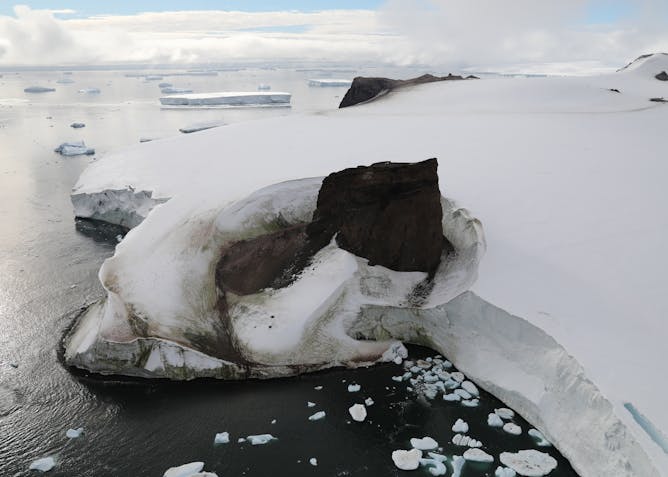 Antarctica’s ice-free rocky outcrops are set to expand this century.
Peter Ryan, Author provided (No reuse)
Antarctica’s ice-free rocky outcrops are set to expand this century.
Peter Ryan, Author provided (No reuse)
Our study, published today in Nature, forecasts that climate change will expand Antarctica’s ice-free areas over the course of this century. Under the most severe scenario that we modelled (which is also the one on which the globe is currently tracking), more than 17,000 square km of new ice-free area could emerge across the continent by 2100.
This would increase the current total ice-free area by nearly a quarter. The majority of this new ice-free land will be on the Antarctic Peninsula, which could have three times as much ice-free area as it does today.
 Projected Antarctic ice melt this century.
Lee et al. (2017) Nature
Projected Antarctic ice melt this century.
Lee et al. (2017) Nature
Brave new world
As the ice-free areas expand, the distances between them will decrease, giving plants and animals more opportunity to spread through the landscape. On the Antarctic Peninsula, which has already warmed more than anywhere else in Antarctica, many of the ice-free patches will expand so much that they will start joining together.
Will this increase in habitat availability benefit the plants and animals that live there? It will definitely provide new opportunities for some native plants and animals to expand their range and colonise new areas. The warming climate may also give a boost to species that are currently hampered by the lack of warmth, nutrients and water. Some Antarctic mosses, for example, are expected to grow faster as temperatures rise, and Antarctica’s two flowering plant species are already expanding southward.
However, the potential benefits seem likely to be outweighed by the negatives. The joining-up of habitat patches could allow species that have been isolated for much of their evolutionary past to meet suddenly. If the newcomers to a particular area outcompete the native species, then it may lead to localised extinctions. Over the coming centuries this could lead to the loss of many plants and animals, and the homogenisation of Antarctica’s ecosystems.
Antarctic aliens
An even bigger concern is that Antarctica’s great thaw could provide new opportunities for species to invade. Antarctica’s best bulwark against non-native species is its harsh climate and extreme weather, to which native Antarctic species have spent many thousands of years adapting.
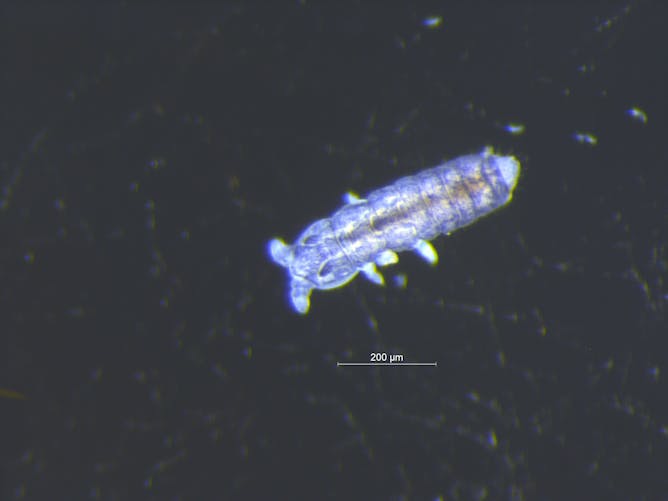 A native Frisea springtail.
Melissa Houghton
A native Frisea springtail.
Melissa Houghton
We already know that many plants and invertebrates are reaching Antarctica, most often in food or cargo shipments. As the climate warms, some of these non-native species may be able to establish themselves on the Antarctic Peninsula, and the increasing connectivity will allow them to easily move through the landscape. Many of these animals and plants may become invasive, competing with the native species for space and resources.
We don’t know how Antarctica’s species will cope with the increasing competition. But if the sub-Antarctic islands provide any indication, the outlook is depressing. Australia’s World Heritage-listed Macquarie Island, for example, was severely impacted by invasive cats, rats, rabbits and mice (although it has since been declared free of these pests after an intensive eradication effort).
Several non-native species have already come to Antarctica, including the invasive annual meadowgrass Poa annua (a common weed around the world), which has colonised newly ice-free areas left behind by retreating glaciers. It is thought to outcompete Antarctica’s native plants, although we don’t yet know what the impact will be on animals.
 Invasive meadowgrass on Macquarie Island.
Laura Williams
Invasive meadowgrass on Macquarie Island.
Laura Williams
Humans – both scientists and tourists – are key transporters of non-native species to the continent, and tourist numbers continue to grow (almost 37,000 visited in the 2016-17 summer).
Biosecurity is paramount for the ongoing protection of Antarctica. If bags, shoes, clothes and field equipment are not properly cleaned and inspected before arriving on the continent, then non-native seeds, microbes and insects could be transported to Antarctica and begin to spread.
We call for protection of ice-free areas that will remain intact in a changing climate, and for the Antarctic scientific and tourism communities to pinpoint key areas where greater biosecurity and monitoring for invasive species may be needed.
Authors: Jasmine Lee, PhD candidate, biodiversity conservation and climate change, The University of Queensland
Read more http://theconversation.com/the-winners-and-losers-of-antarcticas-great-thaw-80140


 Daily Bulletin


