

Why the climate is more sensitive to carbon dioxide than weather records suggest
- Written by: Andrew Glikson, Earth and paleo-climate scientist, Australian National University
One of the key questions about climate change is the strength of the greenhouse effect. In scientific terms this is described as “climate sensitivity”. It’s defined as the amount Earth’s average temperature will ultimately rise in response to a doubling of atmospheric carbon dioxide levels.
Climate sensitivity has been hard to pin down accurately. Climate models give a range of 1.5-4.5℃ per doubling of CO₂, whereas historical weather observations suggest a smaller range of 1.5-3.0℃ per doubling of CO₂.
In a new study published in Science Advances, Cristian Proistosescu and Peter J. Huybers of Harvard University resolve this discrepancy, by showing that the models are likely to be right.
According to their statistical analysis, historical weather observations reveal only a portion of the planet’s full response to rising CO₂ levels. The true climate sensitivity will only become manifest on a time scale of centuries, due to effects that researchers call “slow climate feedbacks”.
Fast and slow
To understand this, it is important to know precisely what we mean when we talk about climate sensitivity. So-called “equilibrium climate sensitivity”, or slow climate feedbacks, refers to the ultimate consequence of climate response – in other words, the final effects and environmental consequences that a given greenhouse gas concentration will deliver.
These can include long-term climate feedback processes such as ice sheet disintegration with consequent changes in Earth’s surface reflection (albedo), changes to vegetation patterns, and the release of greenhouse gases such as methane from soils, tundra or ocean sediments. These processes can take place on time scales of centuries or more. As such they can only be predicted using climate models based on prehistoric data and paleoclimate evidence.
On the other hand, when greenhouse gas forcing rises at a rate as high as 2–3 parts per million (ppm) of CO₂ per year, as is the case during the past decade or so, the rate of slow feedback processes may be accelerated.
Measurements of atmosphere and marine changes made since the Industrial Revolution (when humans first began the mass release of greenhouse gases) capture mainly the direct warming effects of CO₂, as well as short-term feedbacks such as changes to water vapour and clouds.
A study led by climatologist James Hansen concluded that climate sensitivity is about 3℃ for a doubling of CO₂ when considering only short-term feedbacks. However, it’s potentially as high as 6℃ when considering a final equilibrium involving much of the West and East Antarctic ice melting, if and when global greenhouse levels transcend the 500-700ppm CO₂ range.
This illustrates the problem with using historical weather observations to estimate climate sensitivity – it assumes the response will be linear. In fact, there are factors in the future that can push the curve upwards and increase climate variability, including transient reversals that might interrupt long-term warming. Put simply, temperatures have not yet caught up with the rising greenhouse gas levels.
Prehistoric climate records for the Holocene (10,000-250 years ago), the end of the last ice age roughly 11,700 years ago, and earlier periods such as the Eemian (around 115,000-130,000 years ago) suggest equilibrium climate sensitivities as high as 7.1-8.7℃.
So far we have experienced about 1.1℃ of average global warming since the Industrial Revolution. Over this time atmospheric CO₂ levels have risen from 280ppm to 410ppm – and the equivalent of more than 450ppm after factoring in the effects of all the other greenhouse gases besides CO₂.
 Estimate of climate forcing for 1750-2000.
Author provided
Estimate of climate forcing for 1750-2000.
Author provided
Crossing the threshold
Climate change is unlikely to proceed in a linear way. Instead, there is a range of potential thresholds, tipping points, and points of no return that can be crossed during either warming or transient short-lived cooling pauses followed by further warming.
The prehistoric records of the cycles between ice ages, namely intervening warmer “interglacial” periods, reveal several such events, such as the big freeze that suddenly took hold about 12,900 years ago, and the abrupt thaw about 8,200 years ago.
In the prehistoric record, sudden freezing events (called “stadial events”) consistently follow peak interglacial temperatures.
Such events could include the collapse of the Atlantic Mid-Ocean Circulation (AMOC), with consequent widespread freezing associated with influx of extensive ice melt from the Greenland and other polar ice sheets. The influx of cold ice-melt water would abort the warm salt-rich AMOC, leading to regional cooling such as is recorded following each temperature peak during previous interglacial periods.
Over the past few years cold water pools south of Greenland have indicated such cooling of the North Atlantic Ocean. The current rate of global warming could potentially trigger the AMOC to collapse.
A collapse of the AMOC, which climate “sceptics” would no doubt welcome as “evidence of global cooling”, would represent a highly disruptive transient event that would damage agriculture, particularly in the Northern Hemisphere. Because of the cumulative build-up of greenhouse gases in the atmosphere such a cool pause is bound to be followed by resumed heating, consistent with IPCC projections.
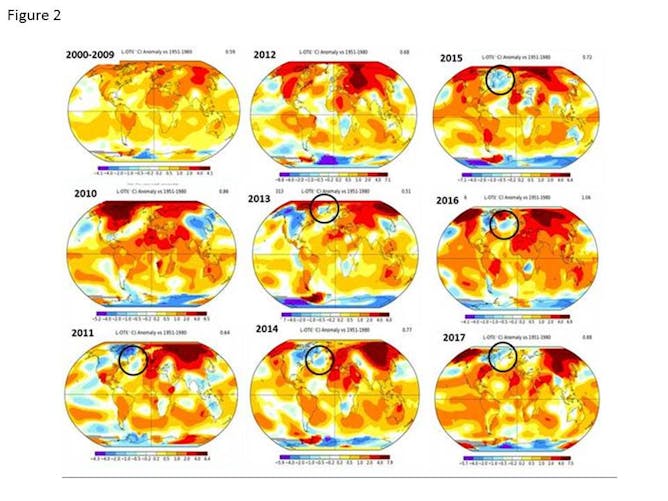 The growth in the cold water region south of Greenland, heralding a possible collapse of the Atlantic Mid-Ocean Circulation.
Author provided
The growth in the cold water region south of Greenland, heralding a possible collapse of the Atlantic Mid-Ocean Circulation.
Author provided
Humanity’s release of greenhouse gases is unprecedented in speed and scale. But if we look far enough back in time we can get some clues as to what to expect. Around 56 million years ago, Earth experienced warming by 5-8℃ lasting several millennia, after a sudden release of methane-triggered feedbacks that caused the CO₂ level rise to around 1,800ppm.
Yet even that sudden rise of CO₂ levels was lower by a large factor than the current CO₂ rise rate of 2-3ppm per year. At this rate, unprecedented in Earth’s recorded history of the past 65 million years (with the exception of the consequences of asteroid impacts), the climate may be entering truly uncharted territory.
Authors: Andrew Glikson, Earth and paleo-climate scientist, Australian National University


 Daily Bulletin


