

How we've evolved to fight the bugs that infect us
- Written by: Simon Reid, Associate Professor, Communicable Disease Control, The University of Queensland
This is the second article in a four-part series looking at how infectious diseases have influenced our culture and evolution, and how we, in turn, have influenced them.
It’s easy to feel our survival is under threat from new and emerging infectious diseases that are going to wipe out the human race, or at least end our current way of life. The recent outbreaks of Ebola in West Africa re-ignited our interest in pandemics and reminded us of our potential frailty in the face of an overwhelming enemy.
With so many microbes capable of hijacking and destroying us, how are we as a species still enduring?
Humans are unique in the world. We are avid “collectors” of infectious diseases acquired from our environment throughout our evolution.
We all just want to survive – and procreate
We share with our invaders a need to survive and propagate our genes. Infectious pathogens, such as bacteria and viruses, are parasitic – they have to find and infect a susceptible host in order to maintain themselves and propagate. Therefore, it’s not really in their best interests to kill us. Our relationship with pathogens is shaped by our capacity to evolve genetically, to modify our behaviour, or to force the pathogens to evolve so that we all survive.
Viruses such as influenza replicate and spread to new hosts before the original host gets sick (with influenza symptoms such as a sore throat and sneezing), meaning the parasite can survive and thrive in new hosts.
On rare occasions the death of the host is necessary for the pathogen to reproduce. One example is trichinellosis (also known as trichinosis), which is caused by eating undercooked or raw meat from animals (usually carnivores and omnivores) infected with a worm (nematode).
To survive in the host the worm constructs a capsule around itself to avoid the immune system. The immature worms in the meat cause muscle weakness and paralysis, and eventually death, in the host. This means the victim is defenceless to predators that may come and gobble it up, thus giving the worm a new host to infect.
This is an old disease that we tackle either by avoiding eating meat (possibly the reason some religions avoid eating pork), or through cultural adaptation such as overcooking.
How we’ve adapted to win the fight
Evolutionary pressures through Darwinian selection, survival of the fittest, constantly shape life on Earth. This innate ability to adapt has enabled humans to develop defence mechanisms to counter some of the most devastating pathogens.
Malaria is a parasite of red blood cells that is estimated to have caused 429,000 deaths in 2015. When malaria became a human disease (it is thought to originate in primates) is unclear. One thing that is clear is that it emerged long enough ago for humans to evolve innate defences.
Sickle cell mutation is a potentially fatal blood disorder seen mainly in Africa. This mutation in a haemoglobin gene (responsible for red pigment in blood cells) is one of a number of genetic traits that actually protect against malaria. People who have this genetic mutation are protected against malaria and thus likely to reproduce and pass on their evolutionary advantage.
A second genetic mutation that protects humans against malaria affects an essential enzyme for red blood cell function. But individuals with this mutation may also develop life-threatening anaemia (deficiency in the number or quality of red blood cells) due to the destruction of red blood cells as a side effect of treatment with some modern anti-malarial drugs.
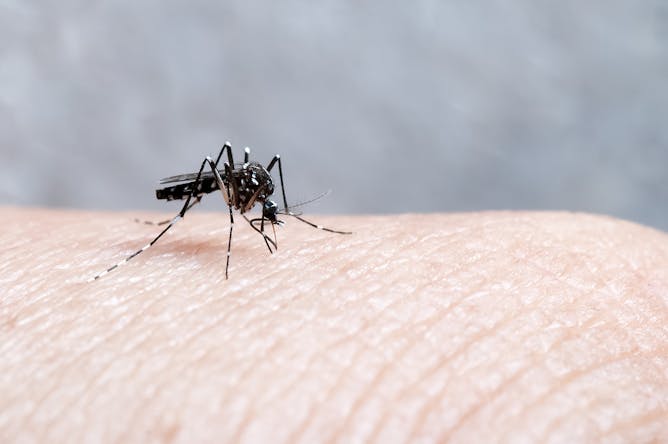 Malaria, common in Africa, infects certain molecules on our red blood cells. Many people in Africa have been born without this molecule so they can’t get malaria.
from www.ahutterstock.com
Malaria, common in Africa, infects certain molecules on our red blood cells. Many people in Africa have been born without this molecule so they can’t get malaria.
from www.ahutterstock.com
Perhaps the most significant and wondrous part of the evolutionary machinery that enables the human race to keep one step ahead of the pathogens is the major histocompatibility complex (MHC). The MHC – proteins on the surface of our white blood cells – evolved along with the vertebrates (animals with a spine), which makes them our oldest defence mechanism.
We have different types of white cells: mobile ones in the blood (lypmphocytes) and resident ones in lymph nodes (macrophages). When there is an infection the macrophages gobble up the bugs and “present” proteins from the organism on their surface like signals.
The lymphocytes containing MHC molecules that recognise this protein bind on. (Our immune system has memory cells that are produced after vaccination or past infections so we can remember how to fight them next time.) The lymphocytes then produce chemicals that recruit more lymphocytes to help. These multiply and you end up with a “swollen gland”.
Our body’s ability to “remember” past infections is one of the reasons the entire population of London didn’t perish during the Black Death. MHC molecules are passed on to our offspring, which explains why we have such a wide variety of these molecules. When a disease enters a population for the first time it always more lethal than subsequent introductions because some people are now immune, and people have been born to the survivors.
Not all pathogens make us stronger
Not all co-evolution leads to changes in human genetics, especially if there is no impact on our ability to procreate. Human tuberculosis is a chronic disease that continues to plague the world with little evidence that humans have developed any ability to resist infection. This is interesting because it is likely to have co-evolved with us from Neolithic times.
We will continue to face new and emerging diseases. So far our capacity to adapt and respond has served us well. But some scientists believe humans are no longer evolving due to the removal of many selection pressures, most importantly things that cause premature death.
The question is whether we are up to the challenges posed by what comes next. Perhaps the most pressing issue facing us now is that bugs seem to be evolving faster than we can create things to kill them – known as anti-microbial resistance.
The spectre of life without antibiotics is terrifying given we never did “overcome” bacterial infections through evolution. Instead we used our ingenuity. Our future will reflect how well we exercise our collective intellect and will to dodge this bullet.
Read the first instalment in the series:
Four of the greatest infectious diseases of our time and how we’re overcoming them
Authors: Simon Reid, Associate Professor, Communicable Disease Control, The University of Queensland
Read more http://theconversation.com/how-weve-evolved-to-fight-the-bugs-that-infect-us-75057


 Daily Bulletin


