

Spilling blood in art, a tale of tampons, Trump and taboos
- Written by: Kate MacNeill, Head of Art History, and Arts and Cultural Management, University of Melbourne
When Donald Trump said of journalist Megyn Kelly, “you could see there was blood coming out of her eyes. Blood coming out of her wherever”, the American artist Sarah Levy responded by painting a portrait of him using her own menstrual blood.
Setting aside, (as if one could), the overt misogyny implicit in Trump’s comments, his views amplify the anxiety the open body creates – the destabilisation of the intact body of the viewer, a momentary collapse of self.
Artistic freedom is given so as to encourage such exploration. Art operates as a laboratory for ideas, it can be radical, political and sometimes deeply confronting; no more so than when art confronts audiences with bodily fluids most often hidden from view. To paint with menstrual blood is a provocation. It asks that we see things differently, and presents us with what is usually unseen.
But not all blood is equal. When blood is spilled it is generally presumed to be male, frequently in the name of the nation, and spent in some heroic act or another - largely on foreign shores, commemorated but rarely seen. Blood has its place – contained, controlled and out of view.
When blood escapes the body or laboratory, it is particularly disturbing and unruly. We speak of spilt blood as contaminated, infected, impure. Controlled blood-letting is a symbol of masculinity; menstruation a sign of abjection, and gay men’s blood is to be feared, to say nothing of the anxiety of intermingling blood between people, races and species. To work with blood can raise ethical issues, but is equally an opportunity to shed light on the source of many prejudices and misconceptions.
Read more: Explainer: what’s actually in our blood
The feminist art movement of the 1960s and 1970s took aim at these entrenched religious and societal norms, and presented audiences with menstrual blood: both as the subject of art works and the material with which artists worked. Feminist artworks that included blood acquired their potency because of its taboo status. Blood was dangerously out of place.
Before Tracey Emin’s blood soaked tampon appeared in her Turner Prize nominated work My Bed, Judy Chicago produced Menstruation Bathroom as part of Womenshouse (Los Angeles, 1972) an iconic feminist art installation. The bathroom contained a rubbish bin with bloodstained sanitary pads and tampons as “unmistakeable marks of our animality”. Carolee Schneeman’s Blood Work Diary (New York, 1972) consisted of a series of bloodstained tissues blotted with blood from one menstrual cycle, as a response to a male partner’s revulsion at the sight of menstrual blood.
These artists sought to make visible the quotidian blood spilling of which we do not speak, enacting the mantra of the feminist movement of the time: “the personal is political”. As Germaine Greer famously said: “If you think you are emancipated, you might consider the idea of tasting your own menstrual blood - if it makes you sick, you’ve got a long way to go, baby”. As we see from Levy’s portrait of Trump, societies’ taboos continue to imbue art using menstrual blood with threatening power.
The ability of the presence of blood and the open body to destabilise one’s sense of self is often utilised by male artists to instil a sense of vulnerability. Franko B’s performance work I Miss You, in the Tate’s Turbine Hall (London, 2003), saw him naked with blood flowing from cuts to his arms and seeping into a canvas covered runway. Largely because of our long standing gendered perceptions of bodies and blood, when male artists bleed, both they and their work tend to be queered, as if “real men” do not bleed.
And so it was that the HIV-AIDS epidemic in western gay communities produced its own form of gendered crisis and diverse cultural and artistic expressions. The blood borne virus also fundamentally changed the way blood was viewed. If women’s menstrual blood was considered taboo, gay men’s blood was considered lethal.
Suddenly the metaphors of blood, pure and impure, clean and unclean, became frightening literal. The spectre of HIV-positive blood pervaded political and social conversations, and the mere sight of blood in association with the gay community set off hysterical reactions.
Read more: Restricting gay men from donating blood is discriminatory
The spectre of blood was ubiquitous during this period, yet ill-informed anxieties around the infection ensured that blood itself was largely absent in art. One exception was Ron Athey’s performance piece, Four Scenes in a Harsh Life, performed at the Walker Art Centre (Minneapolis USA 1994).
Completely fictionalised accounts of the event circulated, with one report describing HIV-positive blood being thrown at the audience. Athey is HIV+, and blood did flow, but it was that of his HIV negative collaborator, Darryl Carlton—aka Divinity Fudge. The erroneous media reactions fuelled the psychic transmission of the virus, if not literally infecting others, at the very least, creating a fear that bodies might silently and secretly be contaminated by mere proximity.
Such fears persist, in spite of scientific knowledge that the virus can only be transmitted intravenously, through sharing needles or blood transfusions, and unprotected sex. It is these phobias that the German artist Basse Stittgen addresses when he creates objects and vessels out of blood products. He challenges audiences to consider whether they would drink out of, or even hold these objects if they were made of blood from HIV or Hepatitis positive donors.
 Blood Objects, Basse Stittgen (The Netherlands, Germany) Objects made from animal and human blood, 2017.
Courtesy of the artist
Blood Objects, Basse Stittgen (The Netherlands, Germany) Objects made from animal and human blood, 2017.
Courtesy of the artist
Mixing bodily fluids is also taboo: Andres Serrano’s photographs of semen and blood most notably made this connection between life and death in his Bodily Fluids series in the late 1980s.
After his son Lucas’s birth, meanwhile, artist Mark Quinn created a sculpture out of the mother Georgia Byng’s placenta. The work challenges us to consider where the mother and child separate, where bodies begin and end. Stelarc and Nina Sellers asked similar questions with their work Blender, which mixed both their blood and extracted fat.
But what of interspecies blood mingling? May the Horse Live in Me!, a collaborative project by Marion Laval-Jeantet and Benoît Mangin presents us with this very provocation. Over time, Laval-Jeantet built up an immunity to horse blood, sufficient to enable her to be injected with horse blood plasma as part of an experiment that they describe as a “foray into human/animal ‘blood-sisterhood’.”
 May the Horse Live in Me! Art Orienté Objet; Marion Laval-Jeantet & Benoît Mangin (France)
Film and relics of original performance, 2011.
Courtesy of the artists
May the Horse Live in Me! Art Orienté Objet; Marion Laval-Jeantet & Benoît Mangin (France)
Film and relics of original performance, 2011.
Courtesy of the artists
This work can also be seen as a response to the hubris of the anthropocene, the implicit assumption that humans are something other than animal. Ultimately this seems to be the common thread in these artworks: each asks questions of the ways in which humans are gendered, categorised and deemed separate from animals and from each other.
An exhibition at the Science Gallery at the University of Melbourne, Blood: Attract and Repel, addresses our ambivalent attitudes to blood. Laval-Jeantet and Mangin’s work is represented in it, as is Stittgen’s Blood Objects.
The Hotham Street Ladies (a collective based in Australia, UK and Berlin) present in the show what might be considered as an hysterical homage to Chicago’s Menstruation Bathroom. Vivid icing and confectionary is used to create menstrual murals in two toilet cubicles. There is no real blood this time but perhaps the work is all the more abject through its excess.
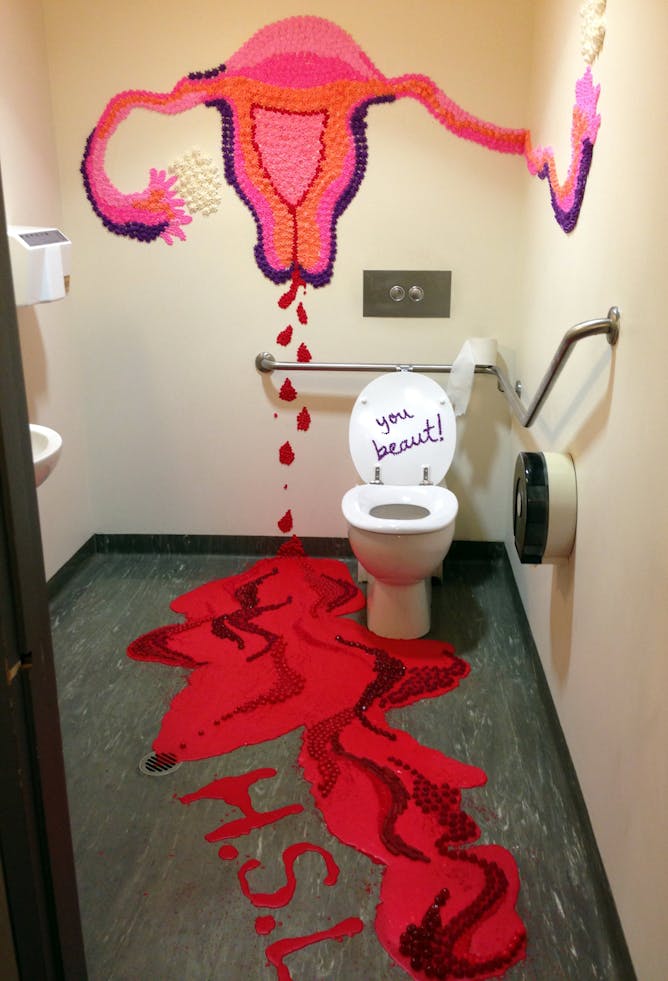 You Beaut, Hotham Street Ladies, (Australia, UK and Germany) Installation, 2017.
Courtesy of the artist
You Beaut, Hotham Street Ladies, (Australia, UK and Germany) Installation, 2017.
Courtesy of the artist
Blood is also absent in Irish artist John O’Shea’s Black Market Pudding. He had hoped to produce a sausage using blood drawn from a living pig, but at the time of writing this is apparently a step too far for Australia, with no farmer willing to provide a pig to be bled.
So the work has been produced elsewhere - highlighting how our industrial, legal and ethical frameworks make it easier to slaughter an animal than bleed one, but keep it alive.
Blood: Attract and Repel opens on August 2 and runs until October 5 at the Science Gallery at University of Melbourne.
Authors: Kate MacNeill, Head of Art History, and Arts and Cultural Management, University of Melbourne
Read more http://theconversation.com/spilling-blood-in-art-a-tale-of-tampons-trump-and-taboos-81455


 Daily Bulletin


