

Both men and women need strong bones, but their skeletons grow differently across ages
- Written by: Paul Anderson, Associate Research Professor, School of Pharmacy and Medical Sciences, University of South Australia
Men and women respond differently to diseases and treatments for biological, social and psychological reasons. In this series on Gender Medicine, experts explore these differences and the importance of approaching treatment and diagnosis through a gender lens.
Osteoporosis, a disease of ageing in which a person’s bones become brittle, putting them at high risk of fracture, is generally considered a woman’s disease. That’s because many more women than men have it.
It is estimated 23% of Australian women over the age of 50 have osteoporosis, compared to 6% of men.
However, both men and women aged over 70 with a clinical diagnosis of osteoporosis and a history of risk factors – such as parent fracture history, certain medications or lifestyle – have a similar high risk of a hip fracture in the next ten years.
This risk is up to 43% chance of hip fracture for men and 47% for women. While the prevalence of hip fractures is higher in women, men have a higher risk of death following hip fracture. The reasons for this are not known.
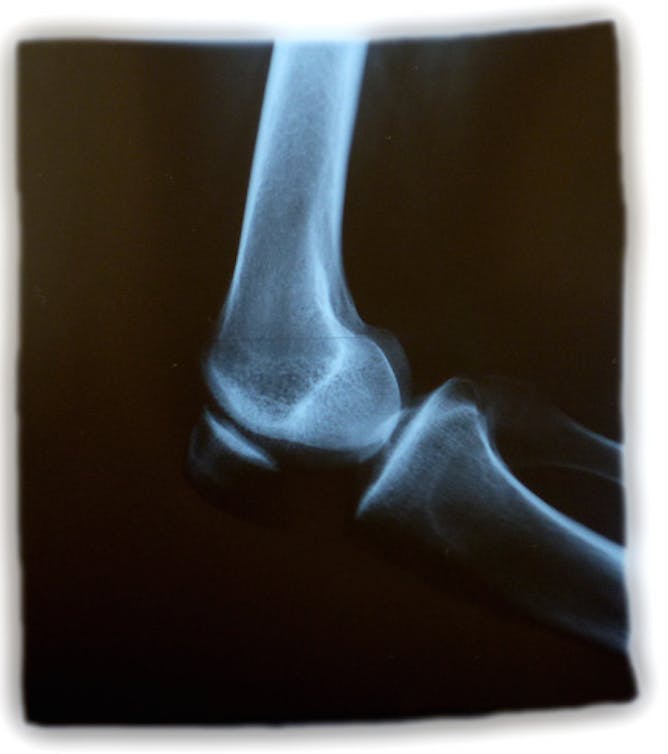 Bone needs to be strong enough to provide support for the body, yet sufficiently flexible and light to allow movement.
eltpics/Flickr, CC BY
Bone needs to be strong enough to provide support for the body, yet sufficiently flexible and light to allow movement.
eltpics/Flickr, CC BY
Bone is a dynamic tissue that is continually broken down and reformed throughout life. Bone health at any given age is determined by the balance between the amount of newly formed bone and the amount of old bone that is lost.
Risk of fracture in any individual is determined by the influence of the environment, nutrition and genes over their lifetime, which contribute to bone structure. The risk is determined by peak bone mass (which is the maximum amount of bone mass attained at adulthood), bone quality (the distribution of minerals in the bone) and bone loss with ageing.
Functionally, bone needs to be strong enough to provide support for the body, yet sufficiently flexible and light to allow movement.
Read more: Why older people get osteoporosis and have falls
Gender differences in adolescence and adulthood
Gender differences in bone and muscle mass are not evident at birth or even until puberty. The growth pattern of bone in boys is different from girls. Boys have two more years of growth before puberty, and the pubertal growth spurt in boys lasts for four years compared to three years in girls.
In childhood and adolescence, the balance of cellular activity is in favour of bone formation over bone resorption in both boys and girls. By the early 20s, women and men achieve peak bone mass, which is the consolidation of total bone mineral accrued over childhood and adolescence years.
A 10% increase in peak bone mass could reduce the risk of fracture by 50% in women after the menopause. So, adolescence is a particularly critical period for bone health for the remainder of adult life. Failure to achieve peak bone mass by the end of adolescence leaves an individual with less reserve to withstand the normal losses during later life.
 Adolescent boys are at higher risk of fracture due to gender-related lifestyle factors like risk taking and more physical activity.
Photo by Julia Komarova on Unsplash
Adolescent boys are at higher risk of fracture due to gender-related lifestyle factors like risk taking and more physical activity.
Photo by Julia Komarova on Unsplash
Although more than 60% of the peak bone mass variance in girls or boys is genetically determined, it is also influenced by modifiable factors such as diet. This includes dairy products as a natural source of calcium and proteins, vitamin D and regular weight-bearing physical activity.
Most gains in bone mass between the ages of 8 and 14 are due to an increase in bone length and size rather than bone mineral. This is one reason why fracture rates are higher during this period relative to late teenage years. Bone mass lags behind growth in bone length, hence bone is temporarily weaker.
In general, adolescent boys are at higher risk of fracture compared to girls. This is due to a combination of biological factors, as well as gender differences linked to levels of physical activities and risk taking.
Testosterone – the major sex hormone in males – increases bone size, while oestrogen – the major sex hormone in females – reduces further growth while improving the levels of mineral in bone. This is why boys develop larger bones and higher peak bone mass than girls, contributing to a lower risk of fracture in adult men compared with adult women.
Bone health in pregnancy
Pregnancy increases the demand for calcium. It’s necessary for building the skeleton of the fetus and during breastfeeding. Poor maternal nutrition has long-term consequences for musculoskeletal development in both boys and girls, with reduced birth weight resulting in reduced bone mass by adulthood.
 Pregnancy increases the demands for calcium.
nicolas michaud/Flickr, CC BY
Pregnancy increases the demands for calcium.
nicolas michaud/Flickr, CC BY
This is why pregnant women need supplementation with calcium and vitamin D to improve skeletal growth and bone mass in newborn babies. Women can sometimes develop osteoporosis during pregnancy or breastfeeding because of poor nutrition. But the skeleton in the mother will completely recover its lost bone when breastfeeding stops.
Current evidence suggests the number of pregnancies and breastfeeding has no impact on the risk of fractures later in life when compared to peers who have not given birth.
Loss of bone in the elderly
On reaching adulthood, certainly by 30 years of age, bone mass remains largely constant and doesn’t begin to fall until the fourth decade of life.
Ageing is associated with a decline or loss of sex hormones in both men and women. Women are at a greater risk of developing osteoporosis because levels of oestrogen, the hormone that helps to conserve calcium in bone, decline rapidly at menopause. At this stage of life a lack of oestrogen results in accelerated bone loss.
Women experience a rapid loss of bone during the first five years after menopause, followed by loss of bone with ageing at a much lower rate.
Men avoid this phase of rapid bone loss, but they do experience loss of bone with ageing, particularly after 70 years. Peak levels of testosterone are attained at puberty after which they continue to fall throughout life. Reduction of testosterone levels can trigger declines in muscle mass, bone mass and physical function. Loss of muscle mass and function with age may also add to fracture risk by increasing the risk of falls.
 Both men and women over the age of 70 who have a clinical diagnosis of osteoporosis have a similar high risk of a hip fracture in the next ten years.
Alexander Danling/Flickr, CC BY
Both men and women over the age of 70 who have a clinical diagnosis of osteoporosis have a similar high risk of a hip fracture in the next ten years.
Alexander Danling/Flickr, CC BY
Treatment
Effective treatments are available to markedly reduce risks of fracture for both men and women and restore life expectancy to that of the non-fracture population. Drugs, such as bisphosphonates, are effective in both men and women.
Lifestyle factors can also reduce the risk of fracture. These include adequate nutrition, including vitamin D dietary calcium, and physical activity at all stages of life.
The best sources of calcium are diary products and vitamin D. While the latter is usually obtained from sun exposure, supplements are cheap and do not require exposure to the damaging effects of sun.
Read more - Explainer: how do our bones get calcium and why do they need it?
Estimates suggest 91% of women and 63% of men aged 51-70 do not meet the average calcium requirements. The recommended average intake of calcium for males and females is 1,000mg per day, rising to 1,300mg per day after 50 years for women and after 70 for men. This amount of calcium equates to three to five serves of calcium-rich foods per day.
A large proportion of Australians also have low vitamin D status. People of any age who don’t have adequate calcium and vitamin D intakes have increased risk of low bone mineral density with negative effects on bone strength. Research shows people who consume more dairy products have better peak bone mass and lower risk of fractures.
Read other articles in the series:
Medicine’s gender revolution: how women stopped being treated as ‘small men’
Man flu is real, but women get more autoimmune diseases and allergies
Women have heart attacks too, but their symptoms are often dismissed as something else
Biology is partly to blame for high rates of mental illness in women – the rest is social
Authors: Paul Anderson, Associate Research Professor, School of Pharmacy and Medical Sciences, University of South Australia


 Daily Bulletin


