

Ancient whales had more bite than today's gentle giants
- Written by: David Hocking, Research associate, Monash University
Millions of years ago, whales looked very different from the gentle giants we know today. They were comparatively small (about 3-5m long) and had a battery of formidable teeth.
Modern mysticetes or baleen whales are the largest animals that have ever lived (blue whales can grow up to 32m) but unlike other mammals they have no teeth. Instead they filter vast amounts of small prey from seawater using baleen: comb-like plates that hang from the roof of their mouths.
How ancient whales lost their teeth and started filtering is something of a mystery, one that we may be one step closer to solving, thanks to a new study published today in Biology Letters.
Read more: When mammals took to water they needed a few tricks to eat their underwater prey
Teeth as tools
Teeth are usually the main tool used during feeding, and their shape can tell us a lot about how and what an animal eats. For example, predators that kill and chew their prey need sharp teeth with cutting blades.
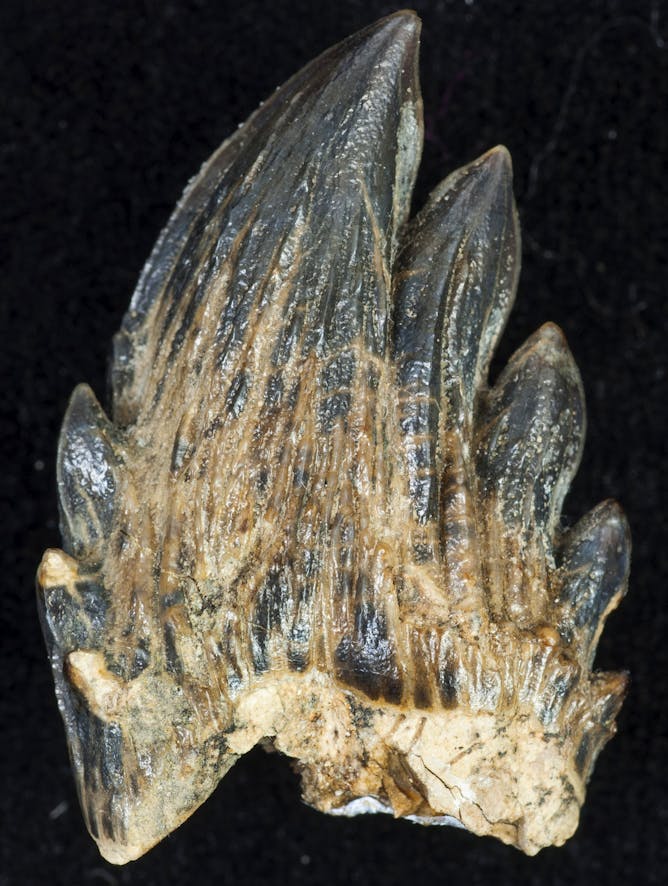 A fossilised tooth from the ancient whale Janjucetus.
Museums Victoria, Author provided
A fossilised tooth from the ancient whale Janjucetus.
Museums Victoria, Author provided
Unlike those of most mammals, the teeth of ancient whales were often rather intricate, and consisted of a series of cusps arranged like the fingers of a hand.
One prominent idea suggests that whales used these teeth in a rather special way: instead of piercing and cutting, they may have used them as a sieve to filter small prey directly from water. A similar behaviour is used by living crabeater and leopard seals when hunting krill in the Antarctic.
 The delicate dental sieve of an Antarctic crabeater seal, used to filter tiny prey such as krill from seawater.
David Hocking, Author provided
The delicate dental sieve of an Antarctic crabeater seal, used to filter tiny prey such as krill from seawater.
David Hocking, Author provided
If early whales really behaved like filter feeding seals, then it was teeth, not baleen, that marked the beginning of the biggest success story on Earth. Baleen would only have evolved later, once the groundwork for filtering had already been laid.
This idea was recently bolstered by the discovery of a previously unknown ancient whale (Coronodon havensteini) with big, intricate teeth, hypothesised to have been used as a sieve. Yet until now it had never been tested directly.
The cutting edge of whale evolution
To find out what the teeth of ancient whales were really capable of, we compared them to both filter feeding seals and a range of known predators, such as dingoes and lions.
 The ancient whale Janjucetus (left) and a modern lion (right) facing off.
Museums Victoria, Author provided
The ancient whale Janjucetus (left) and a modern lion (right) facing off.
Museums Victoria, Author provided
First, we scanned the teeth to create high-resolution 3D computer models.
Next, we digitally cut through different parts of these models, such as the main cusp (the major portion of the tooth that pierces prey during a bite) and the notches between cusps, which can slice up food like a pair of scissors.
Finally, we used these digital cross sections to measure the sharpness of each part of the tooth in unprecedented detail.
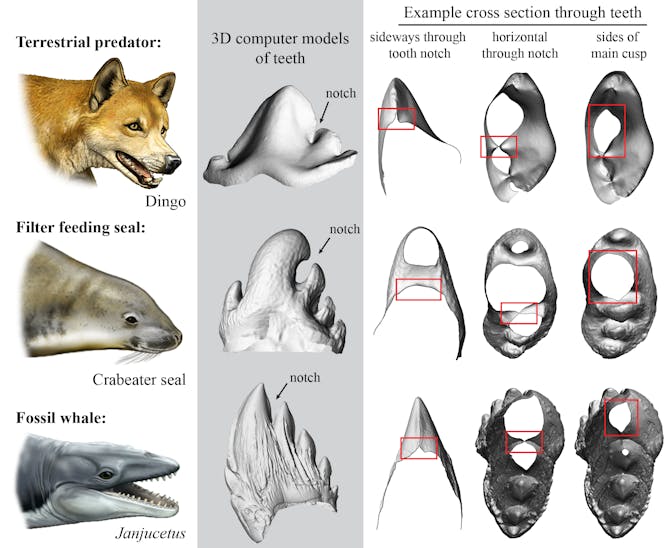 Digital cross-sections through 3D computer models of teeth from living and fossil predators.
David Hocking, illustrations by Carl Buell, Author provided
Digital cross-sections through 3D computer models of teeth from living and fossil predators.
David Hocking, illustrations by Carl Buell, Author provided
From ‘killer’ whales to gentle giants
To our surprise, we found that the teeth of archaic whales were sharp – as sharp, in fact, as those of today’s lions.
By contrast, seals that filter small prey have blunt teeth with rounded edges that allow water to pass out of the mouth – more of a colander than a cutlass. This shows that ancient whales used their teeth to pierce, cut and slice, rather than strain small prey from water.
Unlike their modern descendants, early whales were no gentle giants: they were smaller and considerably meaner, and at least some of them seem to have been ferocious predators.
3D digital model of fossilised tooth from the ancient whale Janjucetus.So how did they turn from killers into filter feeders?
More sucking than biting
Unlike seals, whales probably never used their teeth to strain prey. Instead, we think that they started to suck in, rather than bite, their food.
Among living marine mammals, including whales, dolphins and seals, the ability to suck is almost universal, and the same may well have been true for their extinct forebears.
Living suction feeders have broad snouts and small mouths, which help maximise the strength of suction. Both features appeared in early whales – including in Coronodon, in which the sides of the mouth were partially closed off by tall teeth and thick gums.
Read More: Eavesdropping reveals hidden marine mammal populations in the ocean
As in living sperm whales, beaked whales and several dolphins, suction feeding in early baleen whales would ultimately have led to a gradual reduction of the teeth. Thick, horny gums would have remained, maybe to help grasp prey, or to seal off the sides of the mouth. At the same time, suction would have enabled whales to capture much smaller prey than teeth alone could have handled.
All of this was happening around 30 million years ago, at a time of pronounced global change. As Antarctica broke away from all other continents, cold water began to flow freely around the southern landmass to create the Antarctic Circumpolar Current. This led to a boom in ocean productivity, and an abundance of small prey.
As prey got smaller, the horny gums became larger and more complex. This would have allowed small food items to be retained, while water sucked into the mouth alongside it could be safely expelled.
Ultimately, the horny gums became longer and plate-like, giving rise to baleen and our familiar, filter-feeding gentle giants of today.
Selective feeding by the Blue Whale.Authors: David Hocking, Research associate, Monash University
Read more http://theconversation.com/ancient-whales-had-more-bite-than-todays-gentle-giants-82907


 Daily Bulletin


