

When a 'good death' was often painful: euthanasia through the ages
- Written by: Caitlin Mahar, Adjunct Research Fellow (History), Swinburne University of Technology
Today, a primary goal of both movements aimed at care of the dying – palliative care and euthanasia – is to eliminate suffering. These are underpinned by the idea that a good death is a painless death. But it wasn’t always so.
The term “euthanasia” is derived from the Greek for good death, but it only began to be used in a modern and familiar way in the late 19th century. For centuries in Western societies, “euthanasia” referred to a pious death blessed by God.
The means of achieving a good death was set out in the enormously popular ars moriendi (art of dying) guides that offered prayers, attitudes and actions intended to guide the dying towards salvation. This wasn’t necessarily a painless process. Far and away the most reproduced image of good dying was Christ’s crucifixion.
The pain that could accompany dying was seen as punishment for sin and ultimately redemptive: a chance to transcend the world and flesh through imitation of Christ’s suffering. It was also a test of the compassion and charity of friends, relatives and even strangers.
The Christian injunction to minister to suffering meant visiting and caring for the dying were seen as communal duties. Children as well as adults were expected to offer physical and moral support to those who were gravely ill.
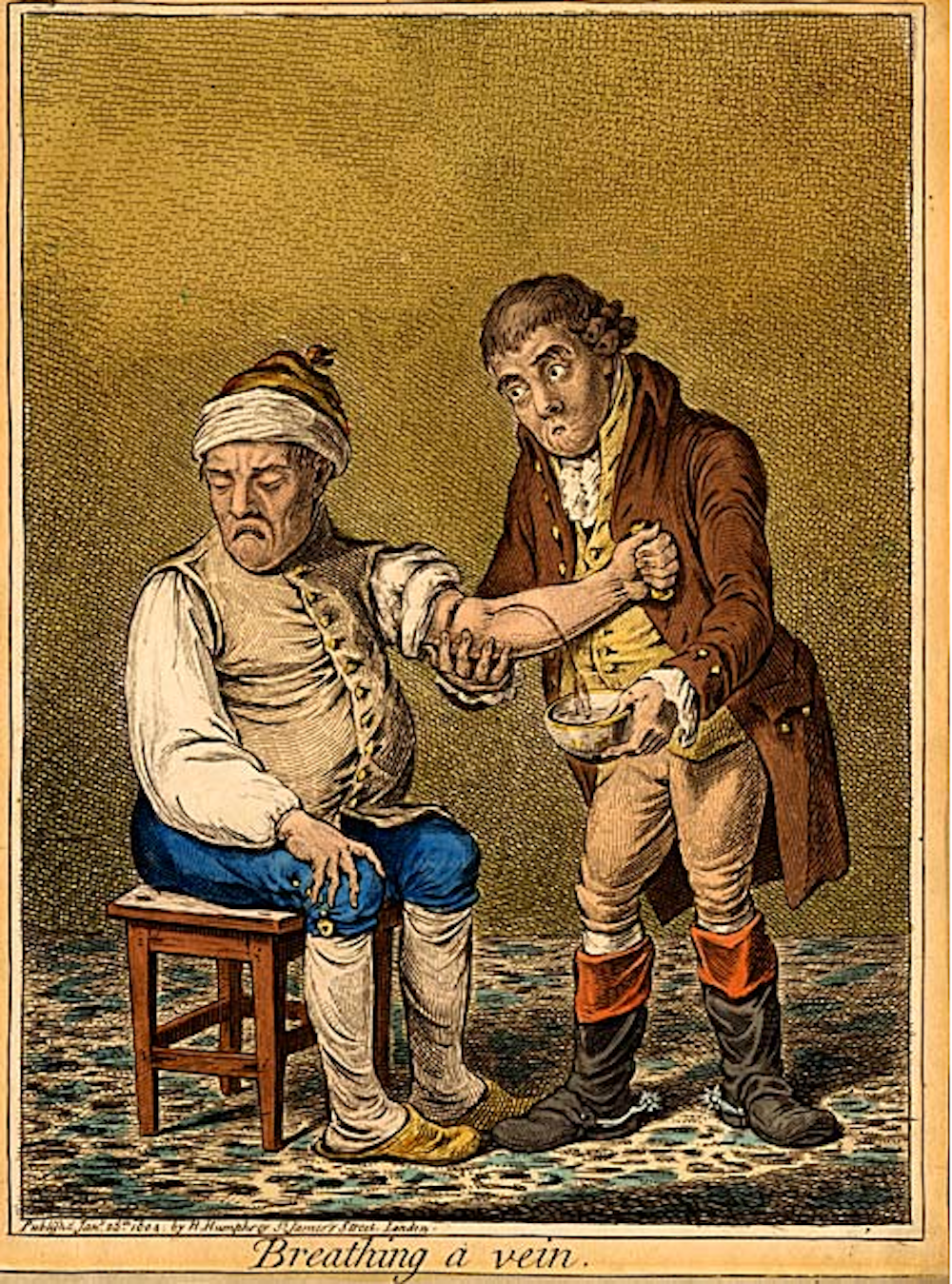 James Gillray, Bleeding a Vein, circa 1804.
Author provided
James Gillray, Bleeding a Vein, circa 1804.
Author provided
Doctors did not typically attend the deathbed. They did not have an obvious role in the central spiritual business of dying, but nor were they particularly associated with the mitigation of suffering.
Indeed, in the pre-anaesthetic era, doctors were more likely to be associated with the infliction of pain. Surgery, of course, was excruciating, but other now infamous “heroic” remedies (such as blistering, excessive bleeding and the application of caustic chemicals to the skin) were based on the belief that pain had healing properties and involved doctors deliberately inducing it.
In the 19th century, pain began to be seen as a discrete and aberrant physiological phenomenon. Both dying and suffering were increasingly medicalised. Doctors gradually took over from the clergy and family as carers of the dying.
At the same time, the word “euthanasia” took on a new meaning. It began to refer to this new medical duty to assist the terminally ill – but not to hasten death.
In the wake of the mid-century revolution in anaesthetics and aided by innovations such as the hypodermic syringe, doctors began to “treat” the dying with painkillers as well as prayers.
In 1870, Samuel Williams, a Birmingham businessman and amateur philosopher, proposed a more definitive form of this new medical treatment for the terminally ill. In an essay called Euthanasia, published by the local Speculative Club, he wrote:
That in all cases of hopeless and painful illness, it should be the recognised duty of the medical attendant, whenever so desired by the patient, to administer chloroform or such other anaesthetic as may by-and-by supersede chloroform – so as to destroy the consciousness at once, and put the sufferer to a quick and painless death.
Williams sparked a debate that has waxed and waned but never gone away. But how had this come to look like a good way to die?
Changing meanings of pain
In 1901 psychologist and philosopher William James wrote of the “strange moral transformation” that had taken place regarding attitudes to pain:
It is not expected of a man that he should either endure it or inflict much of it, and to listen to the recital of cases of it makes our flesh creep morally as well as physically. The way in which our ancestors looked upon pain as an eternal ingredient of the world’s order, and both caused and suffered it as a matter-of-course proportion of their day’s work, fills us with amazement.
Historian Stephanie Snow observes that as anaesthetics and other methods of pain relief became available in the 19th century, people began to see pain – the experience but also the sight of it – as more damaging and demoralising.
A new generation of comfortably off Victorians who considered anaesthesia commonplace could no longer stomach physical suffering. Now pain was something that could not just be eliminated but struck as cruel, unusual and degrading: “an alien force which undermined man’s very humanity”.
Dying and suffering became things from which people, particularly children, should be shielded.
A modern paradox
Medical methods aimed at eliminating the pain of the dying process developed as the fear of death – a fear that for centuries dwelt on the post-mortem horrors of hell – began to centre on the horror that could precede it.
Paradoxically, this fear arose and gained momentum as most people in Western cultures became increasingly insulated from such suffering. As mortality declined, more people died in hospital under the care of specialists, and doctors’ ability to control pain advanced in ways previously unimaginable.
This very modern anxiety can be historically tracked from Williams’s 1870 proposal to the assisted dying bill soon to be debated in the Victorian parliament.
Our ancestors would be amazed.
Authors: Caitlin Mahar, Adjunct Research Fellow (History), Swinburne University of Technology
Read more http://theconversation.com/when-a-good-death-was-often-painful-euthanasia-through-the-ages-84604


 Daily Bulletin


