

Revenge served cold: was Scott of the Antarctic sabotaged by his angry deputy?
- Written by: Chris Turney, Professor of Earth Sciences and Climate Change, UNSW
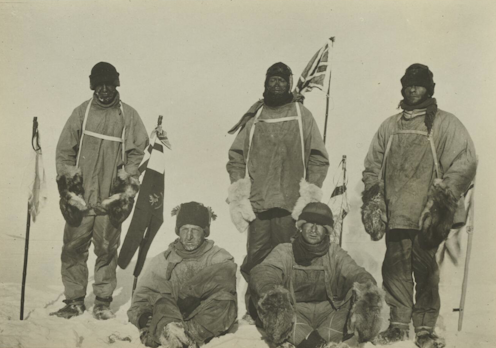
On February 11, 1913, the world woke to the headline “Death of Captain Scott. Lost with four comrades. The Pole reached. Disaster on the return”. A keenly anticipated, privately funded scientific venture “off the map” had turned to tragedy.
Previous reports had described the polar party of the British Antarctic Expedition striking out confidently just 2.5º latitude from their objective: the geographic South Pole. The journals and letters recovered from the bodies, however, told a tale of heartbreak and desperation: the explorers were shattered to find themselves beaten to the pole by Norwegian rival Roald Amundsen, and weakened terribly during their journey back to base.
Of the five men in Captain Robert F. Scott’s party, Petty Officer Edgar Evans was the first to die, while descending from the high-altitude Antarctic Plateau. Then, while searching in vain on the vast Ross Ice Shelf for the dog sleds ordered to speed their return to base, Captain Lawrence “Titus” Oates realised that his ever-slowing pace was threatening the others, and famously walked out into a blizzard with the parting words: “I am just going outside and may be some time.”
Pushing on with limited supplies, the remaining men (Scott, Dr Edward Wilson and Henry “Birdie” Bowers) found themselves trapped by a nine-day blizzard. All three wrote messages to friends and loved ones while waiting, until eventually their food ran out on about March 29, 1912.
Why did they really die?
Their deaths were put down to the fickleness of Antarctic weather, bad luck or, most controversially, poor leadership on the part of Scott.
But my new research, published in the journal Polar Record, has uncovered new evidence about this ill-fated journey. I have identified major contradictions in the testimony of Scott’s second-in-command, Lieutenant Edward “Teddy” Evans, who survived the expedition after being rejected from Scott’s party.
Was Scott scuppered by Evans?Evans’s actions raise the possibility that he played a role in the deaths of the five men. Furious at not being included in the attempt on the pole, Evans was returning to base when he collapsed with scurvy. Evans was the only expedition member to develop scurvy, most probably due to his refusal to eat fresh seal meat, a known preventive measure.
His companions Tom Crean and William Lashly heroically saved Evans’s life, a tale made famous in no small measure by expeditioner Apsley Cherry-Garrard’s classic book on the expedition, The Worst Journey in the World.
Foul play over food?
Buried in the British Library, I found a crucial piece of evidence about Evans’s trip back to camp. Seven pages of notes detail meetings held in April 1913 between Lord Curzon, president of the Royal Geographical Society, and Scott’s and Wilson’s widows, both of whom had read their late husbands’ diaries and correspondence.
According to the notes, Kathleen Scott reported that:
Scott’s words in his diary on exhaustion of food & fuel in depots on his return… It appears Lieut Evans – down with Scurvy – and the 2 men with him must on return journey have entered & consumed more than their share.
Several days later, also according to the meeting notes, Oriana Wilson described how:
…there was a passage in her husband’s diary which spoke of the “inexplicable” shortage of fuel & pemmican [sledging ration] on the return journey… This passage however she proposes to show to no one and to keep secret.
Closer examination of diary entries suggest that the food in question went missing from a depot at the southern end of the Ross Ice Shelf. Letters from the time indicate that Curzon immediately shut down the inquiry he was planning to hold. It is not unreasonable to assume that Curzon’s interpretation of events was that Evans was dangerously ill and if he had not taken the food would have also died.
But the account of exactly when Evans fell down with scurvy changed over time. Returning to civilisation in 1912, Evans described in a letter how he was stricken when he was 300 miles from base, a distance confirmed by media interviews from the time.
But by the following year, this figure had changed to 500 miles, a distance also reported in the book Scott’s Last Expedition. This would put the onset of his sickness at the southern end of the Ross Ice Shelf, precisely where the food appears to have gone missing.
Unwittingly, Cherry-Garrard published a substantially embellished version of Lashly’s sledging diary in The Worst Journey in the World, in which Evans’s sickness was shifted one week earlier to align with the public timeline.
Overall, the evidence strongly suggests that Evans took the cached food when he had not yet succumbed to scurvy, possibly because of his anger at having been sent back early and forced to drag his sledge with just two men. The timing of the various pieces evidence suggest that his story was later changed to fit with the idea that he took the food because he was ill.
Disturbingly, Scott’s order to Evans to send the dog sled teams to the southern end of the Ross Ice Shelf does not appear to have been communicated either, fatally slowing the polar party’s return.
Writing from his deathbed, Scott warned: “Teddy Evans is not to be trusted over much, though he means well.”
Given the evidence, this was arguably a generous statement.
Authors: Chris Turney, Professor of Earth Sciences and Climate Change, UNSW


 Daily Bulletin


