

History says department stores will struggle in the future
- Written by: Matthew Bailey, Lecturer, Retail History, Macquarie University
Explanations for the poor performance of Australian department stores vary broadly. They have focused on the challenges of online competition, weak consumer sentiment and the influx of international retailers.
A few years ago, it was poor service, botched online strategies, and a host of other operational and marketing issues. These critiques are valid, but they are also part of a much longer story.
Department stores began as retail innovators. They arose within a changing consumer environment distributing mass produced goods. The scale of their operations, and the breadth of their product ranges helped establish retail dominance. Bit by bit, their competitive advantage has eroded.
Read more: How shopping centres are changing to fight online shopping
The latest results from Myer and David Jones don’t inspire confidence. Myer experienced an 80% drop in profits over the past year, while for David Jones it was 25%.
Myer chief executive Richard Umbers pointed to “heightened competition, subdued consumer sentiment and discount fatigue”.
David Jones chief executive John Dixon blamed the costs involved in turning around a business that he said had been “in a form of managed decline” prior to being acquired by the South African Woolworths company in 2014.
Changing cities
Department stores emerged in Britain and France in the 19th century. They introduced several new innovations, including set prices rather than allowing haggling, a move away from credit to cash sales, off-the rack clothing, improvements in stock control and a high turnover sales model.
In the second half of the century, large-scale, purpose-built stores that stocked goods meeting a full range of needs for the home, as well as ready-made clothing, were constructed in major cities across Europe, North America and Australasia. These included Harrods in London, Le Bon Marché in Paris, Macy’s and Alexander Turney Stewart’s “Marble Palace” in New York and David Jones in Australia.
These stores reached their height in the interwar years, and despite setbacks during the Great Depression and World War II, dominated consumer imaginations and urban skylines until the late-1950s.
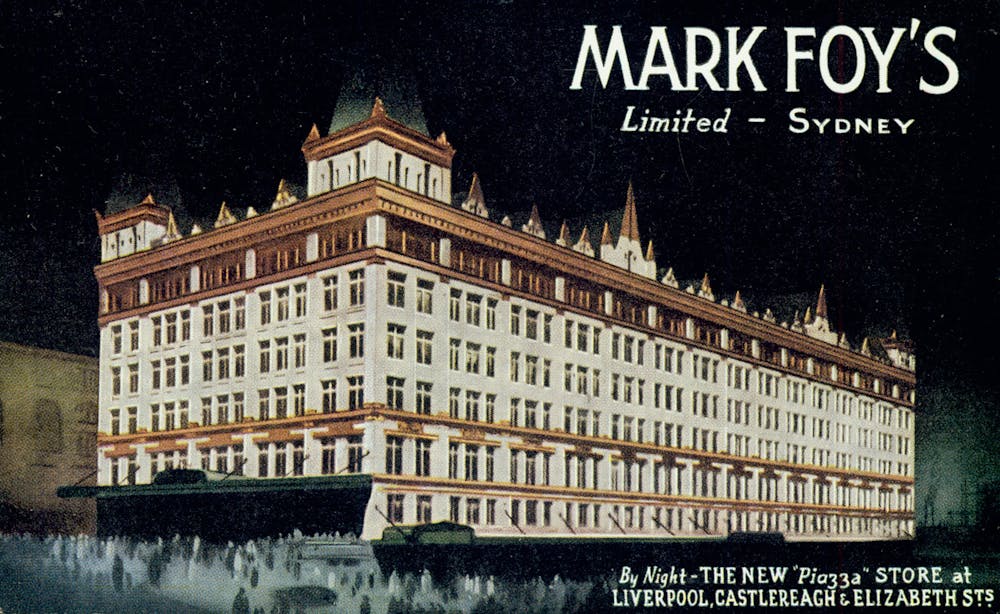 Mark Foy’s Limited, Sydney - the new ‘Piazza’ store at Liverpool, Castlereagh & Elizabeth Streets, circa 1930.
Artist unknown, Caroline Simpson Library & Research Collection, Sydney Living Museums, Record No. 37955
Mark Foy’s Limited, Sydney - the new ‘Piazza’ store at Liverpool, Castlereagh & Elizabeth Streets, circa 1930.
Artist unknown, Caroline Simpson Library & Research Collection, Sydney Living Museums, Record No. 37955
Their retail preeminence was based on urban environments built around public transport. The rise of the automobile posed an existential threat. The great city stores that survived longest in Australia – David Jones, Myer and Grace Bros – were those that embraced suburban expansion through shopping centre development.
Firms that were once household names - Farmers, Anthony Hordern & Sons, Foy & Gibson, Buckley & Nunn and a host of others - have all disappeared.
However, by developing and taking tenancies in shopping centres – an innovation that sustained and prolonged their lifespan – department stores created a powerful competitor. With more efficient, specialist retailers serving as its departments, what is a shopping centre but a department store on a larger scale?
Until the 1970s, department stores were also able to buy customer loyalty by offering exclusive credit provisions. This occurred through store cards that customers could use to make purchases at that store and its branches.
The bankcard rollout, beginning in 1974, and the bank credit cards that followed, helped to democratise credit provision, freeing customers to shop wherever they liked.
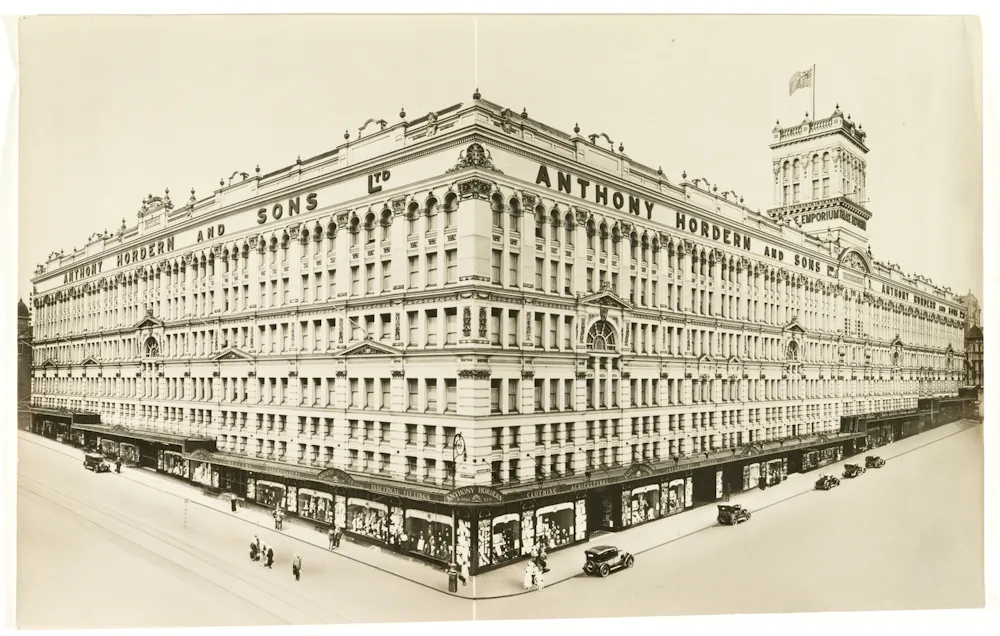 Exteriors of the Anthony Hordern and Sons department store, 1901-1938.
State Library of New South Wales, ID No. IE1001822
Exteriors of the Anthony Hordern and Sons department store, 1901-1938.
State Library of New South Wales, ID No. IE1001822
Discounters and category killers
The next existential threat emerged from a retail innovation that took the United States by storm in the 1950s: discount department stores that used the self-service supermarket retail model to sell department store merchandise.
In Australia, Coles saw an expansion opportunity and launched Kmart in 1969. Myer, observing the impact of discount department stores on traditional department stores in the US, rolled out Target. Woolworths lagged, but introduced Big W in the mid-1970s.
Over time, these stores took a heavy toll on the sales of traditional department stores. Figures provided by Urbis show that in 1974, traditional department stores accounted for 27% of sales of department store-type merchandise such as home furnishings, apparel and cosmetics, with discount stores making just 2% of such sales. By 1991, the figures were 12% and 11% respectively.
Read more: Not the end for department stores - but time is running out to embrace technology
Since then, both have had trouble competing, not only with each other, but with “category killers” that took the self-service model and applied it to specific categories of goods.
This allowed them to achieve efficiencies of scale and brand recognition, while providing deep product ranges, specialist service and cheap prices. Think Toys-R-Us, Rebel, Lincraft, The Good Guys, Harvey Norman, Freedom and Officeworks.
You can still buy toys in Myer, but who does? You can buy a fridge if are happy to pay a significant premium. This is niche retailing – a complete inversion of the mass-market retail principles that underscored the original department store business model.
International fast fashion is just the latest category killer for a product segment sold by department stores. If department stores lose fashion, they are gone. And the retailers they are competing with – Zara, H&M, Uniqlo and others – operate on a scale that eclipses national department store chains.
What’s next?
Department stores may well extend their lifespan. There are plenty of pundits offering solutions, both here and overseas.
Nevertheless, it’s likely Australia will see further market rationalisation. Three chains are likely to be left: David Jones or Myer at the top, Myer or Target in the middle, and Kmart at the bottom. This is not definitive – innovative management can turn around a brand within a few years as Guy Russo did with Kmart recently and Paul Simons did with Woolworths in the late-1980s.
But rationalisation will continue. Time has brought department stores back to the pack. The weakest will merge or fall.
Authors: Matthew Bailey, Lecturer, Retail History, Macquarie University
Read more http://theconversation.com/history-says-department-stores-will-struggle-in-the-future-85527


 Daily Bulletin


