

The Murray Goulburn dilemma – co-operatives are dying out but they're still needed
- Written by: Michael Duffy, Lecturer and Researcher, Monash Business School, Monash University
Canadian diary company Saputo’s bid for Murray Goulburn is just the latest example of how co-operatives are disappearing in the Australian business landscape. But despite this pressure for co-operatives to fold into the dominant corporation model, these business models are still worthy.
Co-operatives have a long history because they have the advantage of minimising conflicts of interest between producers and owners. Producer co-operatives are set up to be centred on the interests of their producer members whereas corporations are motivated by shareholders. Unless all shareholders are also producers, a conflict can arise.
Natural selection plays a part in markets so this comparative advantage could see new types of co-operatives emerge in the market. But the organisation of new, large scale, co-operative ventures is likely to be difficult for busy farmers without extensive cash.
Why are producer co-operatives disappearing?
Australia’s farmers don’t receive subsidies to the extent that European and American farmers do and are often cash strapped, lacking surplus capital to invest. Because of this, co-operative managers argue for the need to look elsewhere for more capital to invest in manufacturing and supply chains.
Co-operatives such as Murray Goulburn have gone to private equity markets but this has diluted their co-operative structure while creating other problems such as conflict between producers and investors. This is exemplified by the current investor class action.
Co-operatives also struggle with banks who are reluctant to lend as they do not understand or even distrust the co-operative structure. Some also argue that increasingly globalised free trade and excess production has depressed agricultural prices which impacts the market power of farmer co-operatives to hold out for a good price.
Regulators also have an interest in transforming co-operative structures into the corporate form for ease of regulation.
Farmer co-operatives are changing
The once proud farmers co-operatives have transformed in Australia. While agricultural co-operatives maintain their popularity overseas, in Australia there are a number of examples of co-operatives restructuring into, or being taken over by, listed companies.
Some examples include former customer co-operative Pivot and former producer co-operatives such as Wesfarmers, Warrnambool Cheese and Butter (now owned by the Canadian Saputo) and Bega Cheese (ASX listed in 2011).
Even the former Australian Wheat Board was briefly a partly co-operative company, between its time as a government selling desk and its takeover by a Canadian firm.Yet some major co-operatives continue in business such as CBH Group (a bulk handling co-operative) and Norco and there are a number of other agricultural co-operatives.
Some agricultural producer co-operatives have to a greater or lesser degree experimented with doses of private non-farmer equity in the hope of survival. Unfortunately the attractions of city capital have inevitably brought conflicts with the old farmer members and an end to the purist model.
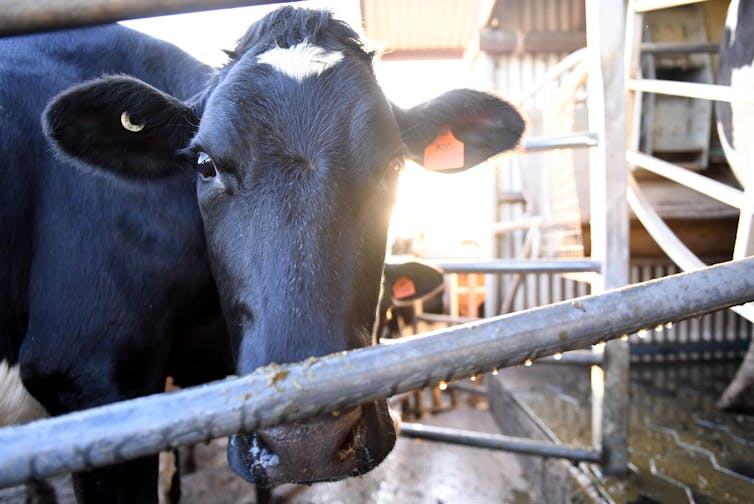 Co-operative Murray Goulburn is being bid for by Canadian dairy corporation Saputo.
Tracey Nearmy/AAP
Co-operative Murray Goulburn is being bid for by Canadian dairy corporation Saputo.
Tracey Nearmy/AAP
Conflict between the corporation and the co-operative
There are some logical reasons why a co-operative structure would transform into a corporation, apart from the ability to raise capital. A business having a corporation type structure allows greater transparency on the health of the business, through a listed share price. It also provides greater liquidity and gives members the ability to exit the business (by selling their shares).
However there is a conflict in producer co-operatives between the objectives of paying farmers the best price and generating highest returns for non-farmer investors. For example, the greater the difference between sale price and farmgate price of produce, the greater the revenue for the corporation.
Though this provides an incentive to maximise the sale price of produce to retailers (which is good for farmers) there may also be a theoretical incentive to minimise farmgate price, as this also increases the returns to non-farmer investors.
There are also competition issues in the corporation model as farmer-owned processors could generally rely on their farmer ownership to avoid price exploitation by the distributor/processor.
However once the processor becomes externally owned, there is the temptation to use that market power against farmer suppliers (in the way some powerful supermarket players do). The ACCC then is left as the only protector in ensuring there is sufficient competition between processors to prevent this.
Another problem in corporations is the focus on short-term capital. This is where people, such as day traders and speculators, seek quick returns and short term share price gains. This could be detrimental to the long term producer interests of maximising farmgate price and reinvesting in the co-operative.
There’s also a lack of intergenerational equity in the corporatisation of co-operatives. Current members and insiders may get windfall gains at the expense of services to future suppliers or customers.
This is because businesses built up over a long period by predecessor farmers, that would otherwise pass to the next generation, have their value crystallised and “cashed out” at an earlier point in time. This means the next generation are likely (in a corporation) to lose the advantageous service arrangements, supplied by the co-operative in the past.
Because of all of these issues in transforming co-operatives to corporations, policymakers need to be careful that their settings are fair to co-operative models, to even the playing field.
Farmers also need to think carefully about what structures will preserve their long-term interests. Given that rural produce (not including mining) accounted for A$4.1 billion in exports out of a total of A$32.9 billion in goods and services exports in September 2017 (or 12.5% of total exports) Australia needs to get these structures right.
Authors: Michael Duffy, Lecturer and Researcher, Monash Business School, Monash University


 Daily Bulletin


