

As China flexes its muscles in Antarctica, science is the best diplomatic tool on the frozen continent
- Written by: Adrian McCallum, Lecturer in Science and Engineering, University of the Sunshine Coast
Science has always drawn people and nations to Antarctica. But territorial claims and political tensions are also part of the history of that continent.
China is investing heavily in infrastructure and capability in Antarctica with research stations, airfields, field camps and plans for more. Science must continue to play a pivotal role in easing territorial tensions, as interest in Antarctica increases.
Read more: How China came in from the cold to help set up Antarctica’s vast new marine park
A brutal scientific history
Some argue that Captain Robert Scott and his team perished on their infamous return journey from the South Pole because of their dogged determination to haul 15kg of geological specimens.
Science has always nestled alongside the dominant motivation of territorial claims. But in Antarctica, it has evolved as a tool of diplomacy between nations, as a means to suppress tensions about national claims to the land.
This tension is not new. It was during his 1929–31 expedition that Sir Douglas Mawson claimed what is now the Australian Antarctic Territory (AAT) as British sovereign territory, with sovereignty eventually being transferred to Australia in 1936.
Australia’s National Antarctic Research Expeditions (ANARE), formalised in 1947, were not established for scientific reasons. Rather, they were meant to support our territorial claims and enable investigation of valuable mineral and marine resources located within the AAT.
A recent event in Hobart held by the Australian Academy of Science, examining the future of antarctic science was underscored by such themes.
A time of increased tensions
In their 2016 book, The Scramble for the Poles, academics Klaus Dodds and Mark Nuttall suggest that the planting of a Russian flag beneath the North Pole in 2007 precipitated a new scramble for resources in the polar regions.
In their view, there is an ongoing and under-discussed unease among Antarctic players when it comes to territory. This is felt particularly keenly by countries that have publicly reserved their right to make a future Antarctic claim (such as the United States and Russia), and those that have made no such claim, nor reserved such a right (such as China).
Australia is one of the original seven Antarctic claimants; we claim 42% of the continent. Our actions in Antarctica are pivotal as we grapple with increasing interest in the continent from assertive states such as China.
In a Special Report to the Australian Strategic Policy Institute in 2017, Anne-Marie Brady of the University of Canterbury outlined three stations, three airfields and two field camps that China has in the AAT. She also noted China’s intention to build a fourth station on King George Island, with plans for a fifth station for the Ross Sea region.
Only weeks ago, Brady released a book, China as a Polar Great Power that further examines the game changing nature of China’s growing strength at the poles.
This power has grown, she argues, thanks to the country “investing more in capacity than any other nation”. This includes investment in BeiDou, China’s own global GPS network, which will enhance capability for the Chinese military.
What is Australia doing about this?
Australia is emerging from a long period of under-investment in Antarctica to slowly address this geopolitical situation.
In 2012, the US released an examination of its need to renew its infrastructure and logistical capability in Antarctica. In 2016, the Australian Antarctic Division released its own Australian Antarctic Strategy and 20 Year Action Plan.
These documents explain Australia’s future role in Antarctica and outline the measures we need to implement to retain our role as an Antarctic leader. These measures include things such as the re-establishment of our overland traverse capability, an upgrade of our ageing Antarctic stations and the investigation of year-round aviation links.
Progress is being made. Australia’s newest icebreaker was recently named and the first steel was cut in June 2017. A Modernisation Taskforce has been established.
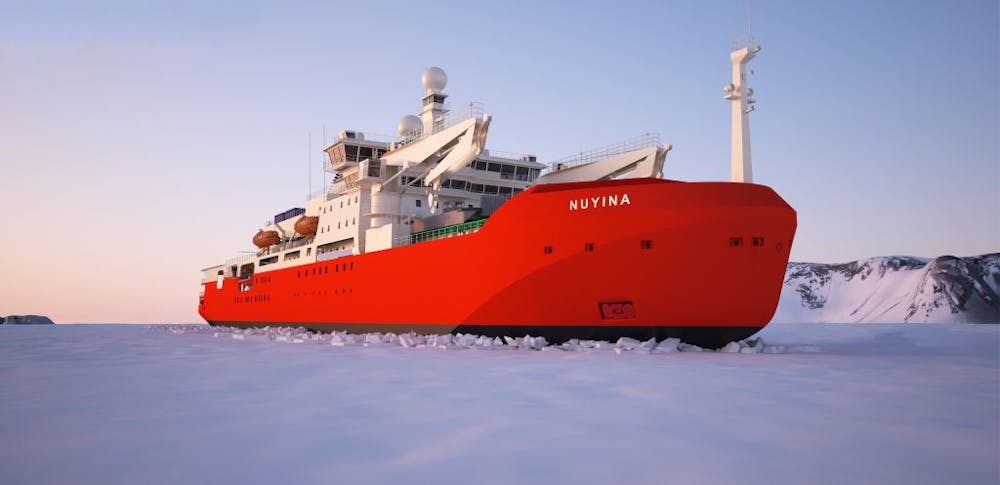 Australia’s new icebreaker will be called RSV Nuyina.
Australian Antarctic Division/Damen/DMS Maritime/Knud E Hansen
Australia’s new icebreaker will be called RSV Nuyina.
Australian Antarctic Division/Damen/DMS Maritime/Knud E Hansen
Without these vital infrastructure and operational assets, we lose the ability to conduct science across our territorial claim. If we lose this, we can no longer wield science as a valuable diplomatic tool.
Science as a bridge builder
Science has long served as a bridge builder in Antarctica, but how long can it sustain this role?
The importance of ongoing scientific collaboration between Australia and China in Antarctica has been discussed.
It is generally asserted that the capacity of science to serve as a form of “soft power” diplomacy is sound and that sovereignty can best be sustained by deploying a continuous and substantial scientific program.
Read more: Revenge served cold: was Scott of the Antarctic sabotaged by his angry deputy?
But, although Antarctica is considered “a reserve for peace and science” under International governance, the robustness of the Antarctic Treaty too is often discussed. Contemporary media continues to illustrate concerns over our claim in Antarctica.
The Chief of the Australian Defence Force spoke recently on such matters in Washington and a colleague and I are currently examining the implications for Australian Defence policy of other states’ assertive actions in Antarctica.
Science must continue to play a pivotal role in sustaining peace in Antarctica so that alternative tools need not be called upon.
Authors: Adrian McCallum, Lecturer in Science and Engineering, University of the Sunshine Coast


 Daily Bulletin


