

Sydney's closer to being a zero-carbon city than you think
- Written by: Rob Roggema, Professor of Sustainable Urban Environments, University of Technology Sydney
You live in one of the sunniest countries in the world. You might want to use that solar advantage and harvest all this free energy. Knowing that solar panels are rapidly becoming cheaper and have become feasible even in less sunny places like the UK, this should be a no-brainer.
Despite this, the Australian government has taken a step backwards at a time when we should be thinking 30 years ahead.
Further reading: Will the national energy guarantee hit pause on renewables?
Can we do it differently? Yes, we can! My ongoing research on sustainable urbanism makes it clear that if we use the available renewable resources in the Sydney region we do not need any fossil resource any more. We can become zero-carbon. (With Louisa King and Andy Van den Dobbelsteen, I have prepared a forthcoming paper, Towards Zero-Carbon Metropolitan Regions: The Example of Sydney, in the journal SASBE.)
Enough solar power for every household
Abundant solar energy is available in the Sydney metropolitan area. If 25% of the houses each installed 35 square metres of solar panels, this could deliver all the energy for the city’s households.
We conservatively estimate a total yield of 195kWh/m2 of PV panel placed on roofs or other horizontal surfaces. The potential area of all Sydney council precincts suited for PV is estimated at around 385km2 – a quarter of the entire roof surface.
We calculate the potential total solar yield at 75.1TWh, which is more than current domestic household energy use (65.3TWh, according to the Jemena energy company).
Further reading: What’s the net cost of using renewables to hit Australia’s climate target?
Wind turbines to drive a whole city
If we install small wind turbines on land and larger turbines offshore we can harvest enough energy to fuel our electric vehicle fleet. Onshore wind turbines of 1-5MW generating capacity can be positioned to capture the prevailing southwest and northeast winds.
The turbines are placed on top of ridges, making use of the funnel effect to increase their output. We estimate around 840km of ridge lines in the Sydney metropolitan area can be used for wind turbines, enabling a total of 1,400 turbines. The total potential generation from onshore wind turbines is 6.13TWh.
Offshore turbines could in principle be placed everywhere, as the wind strength is enough to create an efficient yield. The turbines are larger than the ones on shore, capturing 5-7.5MW each, and can be placed up to 30km offshore. With these boundary conditions, an offshore wind park 45km long and 6km wide is possible. The total offshore potential then is 5.18TWh.
Altogether, then, we estimate the Sydney wind energy potential at 11.3TWh.
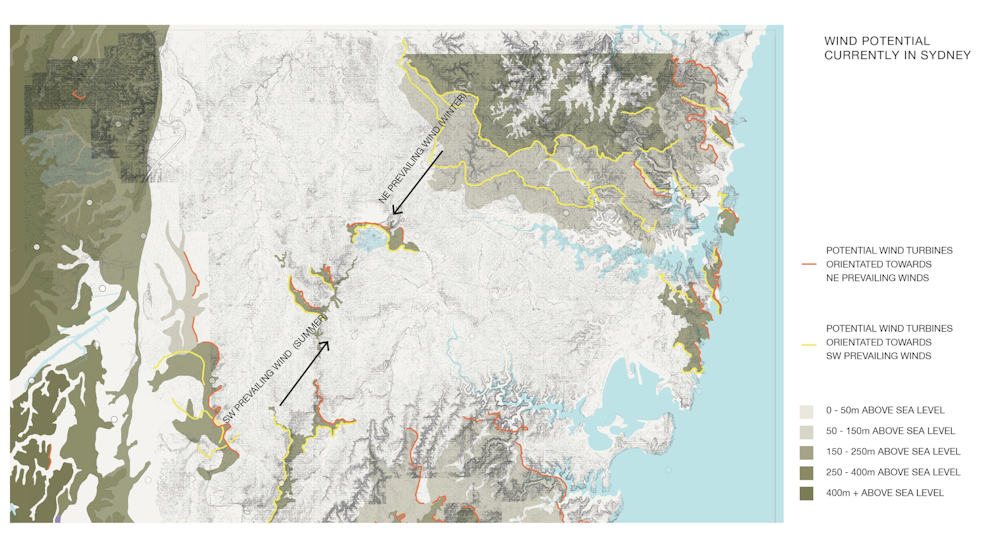 Around 840km of ridge lines (marked in yellow and red) in the Sydney metropolitan area can be used for wind turbines.
Author provided
Around 840km of ridge lines (marked in yellow and red) in the Sydney metropolitan area can be used for wind turbines.
Author provided
Further reading: FactCheck Q&A: is coal still cheaper than renewables as an energy source?
Turning waste into biofuels
We can turn our household waste and green waste from forests, parks and public green spaces into biogas. We can then use the existing gas network to provide heating and cooling for the majority of offices.
Biomass from domestic and green waste will be processed through anaerobic fermentation in old power plants to generate biogas. Gas reserves are created, stored and delivered through the existing power plants and gas grid.
Further reading: Biogas: smells like a solution to our energy and waste problems
Algae has enormous potential for generating bio-energy. Algae can purify wastewater and at the same be harvested and processed to generate biofuels (biodiesel and biokerosene).
Specific locations to grow algae are Botany Bay and Badgerys Creek. It’s noteworthy that both are close to airports, as algae could be important in providing a sustainable fuel resource for planes.
Using algae arrays to treat the waste water of new precincts, roughly a million new households as currently planned in Western Sydney, enables the production of great quantities of biofuel. Experimental test fields show yields can be high. A minimum of 20,000 litres of biodiesel per hectare of algae ponds is possible if organic wastewater is added. This quantity is realisable in Botany Bay and in western Sydney.
 Biomass fermentation of household and green waste and wastewater treatment using algae arrays can generate biogas, biodiesel and biokerosene.
Author provided
Biomass fermentation of household and green waste and wastewater treatment using algae arrays can generate biogas, biodiesel and biokerosene.
Author provided
Further reading: Biofuel breakthroughs bring ‘negative emissions’ a step closer
Extracting heat from beneath the city
Shallow geothermal heat can be tapped through heat pumps and establishing closed loops in the soil. This can occur in large expanses of urban developments within the metropolitan area, which rests predominantly on deposits of Wianamatta shale in the west underlying Parramatta, Liverpool and Penrith.
Where large water surfaces are available, such as in Botany Bay or the Prospect Reservoir, heat can also be harvested from the water body.
The layers of the underlying Hawkesbury sandstone, the bedrock for much of the region, can yield deep geothermal heat. This is done by pumping water into these layers and harvesting the steam as heat, hot water or converted electricity.
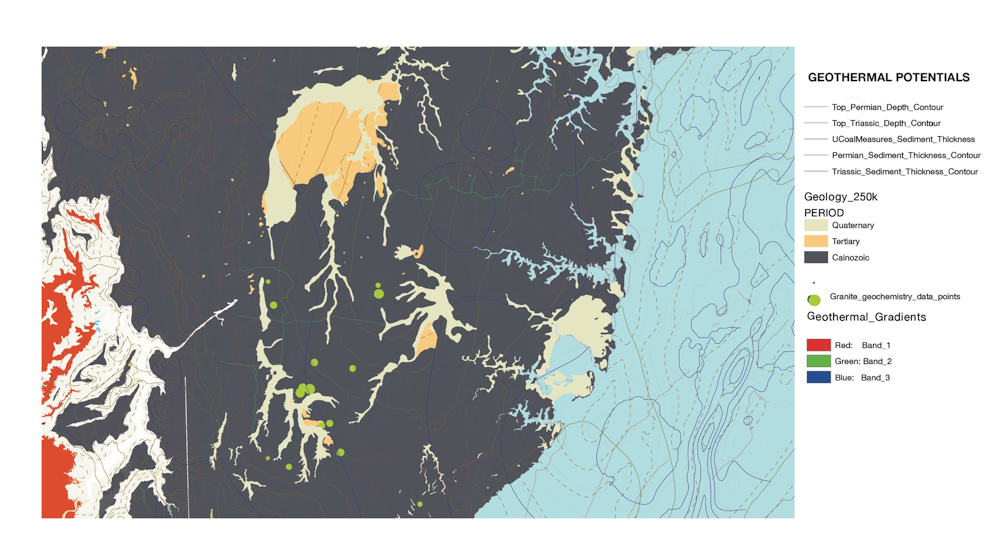 Sydney’s geology offers sources of both shallow and deep theothermal heat.
Author provided
Sydney’s geology offers sources of both shallow and deep theothermal heat.
Author provided
Further reading: Explainer: what is geothermal energy?
Hydropower from multiple sources
The potential sources of energy from hydro generation are diverse. Tidal energy can be harvested at the entrances of Sydney Harbour Bay and Botany Bay, where tidal differences are expected to be highest.
Port Jackson, the Sydney Harbour bay and all of its estuaries have a total area of 55km2. With a tidal difference of two metres, the total maximum energy potential of a tidal plant would be 446TWh. If Sydney could harvest 20% of this, that would be more than twice the yield of solar panels on residential roofs.
If we use the tide to generate electricity, we can also create a surge barrier connecting Middle and South Head. Given the climatic changes occurring and still ahead of us, we need to plan how to protect the city from the threats of future cyclones, storm surges and flooding.
I have written here about the potential benefits of artificially creating a Sydney Barrier Reef. The reef, 30km at most out at sea, would provide Sydney with protection from storms.
At openings along the reef, wave power generators can be placed. Like tidal power, wave power can be calculated: mass displacement times gravity. If around 10km of the Sydney shoreline had wave power vessels, the maximum energy potential would be 3.2TWh.
In the mouths of the estuaries of Sydney Harbour and Botany Bay, freshwater meets saltwater. These places have a large potential to generate “blue energy” through reverse osmosis membrane technology.
To combine protective structures with tidal generating power, an open closure barrier is proposed for the mouth of Sydney Harbour. The large central gates need to be able to accommodate the entrance of large cruise ships and to close in times of a storm surge. At the same time, a tidal plant system operates at the sides of the barrier.
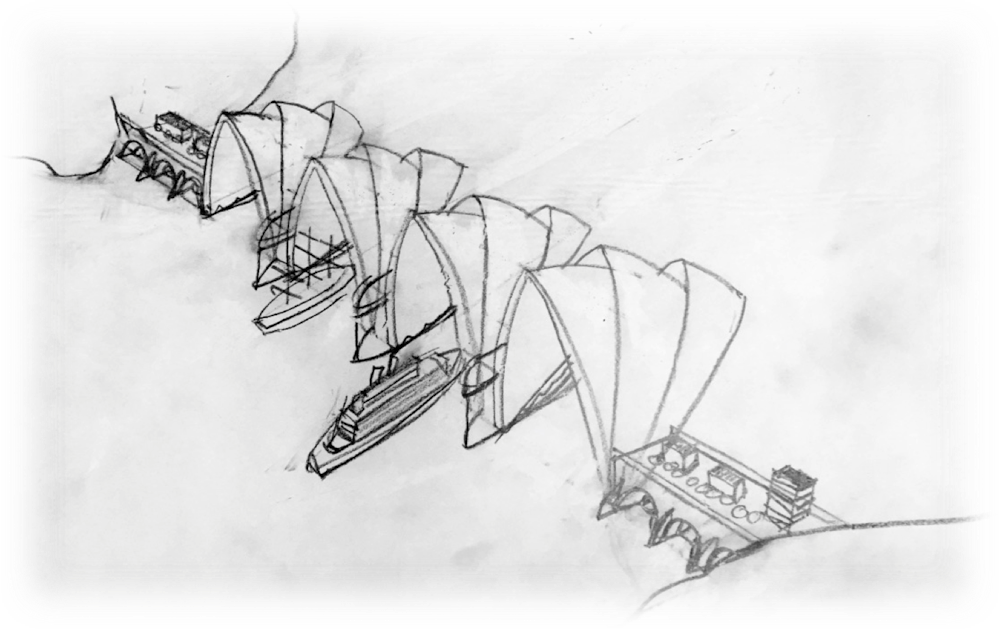 An artist’s impression of the Sydney Harbour surge barrier and tidal plant.
Drawing: Andy van den Dobbelsteen, Author provided
An artist’s impression of the Sydney Harbour surge barrier and tidal plant.
Drawing: Andy van den Dobbelsteen, Author provided
Further reading: Catching the waves: it’s time for Australia to embrace ocean renewable energy
Master plan for a zero-carbon city
All these potential energy sources are integrated into our Master Plan for a Zero-Carbon Sydney. Each has led to design propositions that together can create a zero-carbon city.
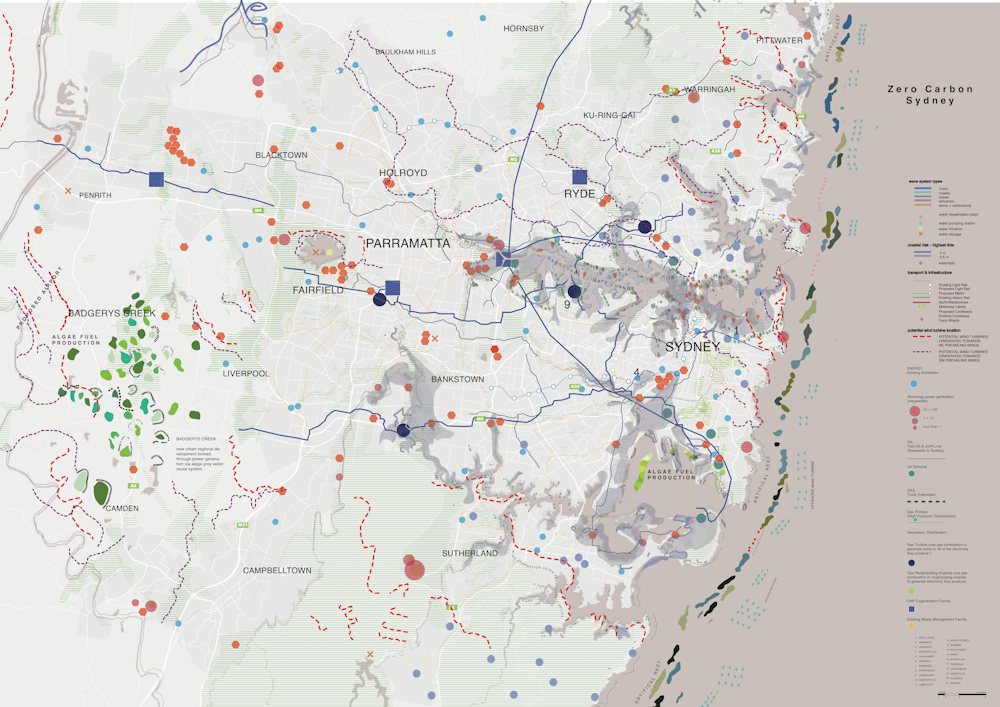 The Zero-Carbon Sydney Master Plan maps out how the city can be fossil-free.
Author provided
The Zero-Carbon Sydney Master Plan maps out how the city can be fossil-free.
Author provided
The research shows there is enough, more than enough, potential reliable renewable energy to supply every household and industry in the region. What is needed is an awareness that Australia could be a global frontrunner in innovative energy policy, instead of a laggard.
Authors: Rob Roggema, Professor of Sustainable Urban Environments, University of Technology Sydney
Read more http://theconversation.com/sydneys-closer-to-being-a-zero-carbon-city-than-you-think-85976


 Daily Bulletin


