

The future of Sydney: a tale of three cities?
- Written by: Rob Roggema, Professor of Sustainable Urban Environments, University of Technology Sydney
Sydney’s future is under constant scrutiny. Planners, politicians, landowners and developers constantly discuss and decide how and where growth should take place – and how that growth should best be managed.
Currently, a spurt of new neighbourhoods are being built toward Sydney’s west. These mushrooming developments have become something of a self-fulfilling prophecy: each new development spurs more growth in its wake.
With a new airport planned for the same area, the Greater Sydney Commission defines this area as a “third city” in its regional strategy.
Sydney’s “first city” is the Harbour City – Sydney’s current CBD and surrounds. The “second city” is the River City, with Parramatta at its heart. The proposed “third city” would be the Western Sydney Parkland City.
The Greater Sydney Commission has put forward an ambitious strategy to transform the Sydney metropolitan area. But is it really the best way to go, compared with international best practice?
Does Sydney need a ‘third city’?
In fact, the necessity of this third city at a larger scale is not proven. It is based on the presumption that Sydney’s growth will continue in the same direction it has taken over the past few decades – and will therefore need a third city to accommodate it.
An alternative strategy is to focus on making Parramatta a successful central hub in the region (before even thinking about a third city), and providing housing for the growing population through densification of low-density areas, close to rapid transport options.
Only then might we be able to create a city that delivers beyond mediocre urbanism. Predicted growth to 8 million people will require a fundamental quality shift if the Sydney metropolitan area is to be a liveable, healthy, economically successful and resilient global city.
As it is, Sydney is facing serious problems with its housing stock and affordability.
While more Sydneysiders are living in more expensive, larger and more energy-intensive housing, the population has become overly reliant on cars as the primary mode of transport to take them to jobs far away from their homes.
The toll for both individuals and society is high. People need to pay for transport, energy and mortgages. And the frequency of social problems such as diabetes, obesity and violence are higher in western Sydney than elsewhere.
Amsterdam
To take Amsterdam as an example, the city’s main transport hub (Schiphol Airport) is located 20km from the (old) city (Central Station). Despite what many people think, Schiphol is not an aerotropolis, as the airport has the same amenities as all other airports in the world: shops, and the occasional hotel.
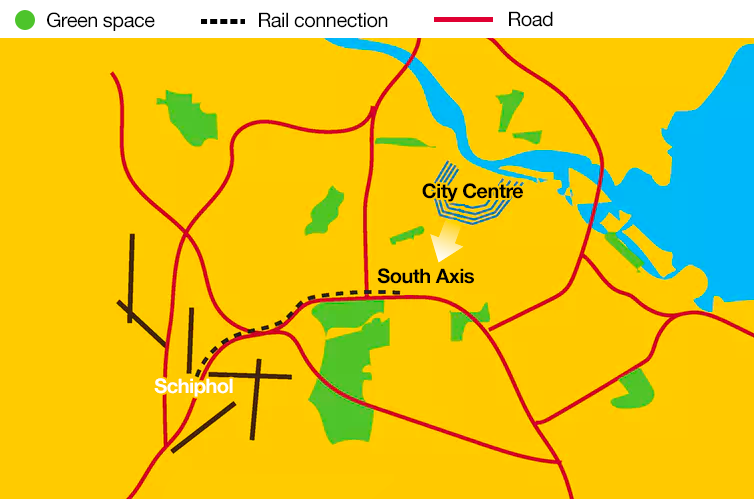 Author provided, CC BY-ND The train station is directly under the airport for easy access. Given these factors, the City of Amsterdam has shifted its traditional (old) centre to the south and created a real aerotropolis environment in the South Axis (Zuid-as). This area has transformed into a vibrant high-density mix of offices and residential properties, with shops, cafes and restaurants around the corner and a large park nearby. The former highway separating south from central Amsterdam will be overloaded, connecting both sides for pedestrians and cyclists. A new metro station is the heart of the development, and will connect through a new metro line into the city. The direct and frequent connection brings you to Schiphol Airport in only six minutes.
  Rijksmuseum building is pictured in this aerial shot of Amsterdam. Reuters London Over the past 50 years, London has slowly decentralised to become a city with more than one centre. The present policy seeks to continue these trends with the development of Olympic Park in Stratford, the construction of Crossrail, and continued restrictions on cars. No new roads have been built in London in the past 20 years, and transport investment has shifted to supporting public transport, walking and cycling.
 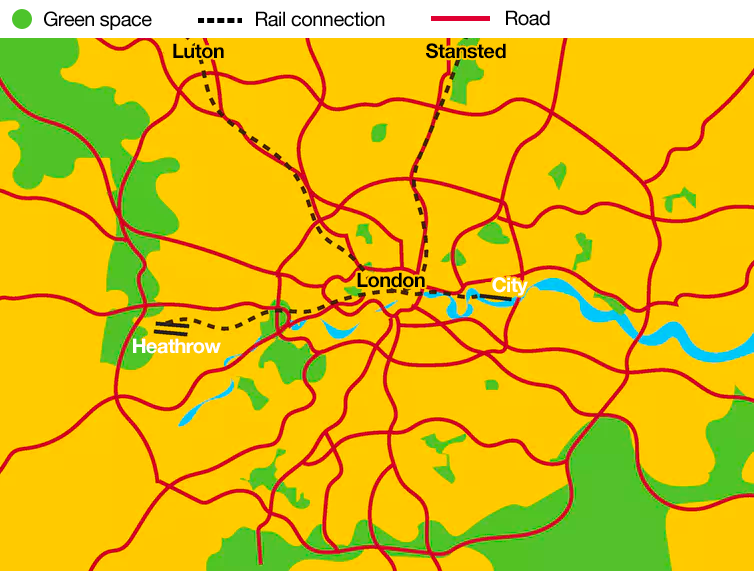 Author provided, CC BY-ND In addition, London has ambitious plans to decarbonise its transport system by 2050. Central London is serviced by airports in different directions with high-speed rail, making travel times of 20 minutes (City Airport) and 45-60 minutes (Heathrow, Stansted) possible.
 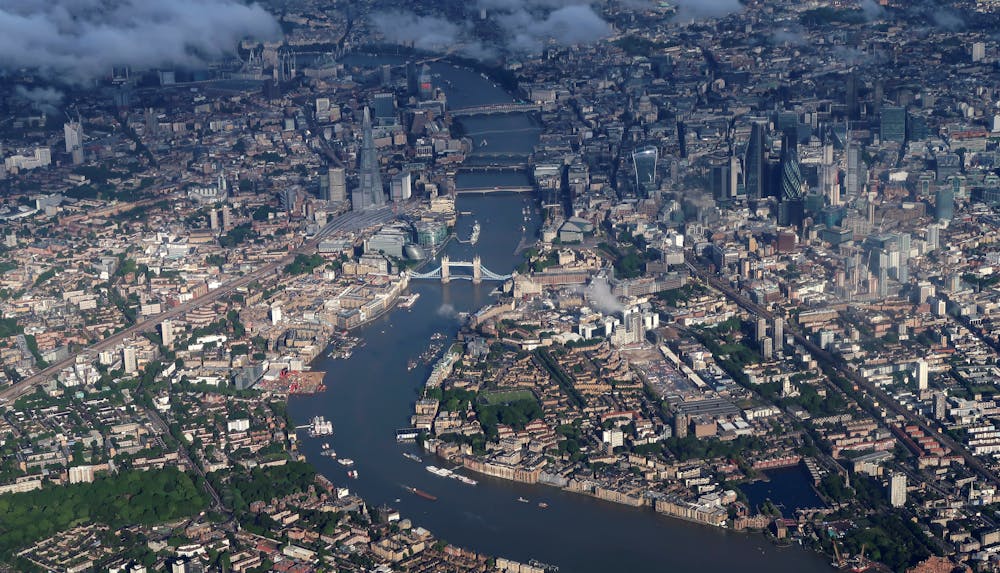 Tower Bridge and central London. Reuters What can Sydney learn from Europe? Learning from Amsterdam and London, several interventions and spatial propositions are needed to make Sydney’s three cities concept a success. The concept of an aerotropolis – a dense city with a mix of uses such as residential, offices, workplaces and retail, around an airport – is a model that has been abandoned for safety and noise reasons a long time ago. It is exactly for these reasons that the city airport in Berlin was closed, and the one in Sao Paulo too lost its international status. In future, some freight operations will be operated by robots and do not require people to live close by. Only functions that are directly related to the airport, such as duty free shopping, transit hotels and airport and aircraft-related operations (quick response, maintenance, air traffic control and the like), require people to live in the vicinity. Therefore, the majority of people will not have to live close to the airport and could be easily served by a high-speed rail connection with Parramatta. Parramatta as a central city To make Parramatta a central city, as per the Greater Sydney Commission’s vision, it has to become the real central transport hub of the entire metropolitan region. Fast rail connections with the old centre (12 minutes) and the new airport (12 minutes), and high-speed connections with Wollongong and Newcastle (less than 30 minutes), could make Parramatta the heart of the region. Keeping the third city area subsequently free of residential development creates a Green Heart, surrounded by Liverpool, Campbelltown, Penrith and Parramatta.
 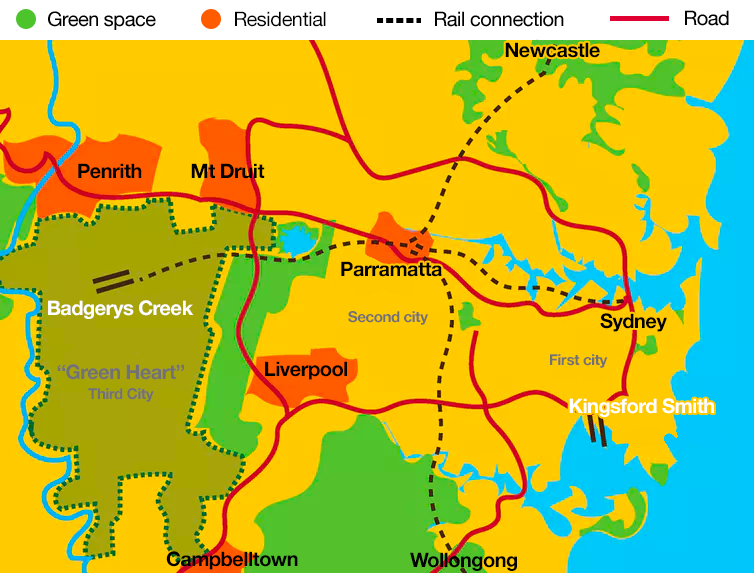 Author provided, CC BY-ND Increasing the density of these places not only backs high-speed rail and vibrancy to the well-designed streets and squares, but also gives people easy access to abundant green space. One step at a time If Sydney is to embark on creating a “third city” in the west, first we need to get the second city right. If Parramatta is to be the central hub, we should focus on making this happen properly. That means getting fast, reliable transport to meet the population density of the second city, with amenities and jobs where they belong – close to where people live. An even better strategic choice to make now would be, instead of sacrificing the open landscape around the new airport, to extend the Western Sydney Parklands all the way up to the Blue Mountains as a Green Heart. That way Sydney will become a more liveable, global city than ever.
 Authors: Rob Roggema, Professor of Sustainable Urban Environments, University of Technology Sydney
Read more http://theconversation.com/the-future-of-sydney-a-tale-of-three-cities-88568


 Daily Bulletin


