

Mum, dad and two kids no longer the norm in the changing Australian family
- Written by: Brendan Churchill, Research Fellow, University of Melbourne
The image of the typical family – mum, dad, and two kids – still permeates how we define and understand the family in contemporary Australia. This ideal saturates our screens and newsfeeds and was at the centre of the marriage equality debate, underscoring the pervasiveness of the nuclear family as the dominant family form in our consciousness.
However, this conceptualisation masks the true nature of Australian families, which has changed significantly in recent decades. As sociologists and demographers have long known, the Australian family is as diverse and different as the country’s terrain.
Drawing on data from the 2016 Census, we know there are more than 6 million families in Australia. This is a significant increase from the 5 million or so families counted at the 2011 Census.
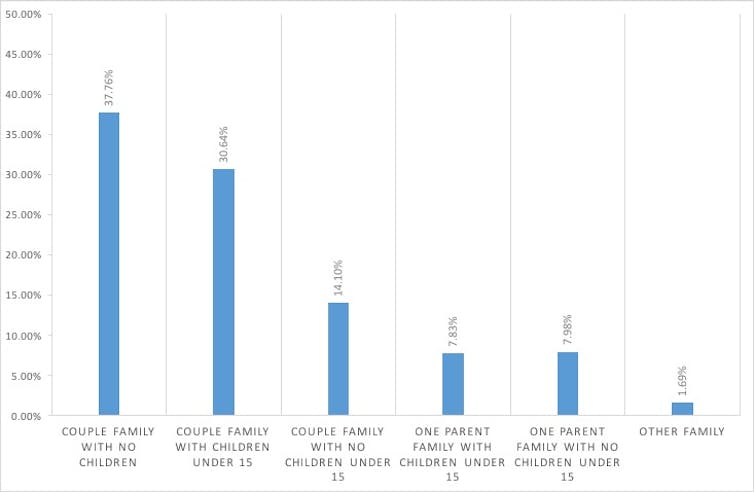 Figure 1 – Family composition.
2016 Census - Counting Families, Place of Enumeration
Figure 1 – Family composition.
2016 Census - Counting Families, Place of Enumeration
Of these 6 million families, the most-common family form (as illustrated in Figure 1) was the couple family with no children (37.76%). The next-most-common was couple families with dependent children under the age of 15 (30.64%).
These proportions confirm that the nuclear family is no longer the most common family form in Australia. One-parent families with dependent children comprise around 8% of all Australian families.
Reflecting this move away from the traditional, nuclear family and the rise of more couple families without children, is the size of families. In 2016, around 30% of all families were two-person families. A further 27% were four-person families.
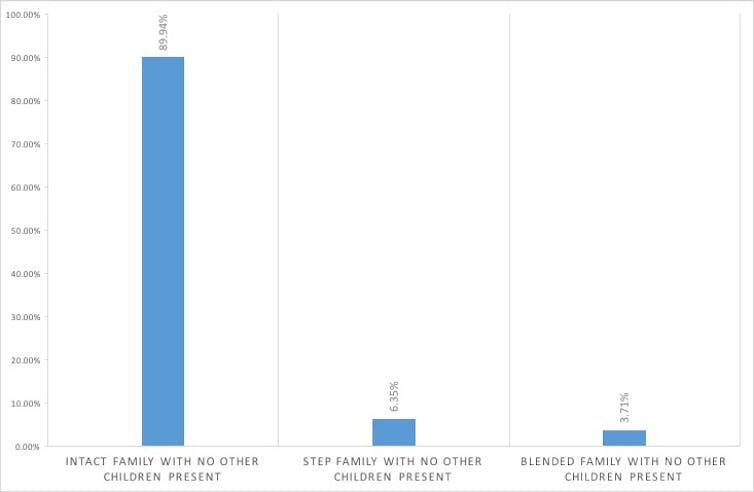 Figure 2 – Family blending.
2016 Census – Counting Families, Place of Enumeration
Figure 2 – Family blending.
2016 Census – Counting Families, Place of Enumeration
Most couple families with children in Australia are so-called “intact families” (89.94%), consisting of at least one one child who is the natural or adopted child of both partners in the couple.
However, families are becoming increasingly more “blended”, as couples dissolve (due to separation, divorce or death of a partner) and new families are formed.
Blended families are a small proportion of modern Australian family forms, accounting for just over 3.7% of all families. This includes families with two or more children, at least one of whom is the natural or adopted child of both partners and at least one other child who is the step-child of one of them.
A further 6.3% of families are step-families. Here, there is at least one resident step-child, but no child who is the natural or adopted child of both partners.
Grandparent-led families are also increasingly significant.
Grandparents already play a significant role in Australian family lives through the provision of informal child care, but there are now just over 60,000 grandparent families in Australia (which a significant increase from estimates in 2004, which found around 22,500 grandparent families). Of those, 53% of grandparent families are couple families with grandchildren and 47% are lone grandparent families.
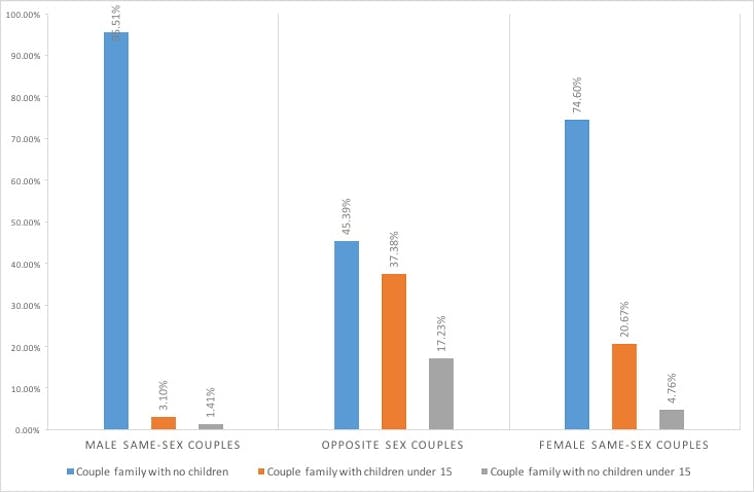 Figure 3 – Family composition by same-sex.
2016 Census – Counting Families, Place of Enumeration
Figure 3 – Family composition by same-sex.
2016 Census – Counting Families, Place of Enumeration
The 2016 Census gathered information on same-sex couples. Compared with opposite-sex couples, these data show that family forms differ across sexual orientation.
Overall, around 15% of same-sex couples had children. Female same-sex couples were more likely to be in couple families with dependent children (20.67%) compared to male same-sex couples (3.10%), or opposite-sex couples (37.8%).
However, same-sex couples were still more likely to be in couple families with no children than were opposite-sex couples, and they were more likely to have smaller families. Of those, around 54% of male same-sex couples with children and 51% of female same-sex couples with children had one-child families. One-third of same-sex couples had two children.
In comparison, 36% of opposite sex-couples had one child, and 42% had two children.
What these data from the 2016 Census show is just some of the diversity within the Australian family. While the idealised nuclear family of the past is no more, this does not mean that the family as a social institution is in decline, or that families in contemporary Australia are at risk.
But it does mean families are changing. Our political leaders should reflect on this diversity to ensure social policies reflect these differences, so that all families are well supported.
Authors: Brendan Churchill, Research Fellow, University of Melbourne


 Daily Bulletin


