

Home biogas: turning food waste into renewable energy
- Written by: Samuel Alexander, Research fellow, Melbourne Sustainable Society Institute, University of Melbourne
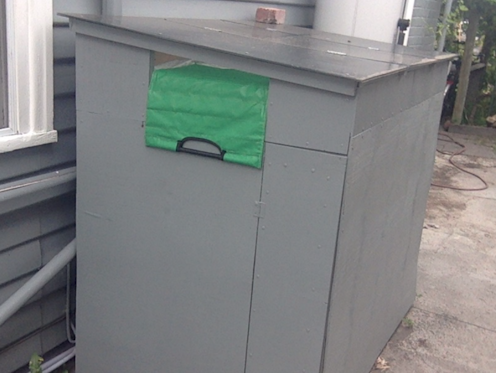
Last night I cooked my family a delicious pasta dinner using biogas energy. This morning we all had eggs cooked on biogas. I’m not sure what’s for dinner tonight, but I know what will provide the energy for cooking: biogas.
And not just any biogas – it’s home biogas, produced in our suburban backyard, as part of my ongoing “action research” into sustainable energy practices.
Read more: Biogas: smells like a solution to our energy and waste problems
In an age of worrying climate change and looming fossil energy decline, the benefits of biogas are obvious. It is a renewable energy source with zero net greenhouse emissions. And yet its potential has largely gone untapped, at least in the developed world.
Based on my research and experience, I contend that home-produced biogas is an extremely promising technology whose time has come. In fact, I believe it could provoke a domestic green energy revolution, if only we let it.
What is biogas?
Biogas is produced when organic matter biodegrades under anaerobic conditions (that is, in the absence of oxygen). This process produces a mixture of gases – primarily methane, some carbon dioxide and tiny portions of other gases such as hydrogen sulfide.
When the biogas is filtered to remove the hydrogen sulfide, the resulting mixture can be burned as an energy source for cooking, lighting, or heating water or space. When compressed it can be used as fuel for vehicles. On a commercial scale biogas can be used to generate electricity or even refined and fed into the gas grid.
The types of organic matter used to produce biogas include food waste, animal manure and agricultural byproducts. Some commercial systems use sewage to produce and capture biogas.
Biogas benefits
The primary benefit of biogas is that it is renewable. Whereas the production of oil and other fossil fuels will eventually peak and decline, we will always be able to make biogas as long as the sun is shining and plants can grow.
Biogas has zero net greenhouse emissions because the CO₂ that is released into the atmosphere when it burns is no more than what was drawn down from the atmosphere when the organic matter was first grown.
As already noted, when organic matter biodegrades under anaerobic conditions, methane is produced. It has been estimated that each year between 590 million and 800 million tones of methane is released into the atmosphere. This is bad news for the climate – pound for pound, methane is a far more potent greenhouse gas than CO₂.
But in a biogas system this methane is captured and ultimately converted to CO₂ when the fuel is burned. Because that CO₂ was going to end up in the atmosphere anyway through natural degradation, biogas has zero net emissions.
There are other benefits too. The organic matter used in biogas digesters is typically a waste product. By using biogas we can reduce the amount of food waste and other organic materials being sent to landfill.
Furthermore, biogas systems produce a nutrient-rich sludge that can be watered down into a fertiliser for gardens or farms. All of this can help to develop increased energy independence, build resilience and save money.
My biogas experiment
In the spirit of scientific research, I installed one of the few home biogas systems currently available, at a cost of just over A$1,000 delivered, and have been impressed by its ease and functionality. (Please note that I have no affiliation, commercial or otherwise, with the manufacturer.)
In practical terms, I put in about 2kg of food waste each day and so far I have had enough gas to cook with, sometimes twice a day. If I ever needed more gas, I could put in more organic matter. I will continue to monitor the system as part of my research and will publish updates in due course. If interested, watch this space.
My personal motivation to explore biogas (related to my research) arises primarily from a desire to decarbonise my household’s energy use. So far, so good. We have disconnected from the conventional gas grid and now have more money to spend on projects such as expanding our solar array.
Given the alarming levels of food waste in Australia, I also like the idea of turning this waste into green energy. My neighbours kindly donate their organic matter to supplement our own inputs, increasing community engagement. When necessary I cycle to my local vegetable market and enthusiastically jump into their large food waste bin to take what I need, with permission.
They think I’m mad. But, then, I think using fossil fuels is mad.
Hurdles and hopes
Home biogas is widely produced in developing regions of the world. The World Bank and the United Nations actively encourage its use as a cheap, clean energy source. China has 27 million biogas plants.
But developed regions, including Australia, have been slow to exploit this vast potential. Given that Australia is one of the most carbon-intensive countries on Earth, this is unfortunate.
The failure to embrace home biogas is partly due to a lack of clear regulations about its use. Where is the Home Biogas Act? Almost every Australian backyard has an independent gas bottle to power the ubiquitous barbecue, so clearly storing gas in the backyard is not a problem. My biogas system came with robust safety certificates, warranties and insurance, and these systems do not feature high-pressure gas pipes.
Read more: Capturing the true wealth of Australia’s waste
Home biogas production is unusual. But I believe that state governments should draw up legislation to accommodate it, and that local councils should offer advice and assistance to householders who are interested in taking it up. Hoping for progress in this regard, I recently made a submission to the Victorian government as part of its Waste to Energy consultations.
My own carefully managed experiment demonstrates how home biogas can be used safely and successfully. Nevertheless, biogas is a combustible fuel and needs to be filtered for poisonous hydrogen sulfide. Like any fuel, it should be respected and used responsibly. But biogas need not be feared. Fossil gas is far more dangerous anyway.
Authors: Samuel Alexander, Research fellow, Melbourne Sustainable Society Institute, University of Melbourne
Read more http://theconversation.com/home-biogas-turning-food-waste-into-renewable-energy-89920


 Daily Bulletin


