

Three key steps are linked with success in the Australian Open
- Written by: Stephanie Kovalchik, Research Fellow, Institute of Sport, Exercise and Active Living, Victoria University
Australia’s chances of having a player in the men’s singles final of the 2018 Australian Open were dashed when Nick Kyrgios lost to Grigor Dimitrov in their fourth round clash on Sunday.
In this year’s Open, Kyrgios is one of 26 so-called “NextGen” players: those aged 23 years or younger who have not yet won a Grand Slam title.
Six of the 128 competitors on the men’s side of the draw have won a Grand Slam in the past, including defending champion Roger Federer, 2017 finalist Rafael Nadal, and six-time Australian Open champion Novak Djokovic.
Read more: All the racquet: what science tells us about the pros and cons of grunting in tennis
So while almost all of the healthy top 100 ranked male players in the world are in the Melbourne championship, the playing field is by no means level. But it’s still possible for the NextGen players to get ahead, if you look at the numbers.
To be a contender
Tennis Australia’s Game Insight Group (GIG), in partnership with Victoria University, has taken a mathematical approach to determining which players are best placed to crash the seemingly closed party of Grand Slam title winners.
To do this, we took previous male Grand Slam winners from 1990 to the present, and coded where they finished at each Glam Slam tournament, up until their first Grand Slam win. We then applied machine learning models to find the strongest predictors of a first Grand Slam win.
There were 19 male players and 330 Grand Slam appearances across this select list of players. So how does a player break through?
Step 1: Work your way up the ranks
Elo ratings were first developed by Arpad Elo, a Hungarian-born American physics professor, to calculate the relative skill levels of chess players. The same mathematical principles have now been applied to tennis (and several other sports such as baseball).
It has been shown that an Elo rating is a more accurate reflection of a player’s relative standing in the game than their official tour ranking. Among other things, it weights a player’s performance against the skill level of the opponent. For example, a highly rated player gets fewer points for defeating a low-ranked player.
When it comes to predicting who is next likely to win a Grand Slam, GIG’s modelling has determined that players need an Elo rating of more than 2,000 (see the graphic, later). While this is a useful first step, on it’s own is not overly insightful.
Step 2: Start winning Gram Slam matches
For those players with more than 2,000 Elo rating points, the next step in the equation is to win 25 or more Grand Slam matches. When we apply this criterion, we begin to sharpen our understanding of the path that most Slam winners have walked.
Step 3: Develop a winning track record early
While winning Grand Slam matches is a somewhat obvious step, there is important context that needs to be considered. Developing a winning track record early in one’s Grand Slam career is also crucial.
In fact, those who have been most successful tend to win their 25 Grand Slam matches or more in a reasonably short time period. Mathematically, it seems you need to win your matches within your first 200 matches won.
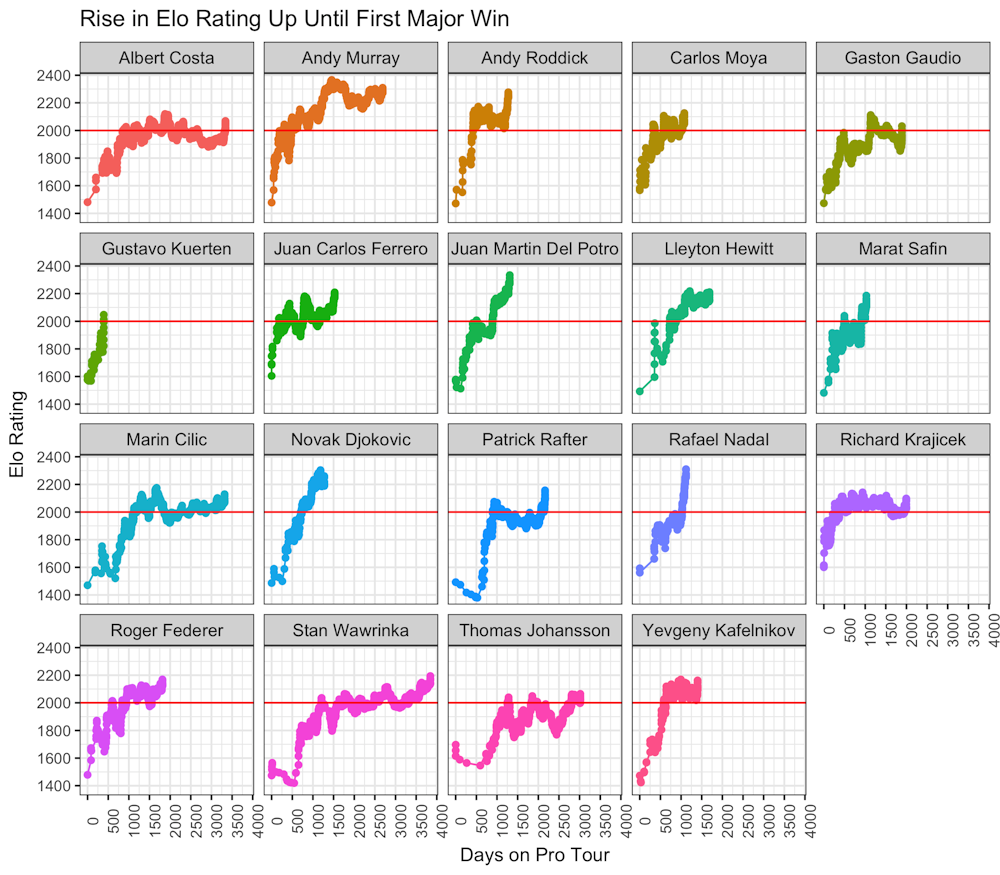 Elo rating progression of the 19 male players included the analysis who had won a Gram Slam event from the 1990s.
Stephanie Kovalchik, Author provided
Elo rating progression of the 19 male players included the analysis who had won a Gram Slam event from the 1990s.
Stephanie Kovalchik, Author provided
The figure (above) highlights the importance of starting to win Grand Slam matches relatively early and often in your first 200 professional matches won.
This is reinforced where, for example, Pat Rafter won his first Grand Slam title six years after first turning pro, which was preceded by a solid period of progressively winning his way deeper and deeper into the majors. In the year of his first US Open title he made the semi-finals at the French Open.
While not the only way to win a Slam, the maths suggests a relatively clear path to success. A path defined by a strong Elo rating created by the effect of winning at least 25 Grand Slam matches in their first 200 professional wins.
When these criteria are considered, 13 of the 19 Grand Slam winners sampled in the GIG model followed this path. This suggests it is a tried and tested pathway to success.
A chance at the Open
Which of the “slamless” competitors this year are best positioned to do the same?
Considering some of the top NextGen prospects for the title at the start of the event, three players who are yet to win a Grand Slam title all meet the pathway criteria: David Goffin, Dominic Thiem and Nick Kyrgios (see the table below).
Win prediction percentage represents each player’s chance of winning the tournament. This is based on a variety of factors including their Elo rating, location within the draw, and preferred court surface. Out of interest, Roger Federer’s win prediction percentage at the start of the event was 38.9%.
Read more: The terrible toll tennis can take on top players who play too much
But now, at the end of round 4, most players have already had to pack their bags and head home. At time of writing, two of the players on our list remain in contention.
So with Dominic Thiem playing late Monday afternoon and Dimitrov knocking out Kyrgios last night, the contenders are dwindling by the day. As it stands, Federer’s chances have continued to improve, with a current win prediction of 58.2%.
If the Australian Open 2018 is any guide, Dimitrov is certainly the NextGen’s heir apparent, and the most likely to crash the exclusive Grand Slam winners’ club.
Authors: Stephanie Kovalchik, Research Fellow, Institute of Sport, Exercise and Active Living, Victoria University
Read more http://theconversation.com/three-key-steps-are-linked-with-success-in-the-australian-open-90226


 Daily Bulletin


