

Smart speakers could be the tipping point for home automation
- Written by: Michael Cowling, Senior Lecturer in Educational Technology, CQUniversity Australia
One of the biggest trends of the Consumer Electronics Show (CES) in Las Vegas this year was companies taking digital smart assistants – think Apple’s Siri, Google’s Assistant and Amazon’s Alexa – and incorporating them into more and more consumer devices.
From smart light bulbs to smart toilets, it’s clear that the market sees great promise in devices you can speak to, combined with home devices you can control.
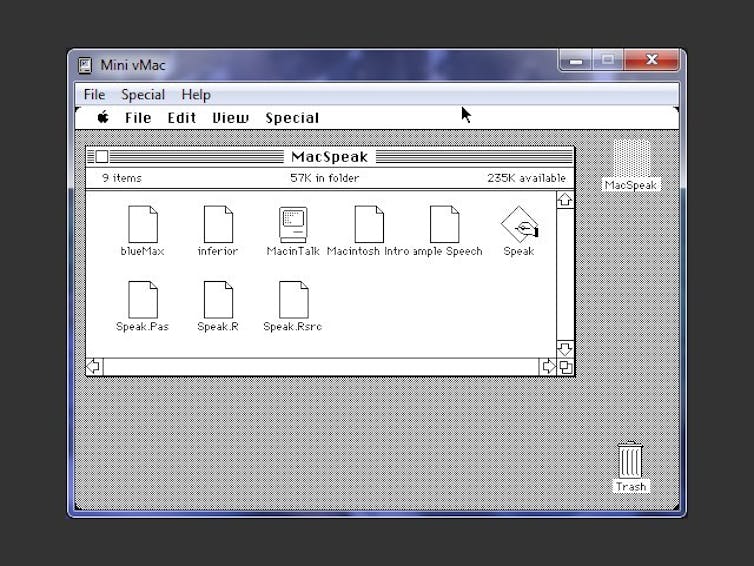 MacSpeak, an early Computer Speech Recognition system.
Via Macintosh Repository
MacSpeak, an early Computer Speech Recognition system.
Via Macintosh Repository
‘Siri, define computer for me’
We’ve always been fascinated with the ability to speak to a computer.
Fifty years ago when Star Trek debuted, Gene Roddenberry envisioned an interface where you could simply speak into the air and ask the “Computer” to do something and it would respond intelligently.
Once computers shrank to fit on your desk in the 1980’s, this vision was quickly realised through software such as ViaVoice, Dragon Naturally Speaking, or MacSpeak. But due to the technology of the time, it was limited to the tasks you could complete on your computer – and to the room your computer was in.
They even made a joke about it in Star Trek IV in 1996:
Star Trek IV - Computer?Read more: The smart home could worsen domestic abuse. But the same technology may also make us safer
This really started to change with the advent of smart phones.
When Siri was introduced in 2011, many smart phones evolved to have their own digital assistant. And because you carried your smart phone with you everywhere, the voice digital assistant finally escaped a single room. It was usable in any room of the house, and for more eclectic queries than ever before.
‘Alexa, play some rock music please’
But something was still missing from the equation. Despite the proliferation of digital assistants in devices like the Apple/Google watch, the Apple/Android TV and your personal headphones, it was still not quite Star Trek. When Captain Kirk wanted to speak to the computer, he didn’t hold a device to his ear or speak into his watch, he simply made a request into the ether and was greeted by a computerised response.
And in 2015, Amazon finally made that a reality with the Amazon Echo and the digital assistant Alexa. Through the skills interface, Alexa could do much more than previous assistants, and understood you better.
This change served to democratise the use of technology. All of a sudden, users didn’t need to worry about the interface. If you could use the right words to speak to Alexa then she could get the job done for you.
Adding things to your shopping list, or setting some kitchen timers didn’t require any knowledge of the machine and how it worked – as long as you could say “Alexa, set a 10 minute timer for the pasta”, you could use these devices.
Read more: If Google Assistant or Siri aren't smart enough for you, you can build your own AI
Amazon has doubled down on this in recent iterations, with the launch of the Echo Show which includes a screen and a “drop in” call functionality for checking on elderly relatives.
‘OK Google, turn on the porch lights and open the garage door’
Which brings us back to CES and the proliferation of smart assistants. Once you’ve achieved the ability to speak to a digital assistant from any room in the house, what’s the obvious next step?
Make the house able to listen.
There are legitimate security concerns associated with connecting devices in your house to the internet. However, since the debut of Alexa, other tech companies have got on the bandwagon.
Google launched the Google Home in 2016; Apple announced it will launch its HomePod device on February 9 (after being delayed from a December launch); and at CES even Samsung showed off new ways its Bixby digital assistant could appear in the home.
And together with the rise of digital assistants (all your devices truly are listening), home automation has also seen a resurgence.
Read more: 'Smart home' gadgets promise to cut power bills but many lie idle – or can even boost energy use
Long considered a hobbyist pursuit, only for geeks and nerds, it would appear that the arrival of smart speakers has provided the tipping point that home automation needed to truly enter the mainstream.
Rather than expecting users to use an esoteric interface on their phone to control these devices, smart speakers allow for a truly seamless experience, allowing users to control their home using natural voice commands.
Whether it’s turning on the bedroom lights, playing your favourite play list on the living room television, or just checking to make sure the front door is locked, the combination of home automation and smart speakers is providing a push forward for both technologies, as we truly move to a smart home powered by a smart digital assistant.
Google Home allows you to control lights, locks and the temperature in your house.But most importantly, it’s good to know that if “Professor” Scotty from Star Trek were to come back 30 years later, he’d be much more impressed with our ability to speak to our devices – even if he would have to get used to saying “Ok Google” rather than “Computer”.
Authors: Michael Cowling, Senior Lecturer in Educational Technology, CQUniversity Australia
Read more http://theconversation.com/smart-speakers-could-be-the-tipping-point-for-home-automation-90308


 Daily Bulletin


