

US approach to security is deeply troubling – and it's not just about Trump
- Written by: Joseph Camilleri, Emeritus Professor of International Relations, La Trobe University
Media coverage of Donald Trump’s presidency has fixated on his outlandish, off-the-cuff tweets, his ill-conceived and inflammatory positions on immigration, race relations and climate change, his “America First” mantra, and his unrelenting attacks on the various inquiries into collusion with Russia.
The image created has been of a man who, though ignorant, vulgar and deeply polarising, struts the political stage. But is Trump really setting the direction of US security policy?
Mounting evidence suggests the theatre around Trump is so mesmerising that we have lost sight of how the US security establishment wields power – and to what end.
The picture is becoming clear
The security establishment is no monolith, nor does it function as a conspiratorial cabal. Personalities and institutional interests compete for attention and resources.
Yet it has a reasonably coherent mindset, which has its origins in the early days of the Cold War. It is a sense of belonging to a club that connects first and foremost the Department of Defence, various arms of the intelligence community and law enforcement agencies, but also significant voices in other key government departments, areas of the judiciary and Congress, and some of America’s most influential think-tanks and corporations – in particular the leading arms manufacturers.
How this security establishment is handling the Trump phenomenon is an intriguing story, highly complex, and still unfolding. However, several pieces of the jigsaw are beginning to fall into place. Three merit special attention:
Taken together these form a picture of a political and military elite intent on maintaining control of US security policy. They feel the need to immunise it from Trump’s erratic behaviour and his supposedly pro-Russian inclinations, and revive a Cold War mindset that views Russia and China as major adversaries.
The battle for influence
Though Trump and the security establishment may be suspicious of one another, there is also common ground. They disagree not about placing “America first”, but about how this should be done.
The security establishment prefers a carefully devised, longer-term strategy and a less confrontational approach toward friends and allies. It sees value in continuing to extol the virtues of free trade and democracy, though it does not necessarily practise what it preaches.
And it is generally suspicious of personal deal-making – especially where this involves Russia – to which Trump is drawn by instinct, and commercial interest and experience.
The security establishment has therefore made it a priority to gain influence within the administration. It took no more than six months for reliable establishment figures to be firmly in the saddle: Jim Mattis as defence secretary, John Kelly as White House chief-of-staff and H.R. McMaster as national security adviser.
Key Trump campaign advisers thought to have cultivated links with Russia or be otherwise unreliable – including Michael Flynn (whom Trump initially appointed as national security adviser), George Papadopoulos, Paul Manafort, Rick Gates, Stephen Bannon and even Trump’s daughter Ivanka and son-in-law Jared Kushner – have been gently or not-so-gently eased out of their previously influential roles.
Trump himself is seen at best as an unknown quantity, and at worst prone to dangerous illusions about the prospects of cultivating a fruitful personal relationship with Russian President Vladimir Putin.
Behind the lurid accusations of Russian meddling in the US presidential election and alleged collusion between the Trump campaign and the Kremlin, and more recently behind the claims and counterclaims of obstruction of justice by the Trump administration, we can now discern a far more significant jostling for control of US policy.
The ‘new’ Russian threat
The Russia investigations being conducted by congressional committees and by special counsel Robert Mueller are clearly designed to put Trump on the defensive. Congressional Democrats are doing all they can to prolong these inquiries – in some cases with the support of senior Republican senators close to the intelligence community.
Hundreds of witnesses have already given evidence to these inquiries. Many more are expected to appear. And in public comments and her recently published memoir, Hillary Clinton, well known for her antipathy to Putin and his reassertion of Russian influence, has been at pains to identify Russia’s meddling in the election as a key factor in her defeat.
Yet the hard evidence so far produced to support the charges of Russian interference has been scant to say the least.
Putin and his underlings are no angels. But as journalist Aaron Mate has argued:
In Russiagate, unverified claims are reported with little to no scepticism … developments are cherry-picked and overhyped, while countervailing ones are minimised or ignored. Front-page headlines advertise explosive and incriminating developments, only to often be undermined by the article’s content, or retracted entirely.
Whatever the outcome of these various inquiries, one thing is clear. The security establishment has concluded that a resurgent Russia needs to be contained and that any advocacy of dialogue with it must be nipped in the bud.
Allegations of Russian interference in the politics of the US and other Western countries are part of a larger strategy that aims to magnify the threat Russia poses and to thwart any intention on Trump’s part to reset the relationship.
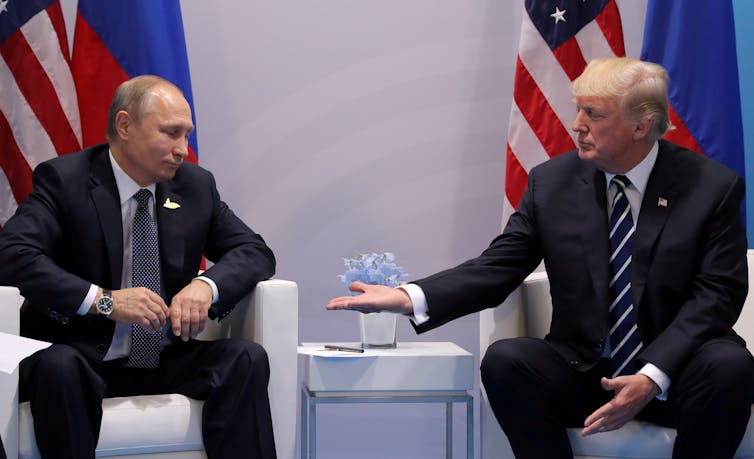 Donald Trump has been keen to offer a hand of friendship to Vladimir Putin’s Russia.
Reuters/Carlos Barria
Donald Trump has been keen to offer a hand of friendship to Vladimir Putin’s Russia.
Reuters/Carlos Barria
Back to the Cold War
The national defence strategy Mattis recently unveiled delivers a stark message. Countering China’s rise and Russia’s resurgence are now at the heart of US policy. The Cold War outlook is back with a vengeance.
To this end, the US military will confront its adversaries across the spectrum of conflicts – mainly in Europe and the Indo-Pacific region, but without neglecting the Middle East.
American armed forces will modernise and build its readiness for future conflicts and consolidate military ties with allies and partners around the world. But conspicuously absent is any notion of neo-isolationism or renewed dialogue with Russia – both of which featured prominently during Trump’s presidential campaign.
The national defence strategy should, in any case, be read in conjunction with the national security strategy released in December 2017 and the more recent nuclear posture review released last week.
The shift in US strategic priorities, which is well under way, will affect all aspects of defence budgeting, weapons development and force management. Training is already focused on high-intensity conflict with major adversaries. Heavily armed deployments are stationed continuously in Europe and across East and Central Asia.
The plan is to modernise all three arms of the US nuclear arsenal – land-based intercontinental ballistic missiles, strategic bombers and submarine-launched ballistic missiles – and design low-yield nuclear weapons that make them more readily usable. In other words, the US is boosting its capacity to escalate non-nuclear conflicts into nuclear war, thereby lowering the nuclear threshold.
Trump’s rhetoric of “fire and fury” is at first sight in accord with these developments. Whether he fully understands them is another matter.
We may not much like what Trump says or wants to do. But even more troubling is the US security establishment’s vision of the future. For US allies, not least Australia, it spells danger and much heartache.
Authors: Joseph Camilleri, Emeritus Professor of International Relations, La Trobe University


 Daily Bulletin


