

Now you see us: how casting an eerie glow on fish can help count and conserve them
- Written by: Maarten De Brauwer, PhD-candidate in Marine Ecology, Curtin University
News stories about fish often focus either on large fish like sharks, or on tasty seafood. So it might come as a surprise that more than half of the fish on coral reefs are tiny and well camouflaged.
This naturally makes them hard to find, and as a result we know very little about these so-called “cryptic” species.
Now my colleagues and I have developed a new method to make it easier to study these fish. As we report in the journal Conservation Biology, many of these species are “biofluorescent” – if you shine blue light on them they will reflect it back in a different colour. This makes them a whole lot easier to spot.
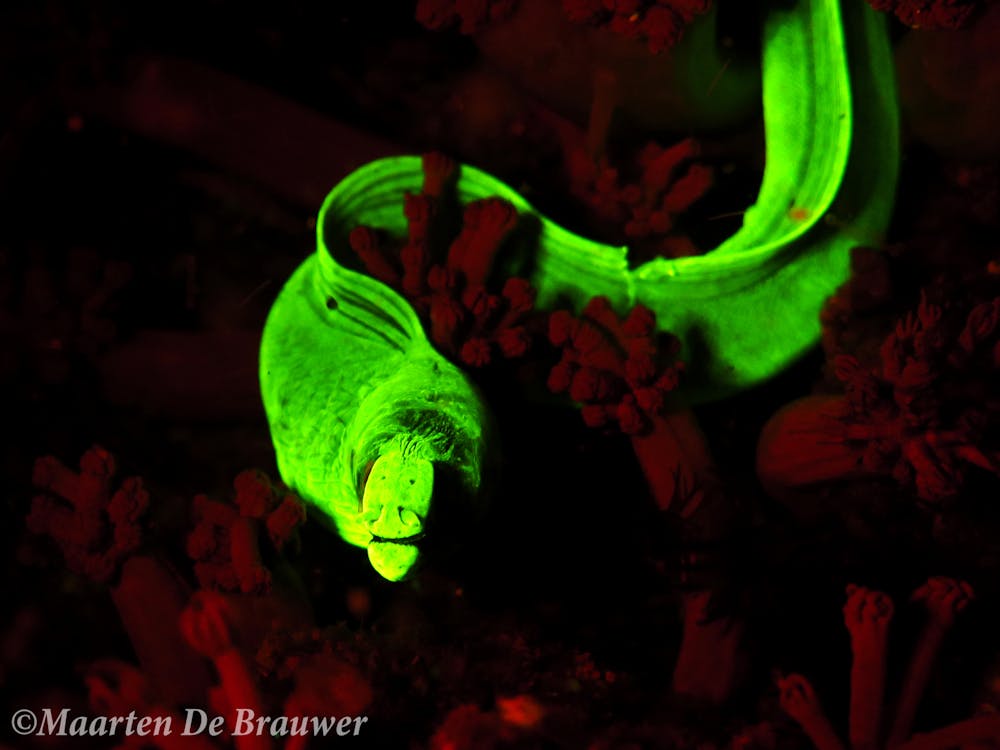 Cryptic fish such as the Moray species are easily detectible using this new method.
Maarten De Brauwer, Author provided
Cryptic fish such as the Moray species are easily detectible using this new method.
Maarten De Brauwer, Author provided
Read more: Dazzling or deceptive? The markings of coral reef fish
Marine biologists try to collect essential information about species so as to help protect them. One of the most important pieces of information is estimating how many of these cryptic species are out there.
Now you ‘sea’ them.These cryptic fishes are more important for us than people realise. They are highly diverse and hugely important to coral reef health. They are also food for the fish we like to eat, and provide incomes for thousands of people through scuba diving tourism.
These small fishes live fast and die young, reproducing quickly and being eaten by bigger fish almost as quickly. We do know that some species are dwindling in number. The Knsyna seahorse in South Africa is in danger of extinction, while many cryptic goby species in the Caribbean were being eaten by invasive lionfish before they had even been described, let alone counted.
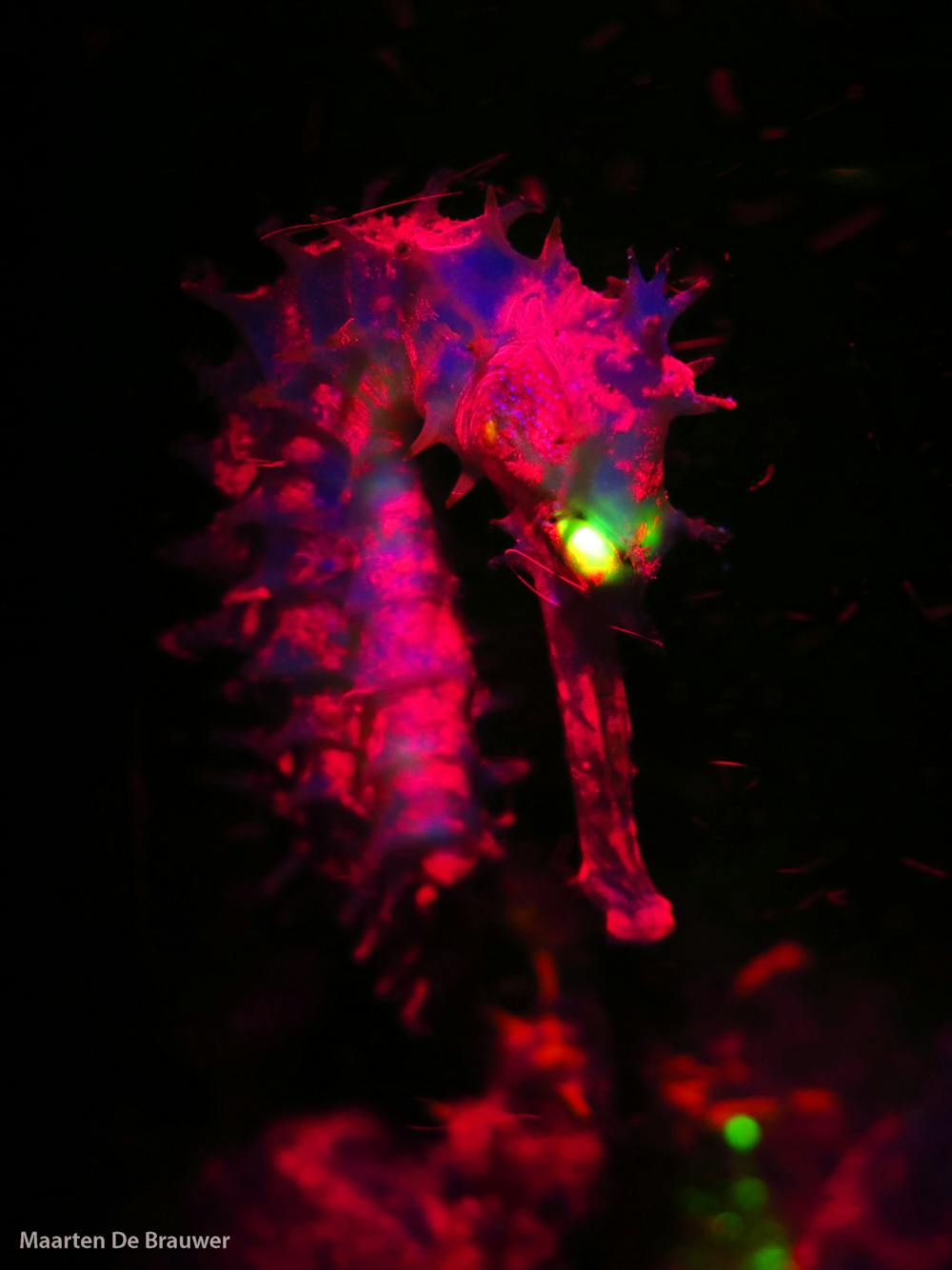 Some cryptic species, such as this thorny seahorse (Hippocampus histrix) are more popular than other species in aquaria, for divers and as the subjects in movies.
Maarten De Brauwer, Author provided
Some cryptic species, such as this thorny seahorse (Hippocampus histrix) are more popular than other species in aquaria, for divers and as the subjects in movies.
Maarten De Brauwer, Author provided
Because cryptic fishes are so easy to miss, their total abundance is likely to be underestimated. When attempting to survey their populations, scientists generally had to resort to using chemicals to stun or kill the fish, after which they are collected and counted. This method is efficient, but it is not ideal to kill members of species that might be endangered.
Developing an efficient, non-destructive way to survey fish would benefit researchers and conservationists, and this is where biofluorescence comes in.
Biofluorescence or bioluminescence?
Biofluorescence is very different to bioluminescence, the chemical process by which animals such as deep-sea fish or fireflies produce their own light. In contrast, biofluorescent animals absorb light and reflect it as a different colour, so this process needs an external source of light.
Biofluorescence is most easily observed in corals, where it has been used to find small juveniles. In the ocean, biofluorescence can be observed by using a strong blue light source, combined with a diving mask fitted with a yellow filter.
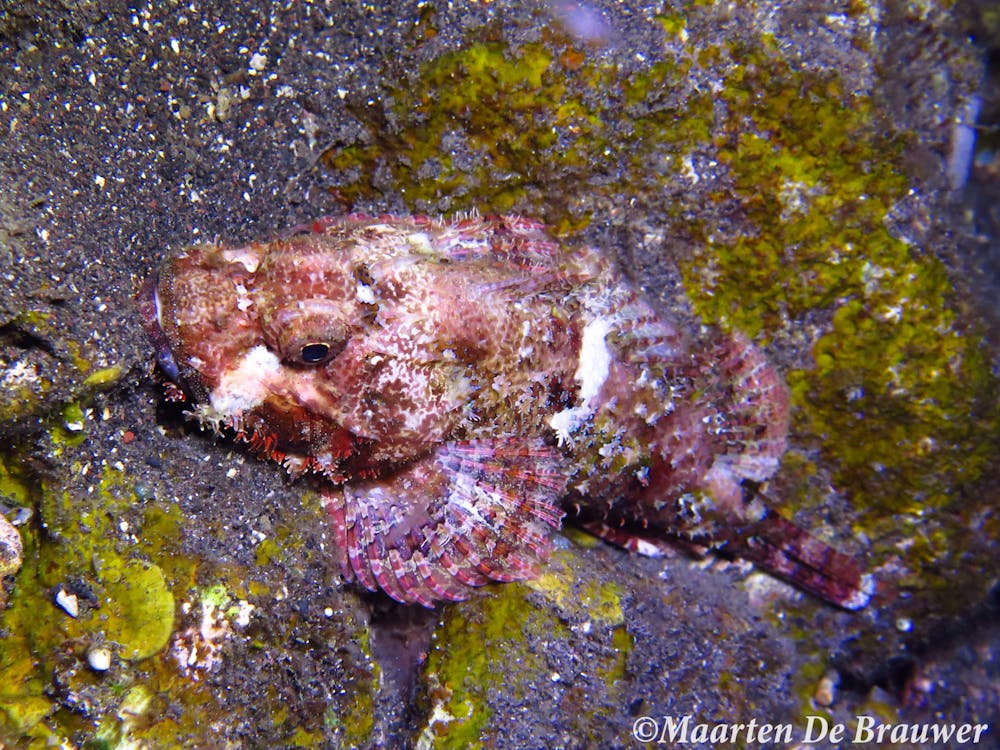 Before… a scorpionfish captured without showing its biofluorescence, camouflaged against the rocks.
Maarten De Brauwer, Author provided
Before… a scorpionfish captured without showing its biofluorescence, camouflaged against the rocks.
Maarten De Brauwer, Author provided
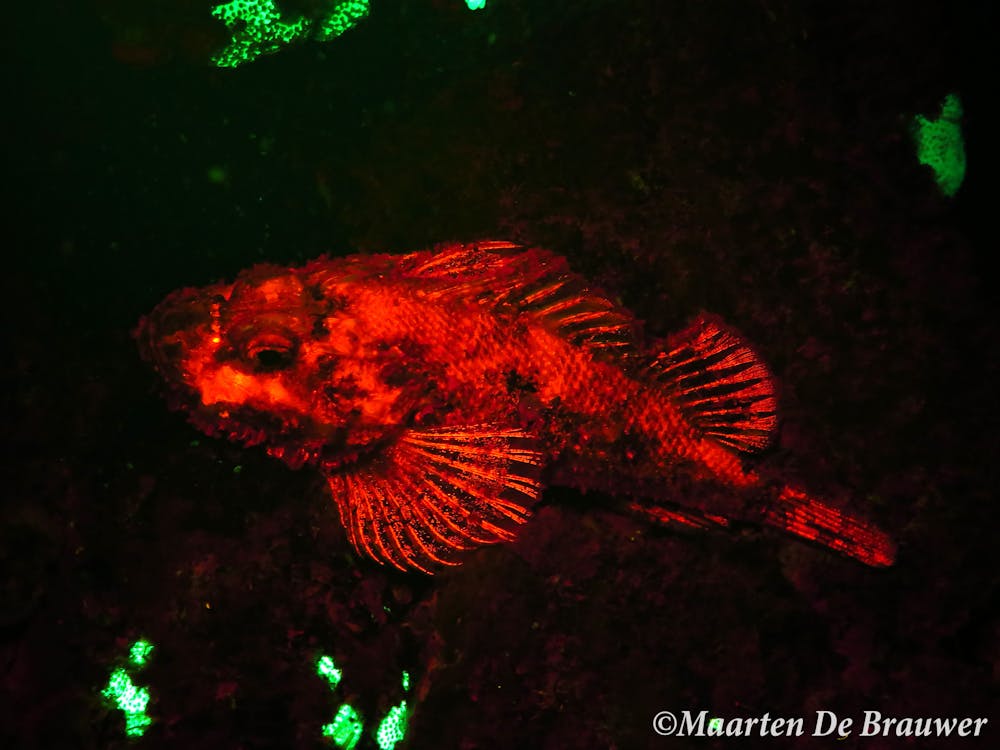 And after… the same scorpionfish in an image that captures its biofluorescence.
Maarten De Brauwer, Author provided
And after… the same scorpionfish in an image that captures its biofluorescence.
Maarten De Brauwer, Author provided
Recent research showed that biofluorescence is more common among fish than we previously realised. This prompted us to investigate whether biofluorescence can be used to detect cryptic fishes.
On the glow
We tested 230 fish species through the Coral Triangle to Australia’s north, and found that biofluorescence is indeed widespread in cryptic fish species.
It is so common, in fact, that the probability of a fish being biofluorescent is 70.9 times greater for cryptic species than for highly visible species.
But can this actually be used to improve our detection of cryptic fish species? The answer is yes.
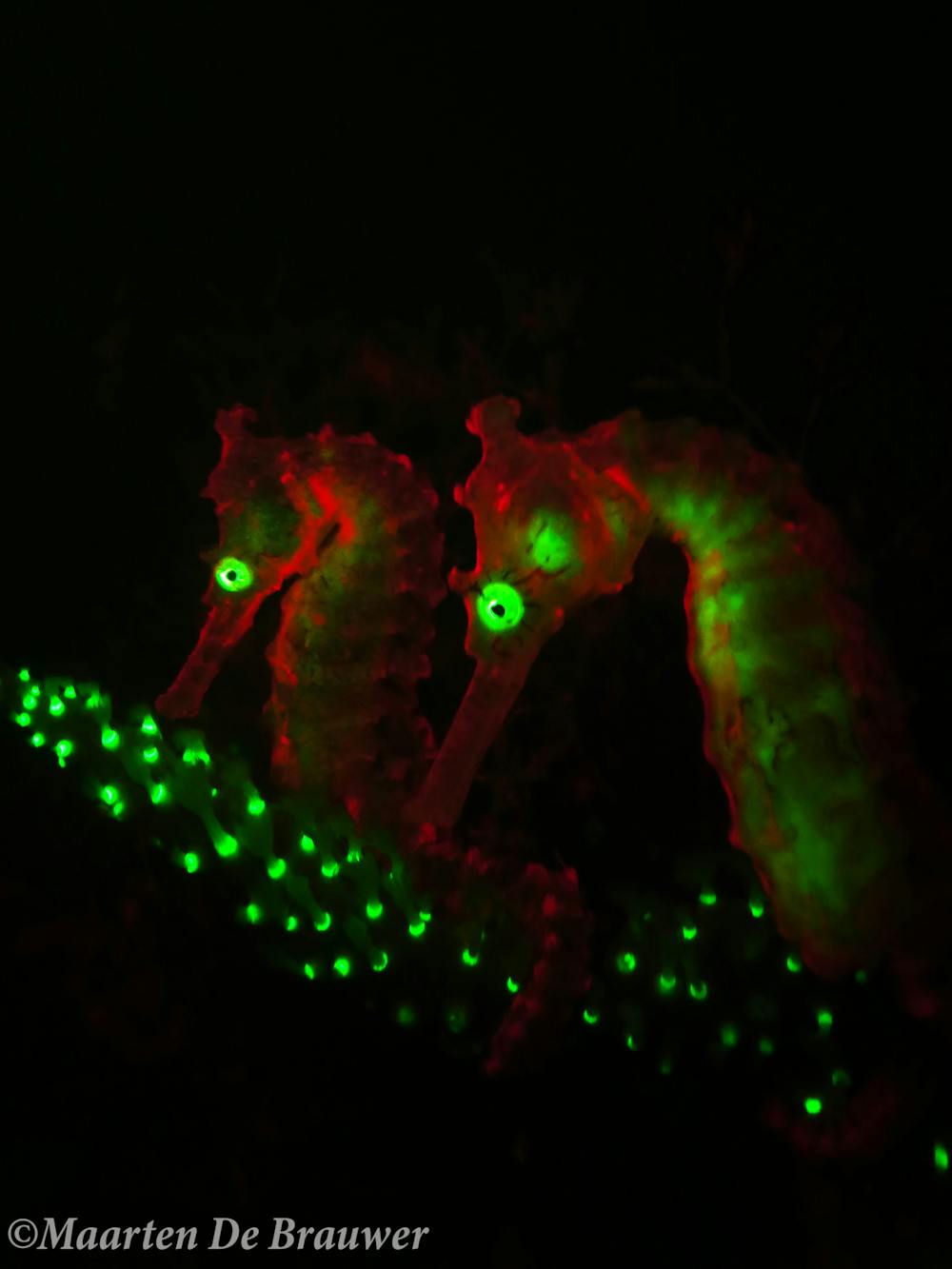 Biofluorescence makes these seahorses much easier to spot.
Maarten De Brauwer, Author provided
Biofluorescence makes these seahorses much easier to spot.
Maarten De Brauwer, Author provided
We compared normal visual surveys to surveys using biofluorescence on one rare (Bargibant’s pygmy seahorse) and two common cryptic species (Largemouth triplefin and Highfin triplefin). Using biofluorescence we found twice as many pygmy seahorses, and three times the number of triplefins than with normal methods.
This method, which we have dubbed the “underwater biofluorescence census” makes detecting cryptic fishes easier, and counting them more accurate. While it might not detect all the animals in the way that surveys with chemicals do, it has the big benefit of not killing the species you’re counting.
A closer look at three large cryptic fish families (Gobies, Scorpionfishes, and Seahorses and Pipefishes) will tell you that they contain more than 2,000 species globally. The extinction risk of more than half of these species has not yet been evaluated. Many species that have been assessed are nevertheless classed as “data deficient” – a euphemistic way of saying that we don’t know enough to decide if they are endangered or not.
Read more: Why you should never put a goldfish in a park pond ... or down the toilet
As the majority of these cryptic species are likely to be biofluorescent, our new technique could be used to help figure out the conservation status of hundreds or even thousands of species. Our method is relatively cheap and easy to learn, and could potentially be used by citizen scientists all over the world.
Ultimately, the goal of scientists and conservationists alike is protecting marine ecosystems so we can have our seafood, enjoy our dives, and people can make a sustainable living off the ocean. Small cryptic fishes are essential in making all of this possible, and biofluorescent fish surveys can play a role in studying these understudied critters.
Authors: Maarten De Brauwer, PhD-candidate in Marine Ecology, Curtin University


 Daily Bulletin


