

Controversial artist Elizabeth Durack gave us a sensitive insight into the lives of Papuan women
- Written by: Roxanne Missingham, University Librarian, Australian National University
In the 1960s, controversial Australian artist Elizabeth Durack challenged the portrayals of Pacific Islanders with her portraits of Papuan women. Until that time, such portraits had emphasised bare breasts and the intellectual view of indigenous Pacific Islanders as “noble savages” or “extremely primitive and barely human”.
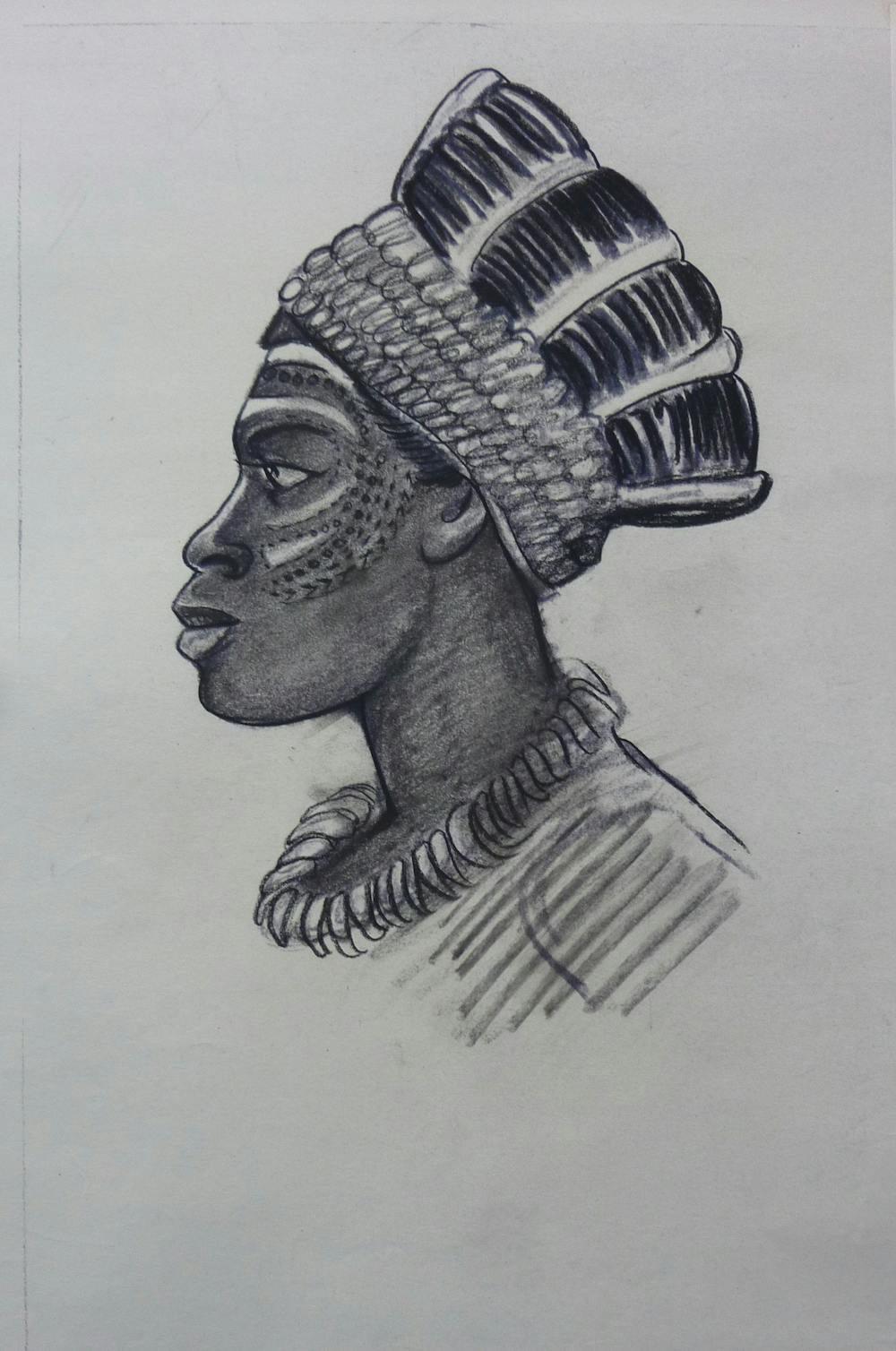 A guest at a courting party, near Kundiawa, Chimbu District, N.G., Elizabeth Durack.
ANU
A guest at a courting party, near Kundiawa, Chimbu District, N.G., Elizabeth Durack.
ANU
Durack arrived in Papua New Guinea in 1968, seven years before the country achieved independence from Australia. She would go on to court controversy in Australia in the 1990s over her assumption of an Aboriginal “nom de plume” and painting style.
Despite this, Durack’s drawings of Papuan women are remarkably sensitive for their time. They provide a critical eye, focusing on women as leaders and a vital labour source for their villages, on the eve of PNG’s independence.
Her 410 drawings have been acquired by the Australian National University Library from her estate. All images are available online, together with seven detailed commentaries on the collection and its value to researchers and historians.
A new eye
Explorers venturing to the Pacific were primarily male, taking a view of “native” life in their records and drawings that focused on men’s roles. Their opinions of women were affected by the gendered perceptions of the period. Scholar Chris Ballard has noted that the portrayal of Indigenous people over many centuries placed women in the background. They were seen, through male eyes, as without productive or leadership roles.
Nora Heysen was the first major Australian female artist to portray PNG women in the 20th century. Dispatched to draw nurses and patients in the army hospital at Finschhafen in 1944 during the second world war, she was the first woman appointed as an official war artist.
While paid the same rate as male artists, she was close to being court-martialled when discovered painting a vase full of roses. Male artists were able to indulge in independent topics for their painting, but what was perceived as a women’s painting was apparently unacceptable.
Hope and turmoil
Born in Perth in 1915, Elizabeth Durack spent much of her early life in the Kimberley, where she encountered and was inspired by Indigenous art. As a child, she was fascinated by Aboriginal people in the region. This interest manifested itself through the retelling of Indigenous stories and incorporation of Indigenous themes in her art.
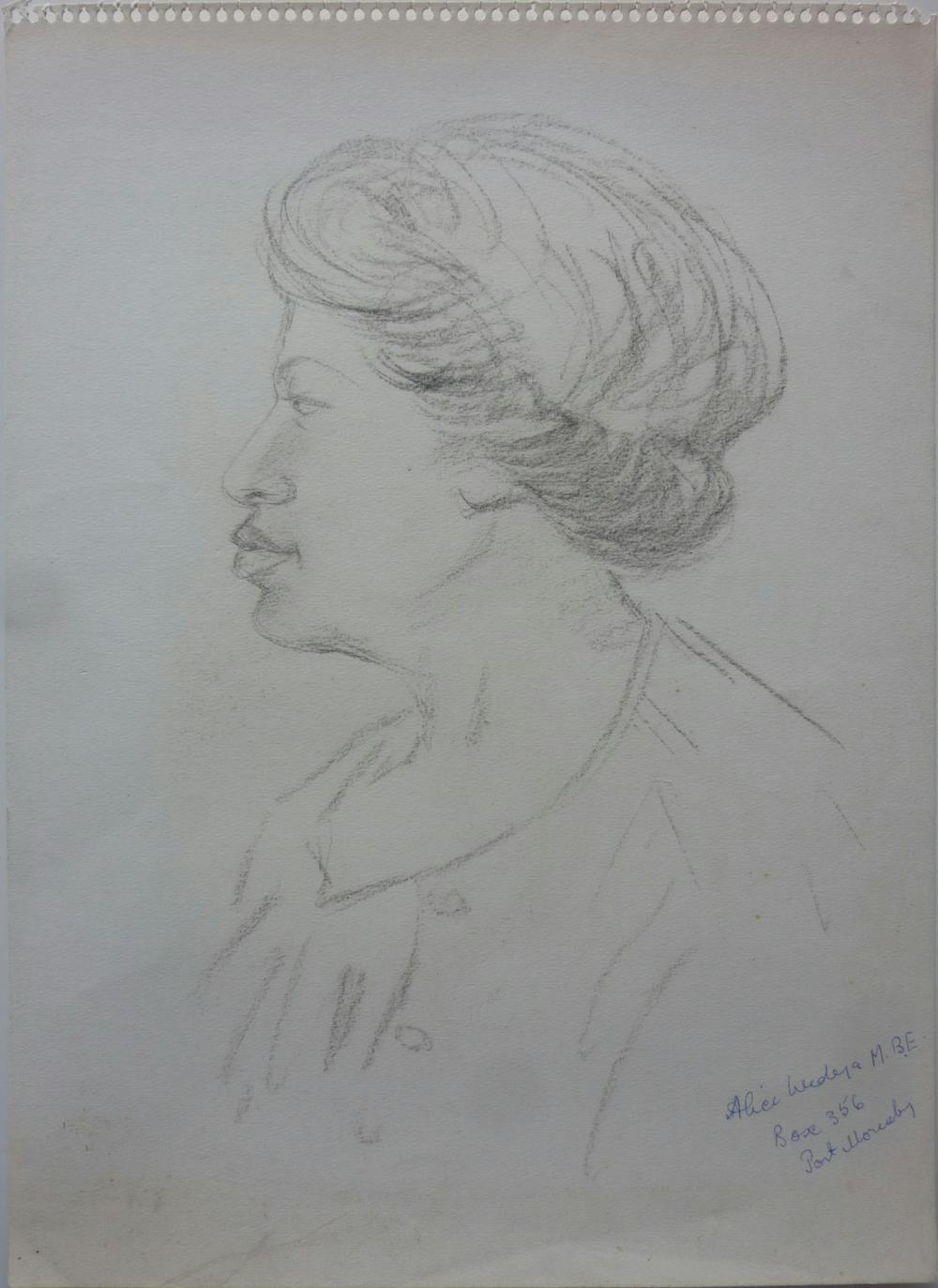 Alice Wedega, PNG’s first female parliamentarian, Elizabeth Durack.
ANU
Alice Wedega, PNG’s first female parliamentarian, Elizabeth Durack.
ANU
Her portraits of Aboriginal people have made their way to galleries across the globe. Durack’s first exhibition was in 1946 and she was awarded an Order of the British Empire in 1966. In the 1990s, however, she produced works under the name “Eddie Burrup”, some of which were included in exhibitions of Aboriginal art. She was heavily criticised by the art world and Indigenous communities, but defended the name as simply a “nom de plume”.
Her journey to PNG was unusual, directly commissioned after a conversation with the then Australian minister for territories, Charles Barnes. She recalled:
[W]e met … in Canberra and I said, ‘I’d love to go to Papua New Guinea’. And then it was worked out through his department that they didn’t think that the women … were not getting the same amount of attention [as men in the independence movement]. He said, ‘Do something on the women of Papua New Guinea’, and so that’s how that … came about.
Durack travelled to PNG during a time of political and social turbulence, when its desire for independence from Australia was being heard around the world. In a country of over 800 languages and 600 islands, many forces were shaping a vision of independent society, including religious groups seeking to strengthen the capabilities of the people and the country.
Interestingly, an internal departmental submission on social affairs, written in 1969, recognised that the role of women and community and school support in the period leading up to independence was vital. It suggested these areas had been overlooked.
Durack had stepped into the arena of women’s life in PNG as it was slowly emerging as important, filling what, on reflection, was a significant policy gap.
Women’s lives
At the time of Durack’s visit the contribution of women in PNG was changing. Secondary schools were opening up, creating a need for teachers – many of whom came from church-run training schools. The number of primary schools doubled in the 1960s, creating more opportunities for women to be educated and opening up yet more teaching positions. Medical services were becoming a part of civil society, requiring greater training for women who achieved new roles as specialised nurses.
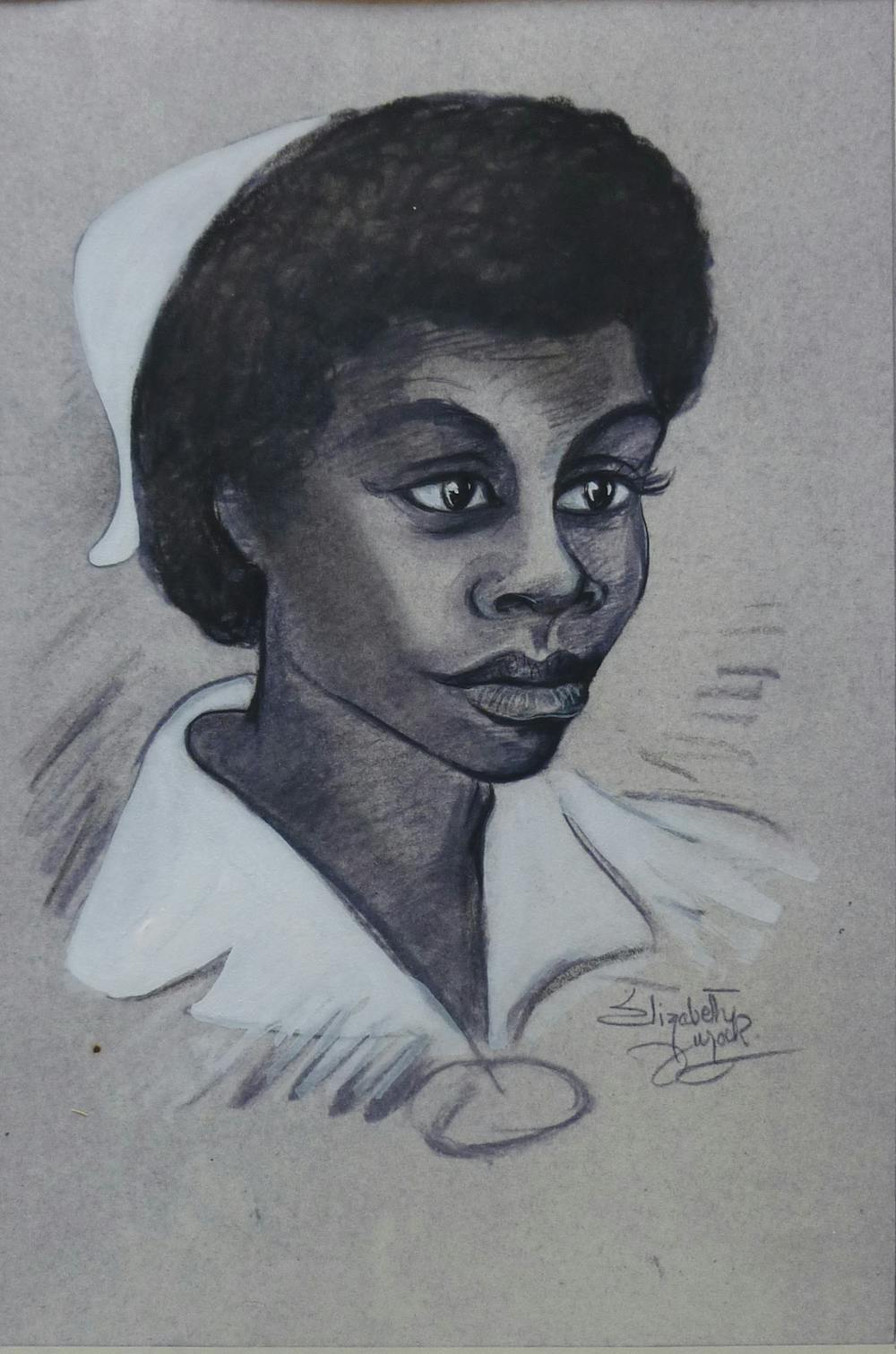 Sister Jean Dingu – from Samarai, Milne Bay District, Papua – Lae General Hospital, Elizabeth Durack.
ANU
Sister Jean Dingu – from Samarai, Milne Bay District, Papua – Lae General Hospital, Elizabeth Durack.
ANU
Durack drew women of social standing, including Alice Wedega, a teacher and PNG’s first female parliamentarian, and portraits of nursing nuns. These were drawn with care and sympathy. Durack’s many images of women in villages and the environment are more sketchily drawn, suggesting she was less interested in these roles.
Not only did Durack draw PNG nuns, she had them write their personal stories. These are part of the collection. The church had identified these young women to be “healers” of their communities and saw them as leaders of the future. Themes of resilience and dedication shine through in both the images and texts.
Nuns speak of their home, family and lives. They reflect on complex issues such as going against their parent’s wishes to become nuns, the importance of continuing to study and their commitment to contributing to PNG.
Sister Andrew Mary wrote:
I like it very much to be in a Convent because we don’t live here just for ourselves but for our own people too. At present we go to visit the sick in the hospital and instruct children in the state schools and to the villages around Port Moresby and we do our studies as well.
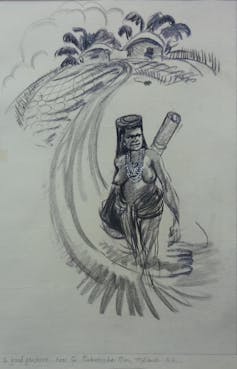 ‘A good gardener near the Purburamba River, Highlands, N.G.’, Elizabeth Durack.
ANU
‘A good gardener near the Purburamba River, Highlands, N.G.’, Elizabeth Durack.
ANU
Finally, a major component of the collection focuses on women in the landscape, and the nature of identity within a complex set of environments. The daily life of the women in PNG — walking, talking, in community groups and village life – clearly fascinated Durack. She captures this community spirit, documenting a hint of stoicism through rain and sunshine.
Durack’s drawings reflect her fascination with the strength and activity of Papuan women at the time. Her desire to step into “man’s territory” and explore the region was built on a genuine interest in Indigenous peoples. This was well before she slipped into appropriating Indigenous culture as Eddie Burrup.
The works contrast with the earlier ethnic typification seen in European depictions over the previous centuries. There are no noble or dangerous savages to be seen in her drawings. Rather they offer a rich and varied eye, depicting people with personality and active community roles.
Authors: Roxanne Missingham, University Librarian, Australian National University


 Daily Bulletin


