

There's still a long way to go for the Don Dale royal commission to achieve justice
- Written by: Thalia Anthony, Associate Professor in Law, University of Technology Sydney
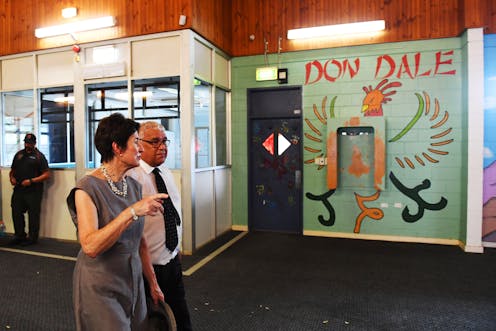
The worth of the royal commission into the Northern Territory’s child detention system will be known only when the territory government goes about the task of implementing its recommendations. It will test the government’s capacity to redress the “systemic and shocking failures” the commission identified.
The detail of the government’s reforms remains elusive four months after the commission’s final report was handed down. However, the challenges to implementation and justice are clear.
In March, the government affirmed its commitment to “generational change”, and announced it will implement all 227 recommendations. Its actions range from spending A$70 million to build new detention centres, diversion strategies (such as bail support and non-custodial sentencing programs), and the establishment of family service hubs.
The government reiterated the promises it made last November to:
close the Don Dale and Alice Springs youth detention centres;
provide bail accommodation; and
have greater Aboriginal Community Controlled Sector involvement in family support.
But will this approach create deep-seated change in youth justice?
Read more: Don Dale royal commission demands sweeping change – is there political will to make it happen?
Recommendations that fall short
A key demand of advocates for youth justice reform has been to shut down detention centres. Their view is detention has failed children and damaged lives.
The commission identified this failure, but it fell short of recommending their closure. Instead, it proposed purpose-built detention centres. The government has announced it will build two new detention centres.
The recommendation to establish 20 family support centres is likely to reproduce old ways of managing Indigenous families without a clear imperative to reduce the removal of children from families.
Without increased resources being given to Indigenous families, communities and organisations to maintain the wellbeing of their children based on Aboriginal ways of knowing, being and doing, these centres will only replicate established institutional practices of managing children.
That there are only 20 centres means they will not provide place-based care across the hundreds of Indigenous communities and homelands in the NT.
The recommendation to consult and partner with Aboriginal Peak Organisations in developing an Aboriginal Out-of-Home Care Strategy may not give Indigenous communities a voice.
The commission heard that since the Intervention in 2007, government consultation has become a dirty word in Indigenous communities. They feel betrayed by the Commonwealth government, which consults only after policies are decided.
Where Indigenous organisations spoke out against government policy, their organisations were defunded. The commitment that is needed therefore is not simply one of consultation, but empowerment.
The commission noted two officers displayed particularly egregious conduct, but did not recommend charges be laid against them or detention managers be held to account. This continues the lack of justice for the young people tortured in detention.
Matters that have gone before the courts paint a bleak picture.
In 2014, Alice Springs detention supervisor Derek Tasker was prosecuted in the NT Supreme Court for choking Dylan Voller and bashing his head against a cell wall. The footage of this incident showed 14-year-old Voller quietly sitting in his cell when Tasker grabbed him. The court found Tasker’s actions were reasonable and he was acquitted.
In 2017, a civil case was brought by four of the six Indigenous boys who were gassed in Don Dale’s isolation unit in 2014. Despite all bar one having been sitting in their cell passively, the court found the gassing was “reasonable and necessary” and did not award compensation for this aspect of the claim.
The NT government’s reticence
Ninety-one of the commission’s recommendations have received mere in-principle support. This includes the controversial measure to increase criminal liability from ten to 12 years of age, and to keep kids under 14 out of detention centres.
This would make the NT the first Australian jurisdiction to lift the age of criminal responsibility from ten. While not substantially reducing the youth detention population, it would prevent the brutalisation of the youngest and most-vulnerable children.
The NT government has continuously referred to the need for the federal government to step up to its responsibility to care for children, especially by matching its initial $50 million funding commitment.
But youth justice and child protection are squarely in the domain of the states and territories. The federal government’s failure to act would be a weak basis for the NT government to disavow its responsibilities.
Ideology gets in the way
Policing of young people alongside a government mantra of “tough on crime” have been major push factors for Indigenous children becoming increasingly detained in the NT over the past decade.
This approach has continued unabated: the government unleashed the Territory Response Group police unit to monitor young people immediately after the royal commission concluded.
Read more: Why are so many Indigenous kids in detention in the NT in the first place?
The NT government continues to refer to children in detention as “problem youth”, and its goal as creating “safer communities”. Such a persistent focus on children as a criminal risk subordinates a focus on children’s human rights.
Indigenous witnesses from remote communities who came before the commission spoke about the devastating effect the Intervention had on their capacity to care for their children.
These witnesses referred to the bureaucratisation of Indigenous services that had previously been community-run and its regime of discriminatory controls. They described the torture in Don Dale as an extension of the Intervention and requiring immediate repeal.
However, in responding to the commission, the federal government said it would not revisit its role in the NT.
A bigger shift is needed
When the commission’s final report was handed down, NT Chief Minister Michael Gunner said the findings were “a stain on the Northern Territory reputation”. But this stain will continue to spread if there is only reform at the margins.
Implementation must proceed on the basis that penal institutions have failed Indigenous children, and upholding the commission’s intent requires a reinvestment in Indigenous models of social, cultural and emotional wellbeing.
Authors: Thalia Anthony, Associate Professor in Law, University of Technology Sydney


 Daily Bulletin


