

Why suspending or expelling students often does more harm than good
- Written by: David Armstrong, Lecturer in Teacher Education (Special Education): Editor of an international research journal, Author, Flinders University
The number of students being suspended or expelled from Australian schools is “skyrocketing”, according to news reports. These note a 10% increase in suspensions over two years at NSW primary schools and that students in south-western Sydney are being suspended more than four times as often as students in other parts of the city.
Suspension and expulsion is widely used in Australia, the UK and the US to respond to problematic behaviour. But evidence shows these tactics aren’t effective in changing a student’s conduct, and carry major long-term risks for their welfare. Students most affected tend to be those with higher and more complex needs, such as those with disabilities and mental health issues.
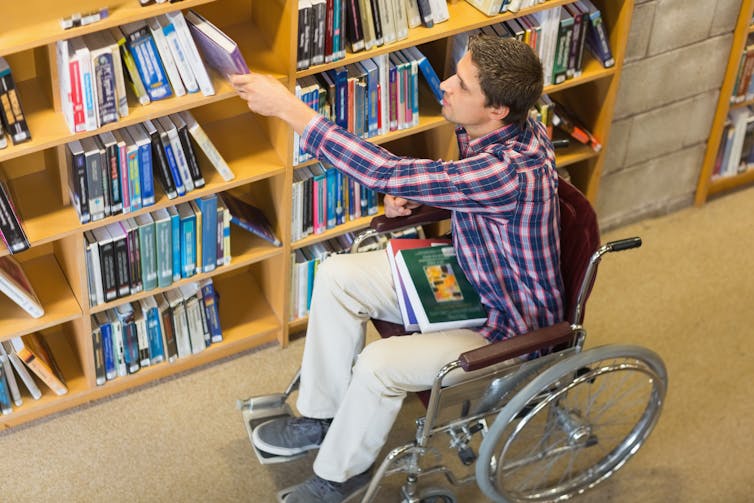 Students most affected tend to be those with higher and more complex needs.
Shutterstock
Students most affected tend to be those with higher and more complex needs.
Shutterstock
Instead of punishing young people, parents should be encouraged to work with schools to improve their child’s behaviour, and governments should install programs to tackle teacher stress. In the case of some schools, this might mean honestly tackling the quality of teaching and leadership, as well as teacher attitudes to students with disabilities.
Read more: Report sparks concern about how schools support students with disabilities
Not the best strategy
Suspension refers to when a student is sent home from school after a serious incident (such as physical assault on a teacher) while a decision is being made about how to respond. Exclusion (also called expulsion in NSW and Victoria) is either for a set period or permanently. It can mean a decision has been taken by the principal or school leadership that the student cannot attend the school as a result of their behaviour.
Providing education for children is the legal responsibility of state governments. A decision to exclude a student means the child either attends an alternative education provider or is home-schooled, depending on family circumstances and judgements of the professionals (typically the principal or senior staff team) involved.
 A decision to exclude a student means the child either attends an alternative education provider or is home-schooled.
Shutterstock
A decision to exclude a student means the child either attends an alternative education provider or is home-schooled.
Shutterstock
A 2017 Victorian Ombudsman report noted school expulsion was an escalating educational issue. It concluded many schools were not equipped with the resources, expertise and assistance to provide support to children with higher needs.
Research shows students who are expelled have a higher future risk of engaging in criminal and anti-social behaviour, or consuming drugs. Excluded young people also have lower odds of a stable, happy and productive adult life.
Read more: Are we expelling too many children from Australian schools?
Suspensions and exclusions also raise serious ethical questions about how our school system accommodates disadvantaged students. Vulnerable (“at risk”) students, such as those with disabilities or mental health difficulties, are disproportionately represented in school exclusions and school suspensions.
A recent SA report, for example, explicitly recommended schools avoid using exclusion or suspension as a default behaviour management strategy for students with disabilities and challenging behaviours.
What can be done
Many evidence-based strategies are available to help improve student (and teacher) behaviours in schools. These can be highly effective if teachers know how to use them and have the confidence to do so. Children with higher behavioural needs may need to receive more intensive, specialist intervention, focused on developing appropriate communication, social skills and emotional regulation.
Teachers can also be helped to gather and record data about when and where problem behaviours occur. This can then be used to gauge what may be driving the behaviour.
 Teaching is widely regarded as an incredibly stressful field.
Shutterstock
Teaching is widely regarded as an incredibly stressful field.
Shutterstock
For example, George wants attention because the academic work set by the teacher is too difficult for him and his disruptive behaviour is a call for help. Annoying the teacher, and being excluded from class, allows a demotivated Carli to escape from the tedium of worksheets. Andy is irritable and prone to aggressive behaviour on Monday morning because he stays at his dad’s on a Sunday night, which unsettles him emotionally and constantly reminds him of his parents’ separation.
Insights from this structured process of data gathering can then enable teachers to help the student learn to modify their behaviour. This includes teaching appropriate behaviours to replace negative ones.
In some cases, teachers and schools, as well as students, need to change their attitudes. Several Australian studies have indicated that unhelpful attitudes by teachers, by parents and school leaders toward “at risk” students (students with disabilities, poor mental health or from disadvantaged backgrounds) can spur behaviours that lead to exclusion or self-exclusion.
My own research shows reducing educational exclusions is an opportunity for changing attitudes toward disability and mental health in schools. Changes in teacher attitudes towards at-risk children are fundamental for positive change in behaviours by teachers and in favour of inclusion.
 A burnout cascade often refers to when an unwell and poorly coping teacher resorts to punitive and ineffective punishment responses.
Shutterstock
A burnout cascade often refers to when an unwell and poorly coping teacher resorts to punitive and ineffective punishment responses.
Shutterstock
Teaching is widely regarded as extremely stressful. While the reasons for this are complex, several studies suggest poor classroom behaviour is an important risk factor.
Emerging knowledge about the relationships between teacher stress and student behaviour suggests it goes two ways. It’s known as a “burnout cascade”, where unwell and poorly coping teachers resort to punitive and ineffective responses. These rapidly escalate incidents and trigger further feelings of inadequacy in a teacher.
Other research suggests stressed teachers are more disconnected from their students. They often fail to notice their needs, which can trigger poor student behaviours. And many schools, and their teachers, just don’t have the skills or knowledge necessary to meet the unique learning and behavioural needs of students with disabilities.
So, future national initiatives designed to reduce teacher occupational stress are likely to reduce unnecessary suspensions and exclusions. The flow on benefits of such initiatives for vulnerable students and for our hard-working teachers could be enormous.
Authors: David Armstrong, Lecturer in Teacher Education (Special Education): Editor of an international research journal, Author, Flinders University
Read more http://theconversation.com/why-suspending-or-expelling-students-often-does-more-harm-than-good-93279


 Daily Bulletin


