

Why we are measuring the health of Australian vegetation poorly
- Written by: Ayesha Tulloch, DECRA Research Fellow, University of Sydney
Many of Australia’s ecosystems are in a much worse condition than we think. This is because officials are measuring the health of ecosystems such as forests and woodlands by their size, instead of how damaged they are by disturbances.
A “disturbance” is a short-term change in environmental conditions that leads to a long-term change in an ecosystem. Some habitat disturbances are natural, such as some fires and extreme weather events. Others are created by human activities, such as logging, pollution, intensive grazing, and mining.
Read more: Native forest protections are deeply flawed, yet may be in place for another 20 years
Frequent or intense disturbances generally pose a bigger threat to the health of an ecosystem and it’s not limited to the area of the ecosystem that is lost. This is because the quality of the vegetation that survives a disturbance, such as a fire, may be too low to support the animals that rely on it for food and shelter.
It is much easier simply to measure ecosystem extent rather than ecosystem condition. However, focusing on quantity instead of quality leads to less informed decisions about where and how to conserve native habitats and the wildlife that lives in it.
Disturbances to habitats
Disturbances have grown in frequency and variety. This is one of the major causes of habitat degradation.
Fires are a common and dangerous disturbance to many Australian habitats. The number of bushfires per week in Australia increased by 40% between 2008 and 2013. Increases in the frequency of fires due to human activity have led to the decline or extinction of more than 100 species and declines in at least 29 threatened ecological communities listed in Australia’s Environment Protection and Biodiversity Conservation Act 1999 (EPBC Act).
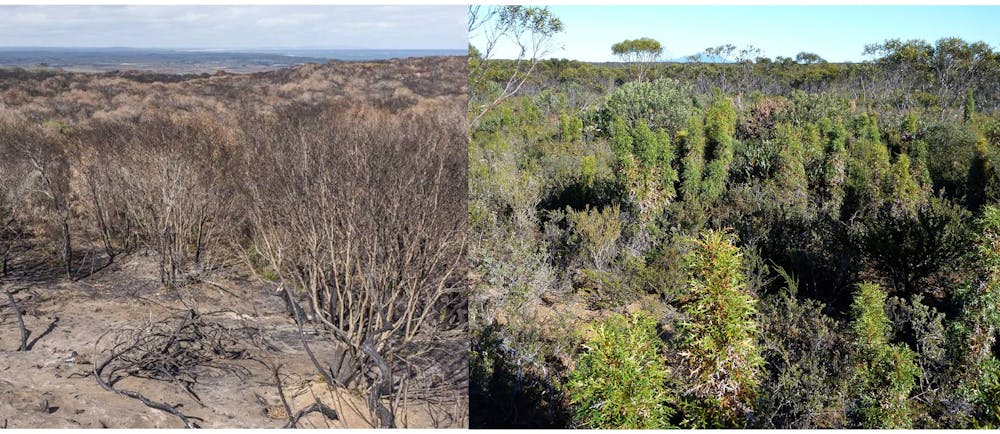 Burnt and unburnt mallee heath in southwest Australia.
Ashley Pearce/Angela Sanders
Burnt and unburnt mallee heath in southwest Australia.
Ashley Pearce/Angela Sanders
More attention is now being paid to evaluating the risk of our ecosystems going extinct. But most of the attention is only on the area of vegetation that has been lost, which is easy to map and calculate thanks to images from satellites.
Measuring the disturbances
In a recent study, we found that some Australian ecosystems are more threatened than might be suggested by looking simply at vegetation loss.
We made this discovery by assessing “whole-of-ecosystem degradation”. This calculation is a two-step process. First, we observe the different ages of the vegetation, known as their “age classes”, in an area. Then, we compare how far the current distribution falls short of the ideal distribution of the group of plants that make up that vegetation community.
Some species (such as large trees) require long intervals between disturbances to allow them to have time to mature and reproduce, so their “ideal” age class distribution will have many old plants and fewer young plants. Other species (such as some fast-growing shrubs) prefer short intervals between disturbances, and their ideal age class distribution will have more young plants than old plants.
The “whole-of-ecosystem degradation” approach
We used this approach to look at the dominant plants and animals in two vegetation types: the protea-rich mallee-heath of southwestern Australia, and Victoria’s mountain ash forest.
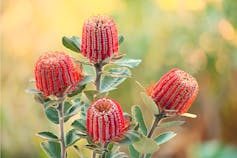 Banksias are a key component of the ecosystem in the protea-rich mallee-heath forest.
from www.shutterstock.com
Banksias are a key component of the ecosystem in the protea-rich mallee-heath forest.
from www.shutterstock.com
In the mallee-heath, the ideal distribution was based on the needs of Banksia species (which are in the Proteacea family). These plants provide critical nectar and pollen resources to many animals such as honey possums and honeyeaters. Many Banksias are long-lived and require up to 80 years between fires to maximise reproductive potential.
Our study showed that the banksia age-class distribution in this ecosystem is unbalanced, and therefore much poorer than indicated by information about just quantity. There are more young banksias (up to ten years old) and fewer older ones (more than 40 years old) than might otherwise be expected.
In simpler terms, the frequency of fire is clearly not able to support the flowering of banksia species, resulting in low habitat quality.
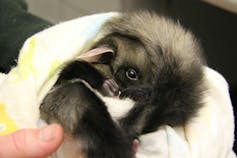 The food and shelter needs of the yellow-bellied glider were used to determine the health of the Victorian mountain ash forest.
Taronga Zoo/AAP
The food and shelter needs of the yellow-bellied glider were used to determine the health of the Victorian mountain ash forest.
Taronga Zoo/AAP
In the mountain ash (Eucalyptus regnans) forest, we used the food and shelter needs of the yellow-bellied glider (Petaurus australis) to assess forest health. This animal is already a threatened mammal.
Fire and logging have disturbed almost 50% of the forest in the last 30 years. Fires here are rare but of high intensity and severity, killing the trees in which these mammals live.
Again, our research shows that the remaining forest is in very poor condition. Compared to what would ideally be expected 120 years after a fire, the forest has more vegetation in very young (less than eight years old) and mid-age (up to 75 years old) age classes, and less vegetation in very old (more than 76 years old) age classes.
To sustain food sources and hollows for the yellow-bellied glider, the mountain ash would need to be protected from disturbance between 40 and 160 years.
 The ideal time interval between fire disturbances to provide food and shelter to yellow-bellied gliders in mountain ash forest is more than 120 years, to allow new trees to grow after burning kills old trees. Photos show progression from newly burnt to old growth forest.
David Blair/Tabitha Boyer
The ideal time interval between fire disturbances to provide food and shelter to yellow-bellied gliders in mountain ash forest is more than 120 years, to allow new trees to grow after burning kills old trees. Photos show progression from newly burnt to old growth forest.
David Blair/Tabitha Boyer
Understanding the effect of disturbances
Our research shows that measuring an ecosystem’s health by its size alone can be misleading, especially when the area is large but severely degraded.
It is therefore crucial to consider disturbances when evaluating ecosystems. This is especially so when forest health is being assessed for listing through the IUCN Red List of Ecosystems, or for conservation planning and management.
Read more: More sightings of an endangered species don't always mean it's recovering
We recommend that decision-makers be more aware of the role of disturbances in degrading ecosystems. This requires two crucial elements of information.
First, we need good maps that tell us when the last disturbance in an area was. This kind of mapping is carried out within our protected reserve system, but is not currently available at a national scale.
Second, we need a better understanding of ideal benchmarks of ecosystems to compare with the current conditions. Benchmarks may be linked to the needs of dominant plant species (such as banksia in mallee-heath) or the needs of dependent species of concern (such as yellow-bellied glider in mountain ash).
We propose that our method be applied to evaluate the condition of different ecosystems. This will ensure that ecosystem declines are identified before systems cannot be recovered.
Authors: Ayesha Tulloch, DECRA Research Fellow, University of Sydney
Read more http://theconversation.com/why-we-are-measuring-the-health-of-australian-vegetation-poorly-94116


 Daily Bulletin


