

New data tool scores Australia and other countries on their human rights performance
- Written by: K. Chad Clay, Assistant Professor of International Affairs, University of Georgia
This year, the Universal Declaration of Human Rights will mark its 70th anniversary, but despite progress in some areas, it remains difficult to measure or compare governments’ performance. We have yet to develop comprehensive human rights measures that are accepted by researchers, policymakers and advocates alike.
With this in mind, my colleagues and I have started the Human Rights Measurement Initiative (HRMI), the first global project to develop a comprehensive suite of metrics covering international human rights.
We have now released our beta dataset and data visualisation tools, publishing 12 metrics that cover five economic and social rights and seven civil and political rights.
Lack of human rights data
People often assume the UN already produces comprehensive data on nations’ human rights performance, but it does not, and likely never will. The members of the UN are governments, and governments are the very actors that are obligated by international human rights law. It would be naïve to hope for governments to effectively monitor and measure their own performance without political bias. There has to be a role for non-state measurement.
Read more: Australia's Human Rights Council election comes with a challenge to improve its domestic record
We hope that the data and visualisations provided by HRMI will empower practitioners, advocates, researchers, journalists and others to speak clearly about human rights outcomes worldwide and hold governments accountable when they fail to meet their obligations under international law.
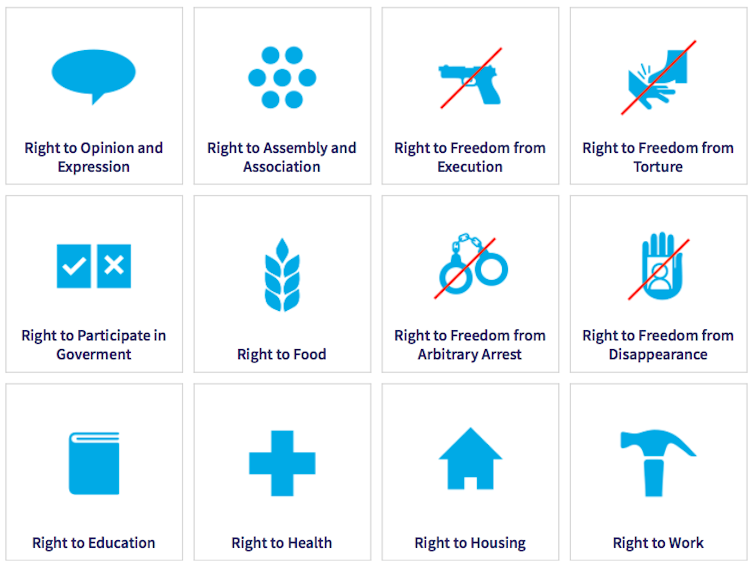 These are the 12 human rights measured by the Human Rights Measurement Initiative (HRMI) project during its pilot stage. The UN’s Universal Declaration of Human Rights defines 30 human rights.
Human Rights Measurement Initiative, CC BY
These are the 12 human rights measured by the Human Rights Measurement Initiative (HRMI) project during its pilot stage. The UN’s Universal Declaration of Human Rights defines 30 human rights.
Human Rights Measurement Initiative, CC BY
The HRMI pilot
At HRMI, alongside our existing methodology for economic and social rights, we are developing a new way of measuring civil and political human rights. In our pilot, we sent an expert survey directly to human rights practitioners who are actively monitoring each country’s human rights situation.
That survey asked respondents about their country’s performance on the rights to assembly and association, opinion and expression, political participation, freedom from torture, freedom from disappearance, freedom from execution, and freedom from arbitrary or political arrest and imprisonment.
Based on those survey responses, we develop data on the overall level of respect for each of the rights. These data are calculated using a statistical method that ensures responses are comparable across experts and countries, and with an uncertainty band to provide transparency about how confident we are in each country’s placement. We also provide information on who our respondents believed were especially at risk for each type of human rights violation.
Human rights in Australia
One way to visualise data on our website is to look at a country’s performance across all 12 human rights for which we have released data at this time. For example, the graph below shows Australia’s performance across all HRMI metrics.
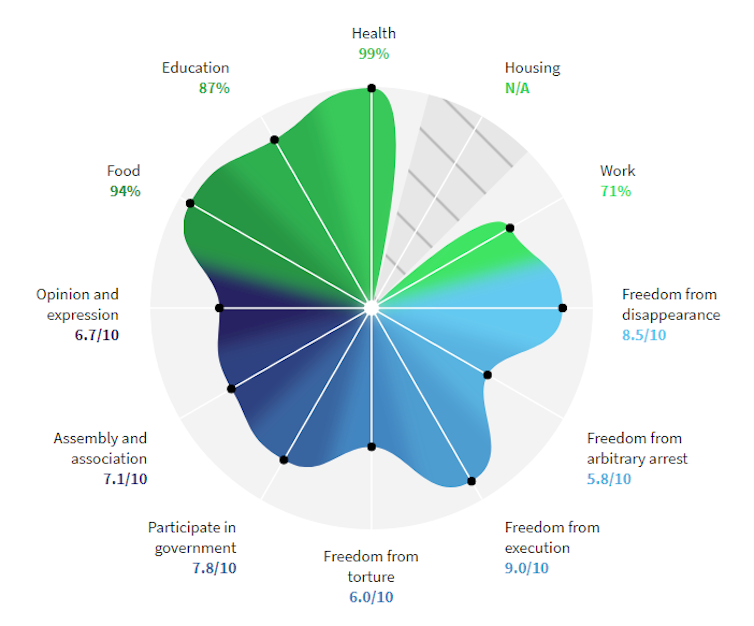 Human rights performance in Australia. Data necessary to calculate a metric for the right to housing at a high-income OECD assessment standard is currently unavailable for Australia.
CC BY
Human rights performance in Australia. Data necessary to calculate a metric for the right to housing at a high-income OECD assessment standard is currently unavailable for Australia.
CC BY
As shown here, Australia performs quite well on some indicators, but quite poorly on others. Looking at civil and political rights (in blue), Australia demonstrates high respect for the right to be free from execution, but does much worse on the rights to be free from torture and arbitrary arrest.
Our respondents often attributed this poor performance on torture and imprisonment to the treatment of refugees, immigrants and asylum seekers, as well as Indigenous peoples, by the Australian government.
Looking across the economic and social rights (in green), Australia shows a range of performance, doing quite well on the right to food, but performing far worse on the right to work.
Read more: Ten things Australia can do to be a human rights hero
Freedom from torture across countries
Another way to visualise our data is to look at respect for a single right across several countries. The graph below shows, for example, overall government respect for the right to be free from torture and ill treatment in all 13 of HRMI’s pilot countries.
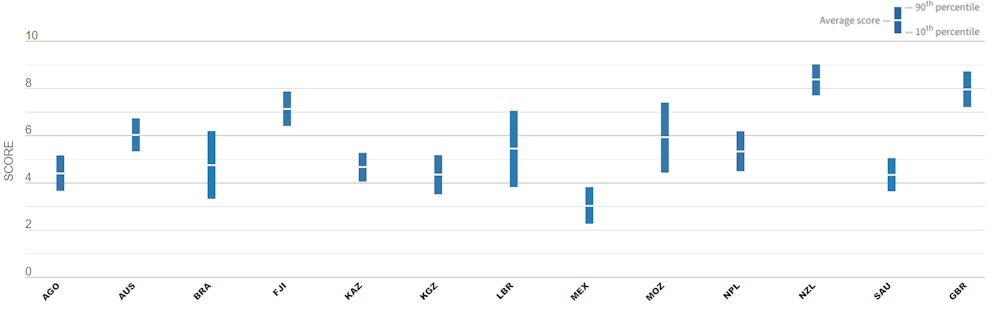 Government respect for the right to be free from torture, January to June 2017.
Human Rights Measurement Initiative (HRMI)
Government respect for the right to be free from torture, January to June 2017.
Human Rights Measurement Initiative (HRMI)
Here, the middle of each blue bar (marked by the small white lines) represents the average estimated level of respect for freedom from torture, while the length of the blue bars demonstrate our certainty in our estimates. For instance, we are much more certain regarding Mexico’s (MEX) low score than Brazil’s (BRA) higher score. Due to this uncertainty and the resulting overlap between the bars, there is only about a 92% chance that Brazil’s score is better than Mexico’s.
In addition to being able to say that torture is probably more prevalent in Mexico than in Brazil, and how certain we are in that comparison, we can also compare the groups of people that our respondents said were at greatest risk of torture. This information is summarised in the two word clouds below; larger words indicate that that group was selected by more survey respondents as being at risk.
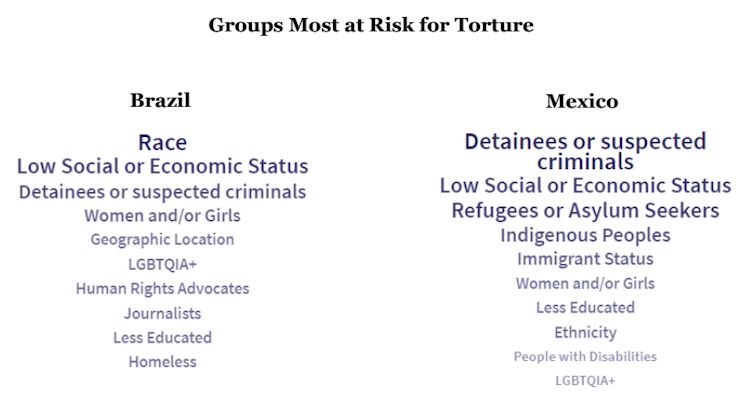 These word clouds show, on the left, the attributes that place a person at risk of torture in Brazil, and on the right, attributes that place one at risk for torture in Mexico, January to June 2017, respectively.
Human Rights Measurement Initiative (HRMI), CC BY
These word clouds show, on the left, the attributes that place a person at risk of torture in Brazil, and on the right, attributes that place one at risk for torture in Mexico, January to June 2017, respectively.
Human Rights Measurement Initiative (HRMI), CC BY
There are both similarities and differences between the groups that were at highest risk in Brazil and Mexico. Based on the survey responses our human rights experts in Brazil gave us, we know that black people, those who live in favelas or quilombolas, those who live in rural or remote areas, landless rural workers, and prison inmates are largely the groups referred to by the terms “race,” “low social or economic status,” or “detainees or suspected criminals”.
On the other hand, in Mexico, imprisoned women and those suspected of involvement with organised crime are the detainees or suspected criminals that our respondents stated were at high risk of torture. Migrants, refugees and asylum seekers travelling through Mexico on the way to the United States are also at risk.
There is much more to be learned from the visualisations and data on our website. After you have had the opportunity to explore, we would love to hear your feedback here about any aspect of our work so far. We are just getting started, and we thrive on collaboration with the wider human rights community.
Authors: K. Chad Clay, Assistant Professor of International Affairs, University of Georgia


 Daily Bulletin


