

Will sorting classrooms by ability improve marks? It depends on the mix
- Written by: Alfredo Paloyo, Senior Lecturer in Economics, University of Wollongong
Parents and teachers are interested in ensuring children perform their best in school. Some believe putting smart students together can improve educational outcomes. But evidence about the impact of classmate or schoolmate quality (as measured by, say, test scores) on individual performance in an educational setting is only just beginning to accumulate.
Establishing the presence and size of peer effects in education is important. Targeted educational interventions for one group of students may spill over to their classmates. Deliberately sorting students may raise the average attainment of pupils in ways other interventions may not.
Who are your friends?
The principal aim of our study was to estimate the impact the quality a student’s class and schoolmates has on academic performance.
 Caption.
Shutterstock
Caption.
Shutterstock
Unfortunately, it’s not as easy as simply taking the outcomes of a student with good peers and comparing those to the outcomes of a student with bad peers, because students tend to choose their peers. The difference in outcomes may be due to differences in other factors that affect peer quality and the academic outcomes simultaneously, such as parental investment in education.
Read more: Why some migrant school students do better than their local peers (they're not 'just smarter')
Also, any particular student is a peer of other students. Thus, this student can influence the outcomes of their peers just as much as their peers affect their outcomes.
A final complication is that students belonging to the same school are exposed to the same factors or shocks that could drive their outcomes. So, any seemingly correlated peer effect may simply be due to exposure to the same environment.
Ideally, one would take a random sample of students, assign half to classrooms with good peers and the other half with bad peers, then take the difference in average outcomes. Obviously, there are sound ethical objections to such an experiment. Instead, we have to rely on a more complicated strategy to estimate the impact of peer quality. In our case, we use changes in one’s peer quality that we believe are not due to self-selection, reflection, or correlated factors to see how these changes translate to individual academic performance.
Using data on English children, our study shows peer quality has a small effect on an individual’s test scores at age 18. But a large proportion of low-ability students has a detrimental impact on the performance of average children. In addition, academically weaker students are influenced most by their peers. All together, putting a weak student in a class with other weak students would be detrimental for all of them.
The variation in peer effects is a particularly interesting result. To demonstrate this, we ranked students by ability. Weaker students are on the left and better students on the right, as measured by their test scores taken at around age 14.
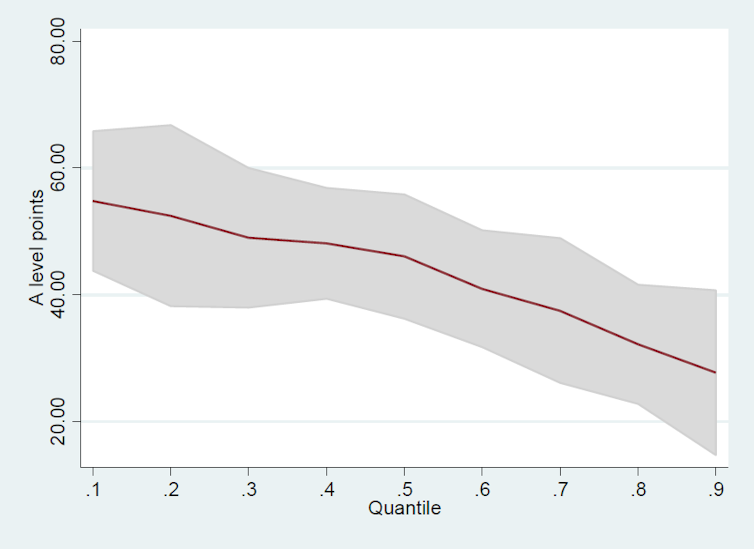 Estimated effects of average peer ability at age 14 on test scores taken at age 17–18 by deciles of own ability. The grey area represents 95% confidence intervals.
Author provided, Author provided
Estimated effects of average peer ability at age 14 on test scores taken at age 17–18 by deciles of own ability. The grey area represents 95% confidence intervals.
Author provided, Author provided
A one-standard-deviation increase in peer quality (as measured by average test scores earlier in life) improves one’s performance in exams taken at around age 17–18 by over 50 points in the bottom quintile. This effect diminishes as we take better and better students. As we move from left to right, the impact estimate, represented by the red line, declines.
Two studies present findings similar to ours. In both cases, the researchers examine how changes in peer quality affect school performance as students transition from primary to secondary school in the UK.
One of the studies demonstrated that average peer ability has no significant impact on individual performance.
The other showed less variation in peer effects than what we uncovered. But their outcome is based on performance in tests at age 14, while we used a broader spectrum of academic outcomes. This includes test scores at age 16 and 17–18, and the likelihood of pursuing tertiary education.
Read more: For Australian students, academic potential still outweighs social circumstances
Sorting students more effectively can help weaker students
Student achievement in school is determined by a variety of factors. These include parental socioeconomic background, individual ability, non-cognitive skills, and peer composition.
It’s important to carefully select an appropriate pupil mix, especially to support weaker students. But such an adjustment is unlikely to compensate for deficiencies in other areas, such as early-childhood investments at home and teacher quality at school.
Can we do better than randomly sorting students into classes? Yes. When placed with better-performing classmates, weaker students are likely to gain from the improved learning environment, and smarter students are unlikely to be negatively affected.
Authors: Alfredo Paloyo, Senior Lecturer in Economics, University of Wollongong


 Daily Bulletin


