

Materials that make heat worse for our kids demand a rethink by designers
- Written by: Abby Mellick Lopes, Senior Lecturer in Design, Western Sydney University
It is with some relief that Australians are leaving behind the excruciatingly hot days of summer. But did you ever stop to think about the role of design in making matters better – or worse? Spending all day in air-conditioned rooms before walking out to a car that has baked in the sun all day is an exercise in extremes that many of us have faced. It’s easy to forget these conditions are shaped and mediated by design.
Campaigns warn us about the dangers of leaving children in hot parked cars. However, there are many more designed microclimates in the city where “real feel” temperatures far exceed reported air temperatures. One example, where children spend many hours of the day, is the childcare centre, where we found some artificial surfaces can become dangerously hot.
Read more: Building cool cities for a hot future
Our preliminary study over the record-breaking summer of 2017-8 assessed the thermal characteristics of outdoor play spaces in three childcare centres in Western Sydney. We discovered that summer temperatures can vary dramatically, depending on the materials and environments being measured.
We measured air and surface temperatures to generate detailed information about the effects of heat on shaded and non-shaded surfaces at each facility. These included artificial materials such as “soft fall” surfaces and Astroturf, “semi-natural” materials such as bricks and woodchips, and natural materials, including sand and grass.
In full sun, the artificial surface materials became dangerously hot. Soft fall surface temperatures reached 71-84°C on days when air temperatures were in the low 30s. Astroturf heated up to nearly 100°C. Plastic toys in direct sun reached temperatures up to 73.7°C – that is one hot rubber duck!
You can see the effect of different surfaces in the thermographic image below. It shows tens of degrees of difference between soft fall and thick grass in full sun.
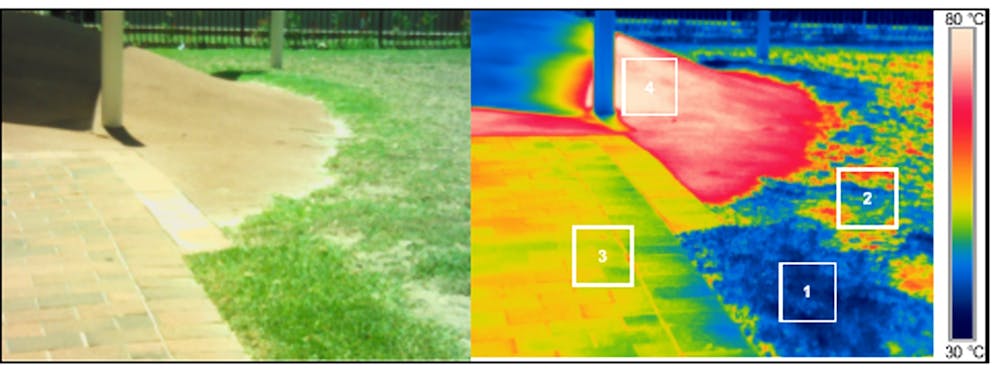 Surface temperatures on a typical summer day (January 18 2018) in a Western Sydney early learning centre. Left: normal view; right: infrared view (surface temperatures are colour-coded). Average temperatures within boxes shown (approx. 0.3m sq): 1 = thick grass, 39°C; 2 = patchy grass 51°C; 3 = red bricks, 53°C; 4 = soft fall 74°C.
Sebastian Pfautsch, Author provided (No reuse)
Surface temperatures on a typical summer day (January 18 2018) in a Western Sydney early learning centre. Left: normal view; right: infrared view (surface temperatures are colour-coded). Average temperatures within boxes shown (approx. 0.3m sq): 1 = thick grass, 39°C; 2 = patchy grass 51°C; 3 = red bricks, 53°C; 4 = soft fall 74°C.
Sebastian Pfautsch, Author provided (No reuse)
Hot materials undermine safety benefits
Soft fall, as the name suggests, is widely used to create “safer” environments for children should they fall. Rising heat undermines this safety benefit. Because it transforms the material into a source of potentially significant harm it also reduces the time that can be spent playing outdoors.
Contrary to their current widespread use, this study found that artificial materials like soft fall and Astroturf should be used sparingly and only in shaded settings. Shade does make a significant difference to the temperatures recorded, but shaded soft fall and Astroturf were still hotter than shaded natural surfaces. Perhaps unsurprisingly, a centre with an old camphor laurel tree supplying ample shade in the play space recorded the lowest daytime air temperatures.
Read more: If planners understand it's cool to green cities, what's stopping them?
A thermally healthy outdoor play space is crucial for supporting children’s social, physical and cognitive development. However, the extreme temperatures recorded in this study turn such spaces into hostile environments that leave little option but to move indoors to cope.
Indoor activities tend to be more sedentary, which is linked to reduced physical fitness and rising obesity. We already spend around 90% of our time indoors in environments (including cars) that depend on air conditioning for habitability.
Of course, you can only air-condition a space effectively if it is enclosed. The rise of the “indoor biome” has been associated with poor air quality and a raft of other complex hazards.
Yet childcare centres with cool, comfortable outdoor play spaces, designed to enable both mobility and a connection with nature, are far from the norm in our rapidly densifying cities. The newest centre in our study, for example, had the smallest outdoor activity space, with the least shade, very limited natural ground cover and the greatest proportion of soft fall. This raises questions about the impact of design trends on the quality of outdoor activity spaces.
It is worth noting too that, given the level of demand, there is often little choice about where a child might be offered a place.
Climate change makes design even more important
How accountable should designers be for the everyday living environments that they create? For example, could the designers of the past have known about the environmental, social and cultural impacts of one of the most transformative designs of the 20th century, the car?
Perhaps not, but things have changed. The need to adapt to a changing climate makes good design important for our survival. And that, in turn, demands designers take greater responsibility for the harms arising from their work.
In the United States, a recent report from the Conservation Law Foundation and Boston Green Ribbon Commission attaches a new urgency to the role of adaptation strategies in regulation, planning and design. The report finds that voluntary measures have not created a noticeable difference in planning, design or development practices. These continue to operate according to climate patterns of the past rather than the present or future.
Read more: When the heat is on, we need city-wide plans to keep cool
In Australia, the National Construction Code has been amended to require more stringent testing of external walls and cladding, following the 2017 Grenfell Tower fire in the UK and 2014 Lacrosse Apartments fire in Melbourne, Australia. But the code still does not account for “hail, storm tide, or have specific requirements related to heat stress”.
Resilience to current and anticipated environmental change requires updated design standards. Designers need to be better trained and supported to foresee harms and respond creatively to conditions we may not have experienced before, even if their clients do not request this.
After all, the lifespan of many designed products, structures and environments can far exceed a human lifespan. This means design decisions being made now leave a legacy for future generations. With 50℃ summer days predicted to occur regularly before mid-century, we need to design our cities differently, now.
This hands a duty of care to all involved in the planning, designing and building professions. It has not traditionally been a compulsory part of their practices, but should be.
Read more: The reality of living with 50℃ temperatures in our major cities
Authors: Abby Mellick Lopes, Senior Lecturer in Design, Western Sydney University


 Daily Bulletin


