

how urban planning has failed women
- Written by: Dorina Pojani, Senior Lecturer in Urban Planning, The University of Queensland
We need to have a conversation about sexism and the city. Gender affects all other “vulnerable group” considerations in the cities, where nearly 90% of Australians live.
Read more: Mansplaining Australian cities – we can do something about that
A bit of history
In the past, women lived and worked in extended families and intimate communities, which were supportive of women’s lives but also restricted them. Families minded children and took care of the old and disabled, but also vetoed marriages and had a say in most decisions affecting women’s lives.
Meanwhile, cities were small and self-contained. One could easily get around. Land uses were mixed: often the same building combined production, consumption and living. This model applied to all continents: from Amsterdam’s canal houses, to Singapore’s shophouses, to New York’s Meatpacking District, to Buenos Aires’ La Boca barrio, to Cairo’s bazaars.
Then, in the 20th century, the state and the market focused on the notion of the individual. Women could liberate themselves from traditional family or community bonds and move into jobs and new localities.
We could have as many children as we liked or none at all. We were promised food, shelter, education, health, employment, pension, insurance and protection.
For most women, however, the new situation became a double burden of family and employment.
A city that hinders women’s many roles
A “zoned” city has been created, in which housing, work, shopping and entertainment are segregated into separate and distant locations. Zoning has produced two types of residential spaces.
The main one involves sprawling, single-family suburbs. These are isolating, inefficient and impersonal. Women have been fed the aspiration of owning large individual houses – full of stuff for us to clean, vacuum and maintain.
Much of this housing has become unaffordable – especially for single mothers or women who lack the financial support of a male partner. Poorer women often end up in minuscule flats in high-rise, anonymous, brutalist architecture.
Read more: With apartment living on the rise, how do families and their noisy children fit in?
For the truly disadvantaged, such as homeless or battered women, few, decrepit and unsafe shelters are available.
What urban amenities and services are provided for women? Unless she belongs to the upper-middle class, a woman is more likely than not to live in a food desert. These areas have limited access to shops that sell healthy food, but an abundance of fast-food outlets.
Childcare facilities are detached from both homes and workplaces. In addition to being physically inaccessible, they are too expensive for many working women.
Green space is inaccessible too – especially for low-income women living on the wrong side of town. Sometimes parks are literally gated. Far from being “civilising” and equalising spaces, public parks have turned into sites of crime, which women are fearful to visit.
Entertainment districts are supposed to promote a sophisticated, cosmopolitan urban culture. In reality, many are beer-based male hangouts. Behaviours such as binge drinking, fighting, street vomiting and urination, and sexual harassment exclude women or make them feel uncomfortable.
Read more: No harm done? 'Sexual entertainment districts' make the city a more threatening place for women
How about transportation spaces? In a world where women drive less than men, getting around is difficult. Extensive and congested highway systems slice across cities.
Public transport is designed along inflexible trunk lines and schedules. Such a system cannot meet the complex travel needs of working mothers who run myriad errands throughout the day. Moreover, women risk getting crushed or groped aboard cramped carriages.
Read more: Gender makes a world of difference for safety on public transport
The gender gap in cycling is staggering: women are much less likely to choose such an unsafe mode.
Walking as a form of transport has not been made easy for women either. Tall kerbs, missing sidewalks, poorly lit alleys and short time spans of pedestrian signals disadvantage both young parents who need to push prams (which still falls mostly to women) and older people with physical impairments. As women live longer than men, they must cope with an age-unfriendly city for a longer time.
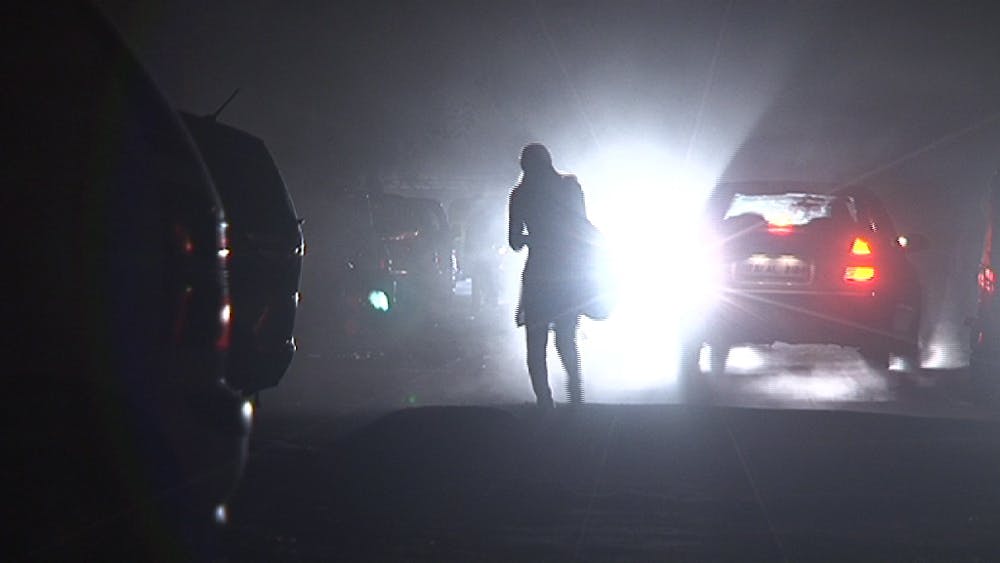 Poor lighting is a clear factor making women and girls feel vulnerable when they need to travel around the city.
UN Women/Flickr, CC BY-NC-ND
Poor lighting is a clear factor making women and girls feel vulnerable when they need to travel around the city.
UN Women/Flickr, CC BY-NC-ND
The need for an ungendered urban agenda
In sum: instead of having it all, women have to do it all on our own – in cities that are not designed for us. That’s because our cities are not designed by women.
According to the 2016 Census, in Australia the male:female ratio in the planning profession is nearly equal. But among Planning Institute of Australia members, only 38% are female. In related professions such as architecture, construction, land surveying and land economics the proportion of women is much lower. Moreover, female planners must contend with a very male-dominated world of real estate development, politics and even planning academia.
Read more: Australian cities are crying out for better planning, but the research funding is missing
Clearly, women must operate within the same city as men, but it is more inconvenient for us.
Patriarchy in city planning is not just a failure of society – it is a failure of the imagination. So, where to from here? The “matriarchal city” is not necessarily the answer. We need to move past the notion that one group – male or female – creates the world on behalf of everyone else.
We join feminist critic Jessa Crispin in saying that, in the 21st century, we need to imagine entirely new ways of ordering our cities, neighbourhoods, streets, homes, workplaces – our very souls. Let’s create a world of fraternity and cooperation.
Authors: Dorina Pojani, Senior Lecturer in Urban Planning, The University of Queensland
Read more http://theconversation.com/sexism-and-the-city-how-urban-planning-has-failed-women-93854


 Daily Bulletin


