

Signals from a spectacular neutron star merger that made gravitational waves are slowly fading away
- Written by: Tara Murphy, Associate Professor and ARC Future Fellow, University of Sydney
Eight months ago, the detection of gravitational waves from a binary neutron star merger had us and other astronomers around the world rushing to observe one of the most energetic events in the universe.
What most people don’t realise is that we continued to observe the event every few weeks from then up to now.
Our team started searching for radio emission from the merger, known as GW170817, making a detection two weeks after the August event. Now, the radio emission is starting to fade.
Read more: After the alert: radio 'eyes' hunt the source of the gravitational waves
As we prepare to say goodbye (at least for now) to this incredible object, we reflect on what what we’ve learned so far, with our paper accepted for publication in the Astrophysical Journal.
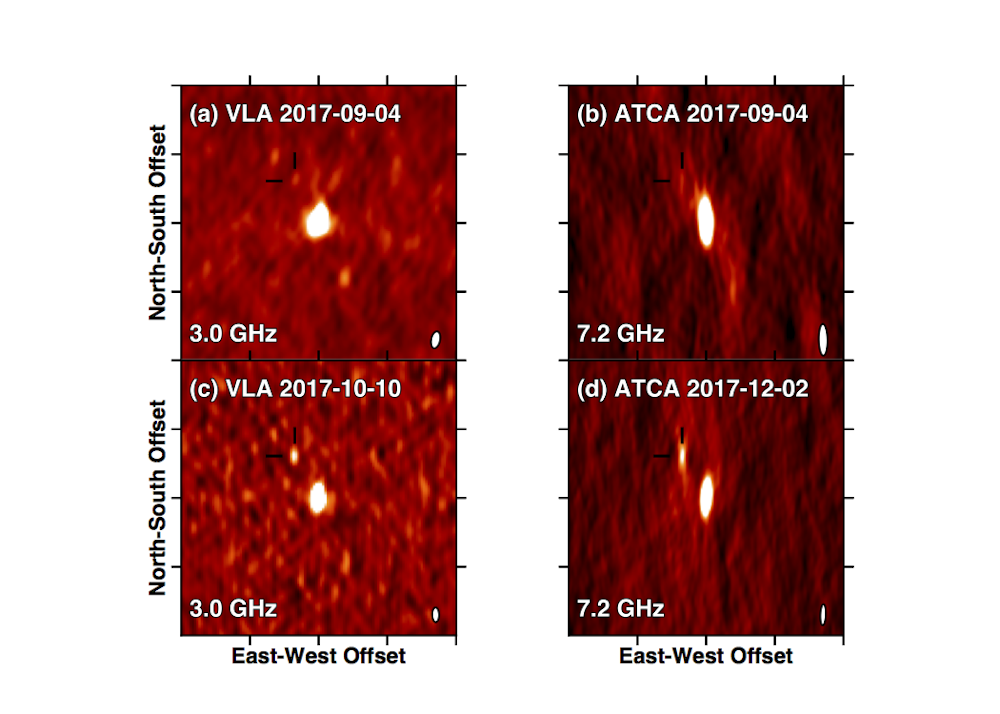 Radio observations of GW170817 from two telescopes. The central bright object in each image is the host galaxy NGC 4993. The smaller bright spot in the crosshairs is the neutron star merger.
David Kaplan. Data from Mooley et al. (2018), Nature, 554, 207, Author provided
Radio observations of GW170817 from two telescopes. The central bright object in each image is the host galaxy NGC 4993. The smaller bright spot in the crosshairs is the neutron star merger.
David Kaplan. Data from Mooley et al. (2018), Nature, 554, 207, Author provided
The detection of gravitational waves and electromagnetic radiation (such as light and radio waves) from the same object mean physicists have been able to:
Observing the merger
Radio telescopes such as the Australia Telescope Compact Array and the Jansky Very Large Array (in the United States) are designed to detect electromagnetic radiation with wavelengths from centimetres to metres.
Unlike visible light, radio waves travel through space almost unimpeded by dust. They can be detected during the day as well as at night: radio telescopes can observe around the clock.
Timelapse of the CSIRO’s Australia Telescope Compact Array. Credit: Alex Cherney (terrastro.com)The radio waves we detected have travelled 130 million light years from the galaxy NGC 4993 where the neutron star merger took place.
When the two neutron stars collided they emitted a burst of gamma rays shortly after, which was detected by the Fermi satellite 1.74 seconds after the gravitational waves. What happened next in the explosion is what we’ve all been trying to work out.
Within 12 hours astronomers had detected a bright, fading signal in visible light. We think this came from neutron star material flung out at 50% of the speed of light. It was glowing hot from a bunch of radioactive decays.
Neutron stars are the most dense objects we know of, except for black holes: imagine the Sun squashed into a region the size of a city.
When two neutron stars collide they form a new object that has slightly less mass than the two original stars: in this case likely a new black hole. A tiny fraction of the mass is blasted out as both matter and energy (remember E=mc2) and that is what we detect on Earth.
What do radio waves tell us?
The radio emission we detected days later, though, is a different matter.
Radio waves are created when electrons are accelerated in magnetic fields. This happens at shock fronts in space, as material from stellar explosions crashes into the stuff around the star.
This stuff is called the interstellar medium and is about 10 quintillion times less dense than air on Earth (almost, but not quite, a vacuum). The nature of the radio waves tells us the details of this shock, which we can run backward in time to try to understand the explosion.
One big question is whether there was a narrow jet of material moving at 99.99% of the speed of light that punched its way out of the explosion and hit the interstellar medium.
We think that these must happen in gamma-ray bursts: did that happen here?
A simulation of a neutron-star merger giving rise to a broad outflow – a ‘cocoon’. A cocoon is the best explanation for the radio waves, gamma rays and X-rays the astronomers saw arising from the neutron-star merger GW170817.What happened in the explosion?
We’re still not sure of the details, but we don’t think there was a successful jet in GW170817. That’s because we have now observed the radio emission start to fade (the optical emission started to fade immediately).
This shows the explosion probably isn’t a classic gamma-ray burst with relativistic jets, as shown in the figure below (left). What is more likely is that we are seeing a “cocoon” of material that has broken out from the explosion.
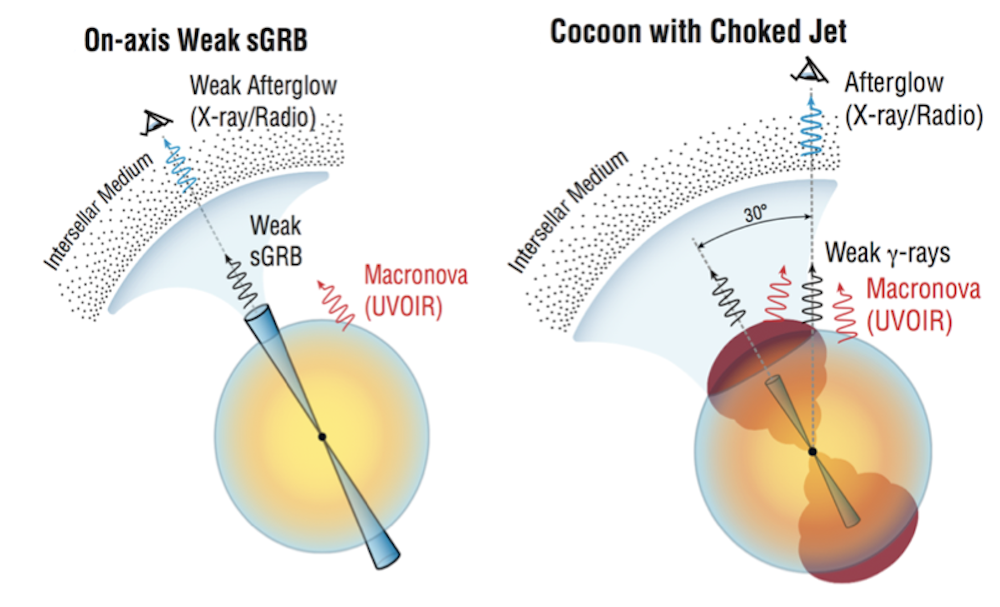 Models of what might be happening in the merger. Our data has shown the left option is unlikely, and the radio emission is probably caused by a cocoon of material (right).
Reprinted with permission from Kasliwal et al., Science (2017), Author provided
Models of what might be happening in the merger. Our data has shown the left option is unlikely, and the radio emission is probably caused by a cocoon of material (right).
Reprinted with permission from Kasliwal et al., Science (2017), Author provided
So where does this material come from?
The material flung out of the neutron stars (known as ejecta) was moving fast, about 50% of the speed of light. What if there was an even faster (99.99% of the speed of light) jet that happened soon after?
This jet could have blown a bubble in the ejecta, making it move faster (maybe 90% of the speed of light) and stopping the jet in its tracks: we call this a cocoon.
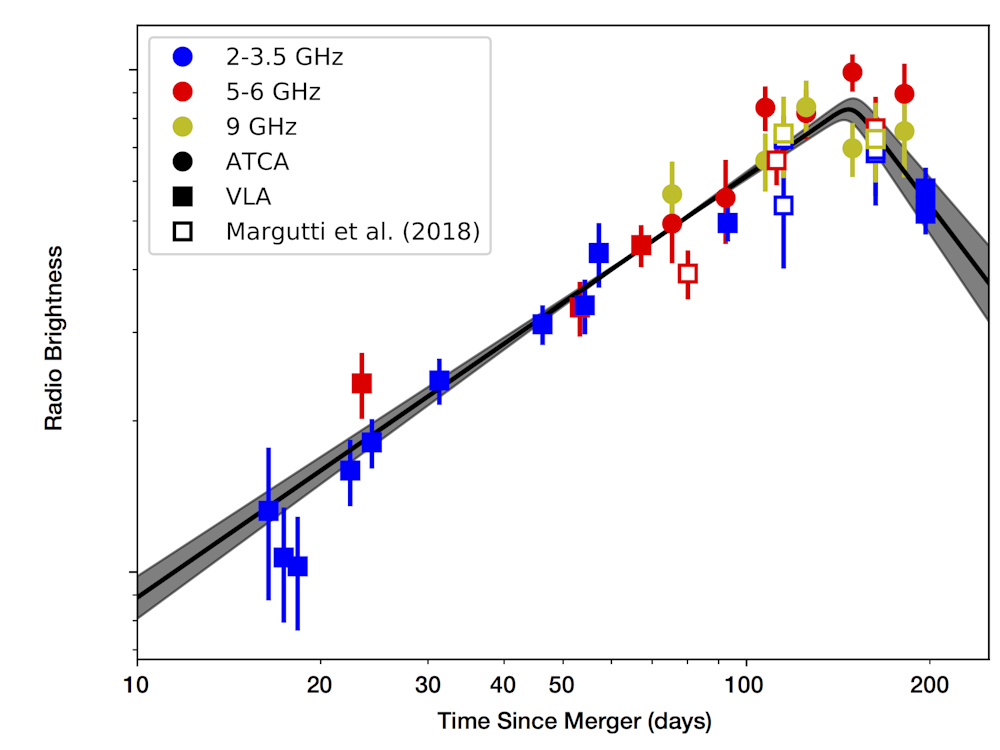 Radio observations of the neutron star merger show that it is now fading.
David Kaplan, Dougal Dobie. Data from Dobie et al. (2018), ApJL, Author provided
Radio observations of the neutron star merger show that it is now fading.
David Kaplan, Dougal Dobie. Data from Dobie et al. (2018), ApJL, Author provided
Saying goodbye (for now)
After eight months of watching GW170817 we know that it is different to anything we’ve seen before, and has behaved in completed unexpected ways.
Read more: Captured! Radio telescope records a rare 'glitch' in a pulsar's regular pulsing beat
The radio emission is now fading, but this may not be the end of the story. Most models predict a long term afterglow from neutron star mergers, so GW170817 might reappear months or even years in the future.
In the meantime, we are waiting with anticipation for the Laser Interferometer Gravitational-Wave Observatory (LIGO) to start its next observing run early next year. We might even capture a new type of event, a neutron star merging with a black hole.
Authors: Tara Murphy, Associate Professor and ARC Future Fellow, University of Sydney


 Daily Bulletin


