

neuroscience is advancing, but we're a long way off head transplants
- Written by: Lyndsey Collins-Praino, Senior Lecturer in School of Medicine, University of Adelaide
Take it from me is a new series in Science and Technology, where we find an expert to provide a personal but informed perspective on a topical issue.
In the 1983 film The Man with Two Brains, Steve Martin’s character falls in love with the disembodied brain of a woman named Anne.
But what once sat in the realm of movies and science fiction novels now seems slightly more plausible. Recent advances in neuroscience have lead to human cells being grown into “mini brains” in the lab, and brains of decapitated pigs being “kept alive” for a day and a half.
So are we closer to a time when brains may be able to function in isolation from a body – leading to head transplants or even brains frozen and brought back to life in the future?
I think such possibilities are a long way off.
Read more: From blood letting to brain stimulation: 200 years of Parkinson's disease treatment
A brain without a body
Professor Nenad Sestan of Yale University reported in March that he and his team restored blood circulation to the brains of decapitated pigs, and kept brain cells alive and functioning for up to 36 hours.
This technology, called “BrainEx”, restores circulation by connecting the brain to a series of pumps and heaters that pump artificial blood and carry oxygen to key regions, including areas deep inside the brain. This allows even microcirculation – the flow of blood to the smallest blood vessels and cells – to be restored.
This work opens up a number of potential future research avenues, including the ability to test new treatments for Alzheimer’s disease and other neurological conditions.
Read more: We can change our brain and its ability to cope with disease with simple lifestyle choices
A more developed area of neuroscience is the generation of brain organoids, “mini brains” grown from human stem cells and kept alive in the laboratory.
These organoids mimic features of the developing brain, allowing researchers to undertake research into conditions such as autism spectrum disorders and schizophrenia.
It doesn’t get much kookier than this 1983 trailer.Are the brains really alive?
Sestan believes his approach to keeping pig brains alive is likely to work in other species, including primates.
But what might keeping brains “alive” mean for the individual? Might it be possible for the disembodied brain to retain its consciousness and memory, devoid of any sensory input or ability to communicate?
Monitoring of the pig brains via a technique known as EEG showed no sign of complex electrical activity indicating thought or sensation. This could be due to lowered activity or damage of brain cells during the procedure.
But some research has indicated that, even when the EEG is a flat line, there may still be some activity in deep brain structures such as the hippocampus, a brain area critical for memory.
The question of measuring activity is also relevant to the brain organoids. With improvements in techniques, there is the potential that organoids may become more complex. Although it’s still very unlikely, it’s possible they may take on aspects of higher-order brain functioning, such as feeling pleasure and pain, storing memories, or even experiencing some degree of consciousness.
Read more: Trust Me I'm An Expert: The science of pain
What is consciousness?
Consciousness is one of the most difficult brain phenomena to explain, and a question that modern neuroscience is just beginning to make progress on. It’s even difficult to actually define what consciousness is.
Australian philosopher David Chalmers has referred to these challenges as the “hard problem” of consciousness – understanding why consciousness occurs.
Multiple theories and models of consciousness have been proposed, and experts tussle back and forth about which is most accurate. Some critics even claim that most theories of consciousness are “worse than wrong” – they don’t actually explain anything.
Physiologically, the EEG is still the most sensitive measure to indicate consciousness. When an individual is awake and alert, the EEG is “activated”, characterised by low voltage, high frequency fast brain waves.
When there is a loss of consciousness, brain waves slow down and get higher in amplitude as brain cells alter their firing rates.
Parts of the brain thought to be involved in consciousness include the rear part of the cerebral cortex (at the surface), and also deeper structures such as the brainstem. EEG activity in specific areas of the brain may be one of the most effective ways to discriminate between conscious and unconscious individuals.
Read more: Explainer: what is traumatic brain injury?
Can a brain without a body be conscious?
Currently we are a long way from experimental models of the human brain – such as brain organoids or disembodied brains – being conscious. However, we could need to confront such a possibility as technology advances and models become more sophisticated.
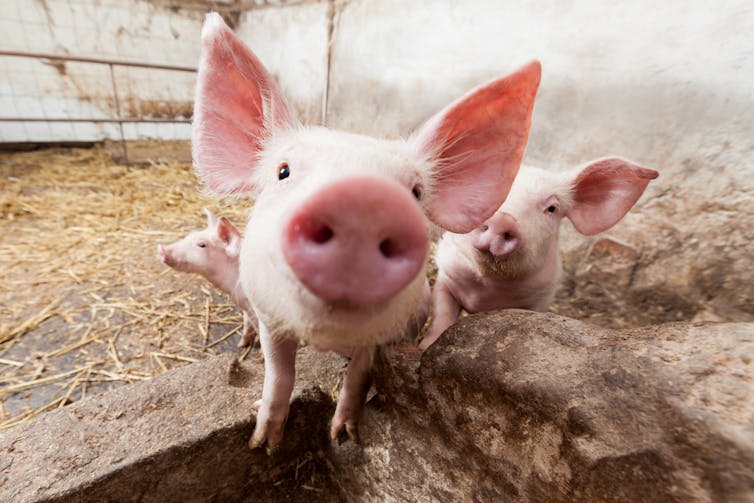 Pigs are very smart animals – they can be taught to play computer games.
from www.shutterstock.com
Pigs are very smart animals – they can be taught to play computer games.
from www.shutterstock.com
Indeed, the hope of this has led to initiatives such as cryogenically preserving (freezing) brains, and even proposed head transplants.
But I wouldn’t rush out and put my name down for these procedures just yet. In the case of cryogenically preserving tissue, evidence has yet to demonstrate that all areas of the brain are reached with the antifreeze used to protect tissue from fracturing at the extremely low temperatures.
Even if the tissue can somehow be protected from freezing damage, warming that tissue back up again is likely to result in further extensive problems. This would make it difficult, if not impossible, to ever return the brain to a conscious state – and that’s all before you deal with the issues inherent in actually transplanting the brain into another body.
Read more: Curious Kids: Why do our brains freak us out with scary dreams?
Many unknowns also exist with head transplants. While Italian neurosurgeon Professor Sergio Canavero has claimed that he will carry out the first human head transplant in 2018, many neuroscientists are sceptical.
There are a host of issues with such a procedure. There’s the possibility of rejection of the head by the donor body, and the difficulty of connecting the spinal cord to the brain in a way that the brain can control the donor body. Additionally, even if it did work in a physical sense, there are problems around how such a procedure might affect the individual’s sense of self-awareness or consciousness.
Where should the field go from here?
There are many ethical concerns linked to the idea of brains in culture or removed from bodies – including what protections are necessary, how to address issues around consent, ownership and post-research tissue handling, and even how to define death.
In late April, 17 experts in neuroscience, stem-cell biology, ethics and philosophy published an editorial in Nature outlining many of the issues that need to be considered and calling for “clear guidelines for research”.
Such conversations also need to be held outside of academic circles and should engage ethics committees, research funding bodies, and, most importantly, the wider public.
While there has never been a more exciting time to work in neuroscience, it is critical that proper safeguards be put in place now as models continue to advance.
Read more: Real Bodies controversy: how Australian museums regulate the display of human remains
Authors: Lyndsey Collins-Praino, Senior Lecturer in School of Medicine, University of Adelaide


 Daily Bulletin


