

If we can't recycle it, why not turn our waste plastic into fuel?
- Written by: Muxina Konarova, Advanced Queensland Research Fellow, The University of Queensland
Australia’s recycling crisis needs us to look into waste management options beyond just recycling and landfilling. Some of our waste, like paper or organic matter, can be composted. Some, like glass, metal and rigid plastics, can be recycled. But we have no immediate solution for non-recyclable plastic waste except landfill.
At a meeting last month, federal and state environment ministers endorsed an ambitious target to make all Australian packaging recyclable, compostable or reusable by 2025. But the ministers also showed support for processes to turn our waste into energy, although they did not specifically discuss plastic waste as an energy source.
Read more: A crisis too big to waste: China's recycling ban calls for a long-term rethink in Australia
The 100% goal could easily be achieved if all packaging were made of paper or wood-based materials. But realistically, plastic will continue to dominate our packaging, especially for food, because it is moisture-proof, airtight, and hygienic.
Most rigid plastic products can only be recycled a few times before they lose their original properties and become non-recyclable. Even in European countries with strict waste management strategies, only 31% of plastic waste is recycled.
Worldwide plastic production is predicted to increase by 3.8% every year until 2030. Flexible, non-recyclable plastic materials are used in an increasing range of applications like packaging, 3D printing, and construction.
We need to expand our range of options for keeping this plastic waste out of landfill. One potential approach is “plastic to energy”, which unlocks the chemical energy stored in waste plastic and uses it to create fuel.
How plastic to energy works
Plastic is made from refined crude oil. Its price and production are dictated by the petrochemical industry and the availability of oil. As oil is a finite natural resource, the most sustainable option would be to reduce crude-oil consumption by recycling the plastic and recovering as much of the raw material as possible.
There are two types of recycling: mechanical and chemical. Mechanical recycling involves sorting, cleaning and shredding plastic to make pellets, which can then be fashioned into other products. This approach works very well if plastic wastes are sorted according to their chemical composition.
Chemical recycling, in contrast, turns the plastic into an energy carrier or feedstock for fuels. There are two different processes by which this can be done: gasification and pyrolysis.
Gasification involves heating the waste plastic with air or steam, to produce a valuable industrial gas mixtures called “synthesis gas”, or syngas. This can then be used to produce diesel and petrol, or burned directly in boilers to generate electricity.
In pyrolysis, plastic waste is heated in the absence of oxygen, which produces mixture of oil similar to crude oil. This can be further refined into transportation fuels.
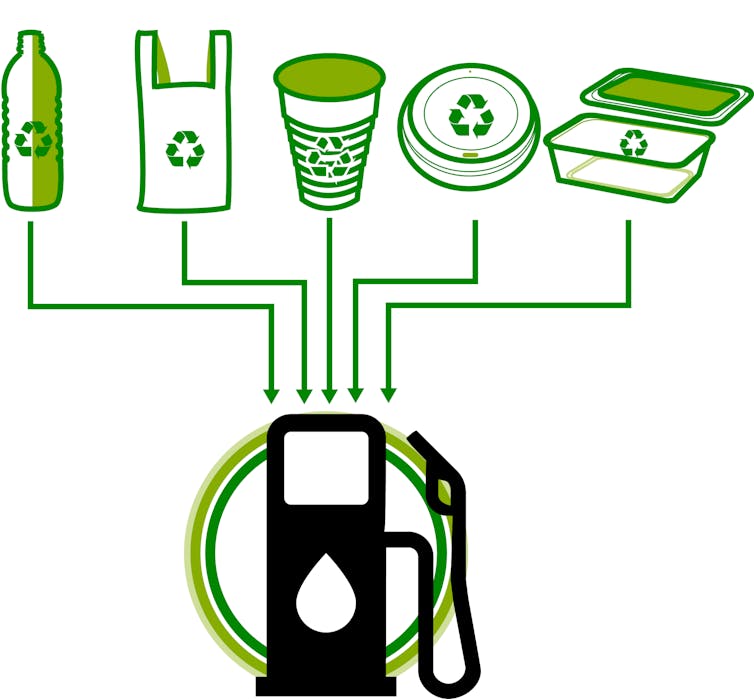 One of the advantages of plastic waste-to-fuel is that plastic doesn’t have to be separated into different types.
Author provided
One of the advantages of plastic waste-to-fuel is that plastic doesn’t have to be separated into different types.
Author provided
Gasification and pyrolysis are completely different processes to simply incinerating the plastic. The main goal of incineration is simply to destroy the waste, thus keeping it out of landfill. The heat released from incineration might be used to produce steam to drive a turbine and generate electricity, but this is only a by-product.
Gasification and pyrolysis can produce electricity or fuels, and provide more flexible ways of storing energy than incineration. They also have much lower emissions of sulfur and nitrogen oxides than incineration.
Currently, incineration plants are viewed as an alternative energy supply source and a modern way of driving a circular economy, particularly in Japan, South Korea and China, where land is valuable and energy resources are scarce. In other countries, although waste incineration is common practice, the debate around human health impacts, supply issues and fuel trade incentives remains unresolved.
Can Australia embrace plastic to waste?
Gasification of plastic waste needs significant initial financing. It requires pre-treatment, cleanup facilities, gas separation units, and advanced control systems. Pyrolysis units, on the other hand, can be modular and be installed to process as little as 10,000 tonnes per year – a relatively small amount in waste management terms. Plastic pyrolysis plants have already been built in the UK, Japan and the United States.
As pyrolysis and gasification technologies can only process plastics, many councils do not see major advantages in using them. But by taking only a specific waste stream, they encourage better waste sorting and help to reduce the flow of mixed waste and plastic litter.
Read more: The recycling crisis in Australia: easy solutions to a hard problem
Australia has invested a serious amount of funding into research, particularly in waste conversion. It has a solid industrialised infrastructure and a highly skilled workforce. The current recycling crisis offers an opportunity to explore some innovative ways of turning our waste into valuable products.
There are direct job opportunities in plastic conversion plants, and indirect jobs around installation, maintenance and distribution of energy and fuels. We might even see jobs in R&D to explore other waste conversion technologies.
In the meantime, the plastic we send to landfill is damaging our environment and harming wildlife. That needs to change, and Australia should consider plastic waste-to-energy as part of that change.
Authors: Muxina Konarova, Advanced Queensland Research Fellow, The University of Queensland
Read more http://theconversation.com/if-we-cant-recycle-it-why-not-turn-our-waste-plastic-into-fuel-96128


 Daily Bulletin


