

Logging burns conceal industrial pollution in the name of 'community safety'
- Written by: Chris Taylor, Researcher, University of Melbourne
Earlier this year, Melbourne and large areas of Central Victoria, experienced days of smoke haze and poor air quality warnings as a result of planned burns. It’s a regular event occurring every autumn.
This smoke has been reported by both government and media outlets as largely the result of planned burns to reduce bushfire risk, along with agricultural burn-offs and increased use of wood heaters.
Read more: Firestorms: the bushfire/thunderstorm hybrids we urgently need to understand
But this is only part of the story. A good proportion of the smoke this autumn has actually come from the intensive burning of debris left behind after clearfell logging. This is essentially industrial pollution.
 Smoke Haze over Mooroolbark and Melbourne’s eastern suburbs on Tuesday 1 May 2018, shortly after the time when the Poor Air Quality Index reached 901.
Photo: Chris Taylor, Author provided
Smoke Haze over Mooroolbark and Melbourne’s eastern suburbs on Tuesday 1 May 2018, shortly after the time when the Poor Air Quality Index reached 901.
Photo: Chris Taylor, Author provided
To understand why clearfell logging burns are different compared with planned burns to reduce bushfire risk, we need to understand clearfell logging, which involves cutting most or all of the commercially valued trees in one single operation across a designated area (called a “coupe”).
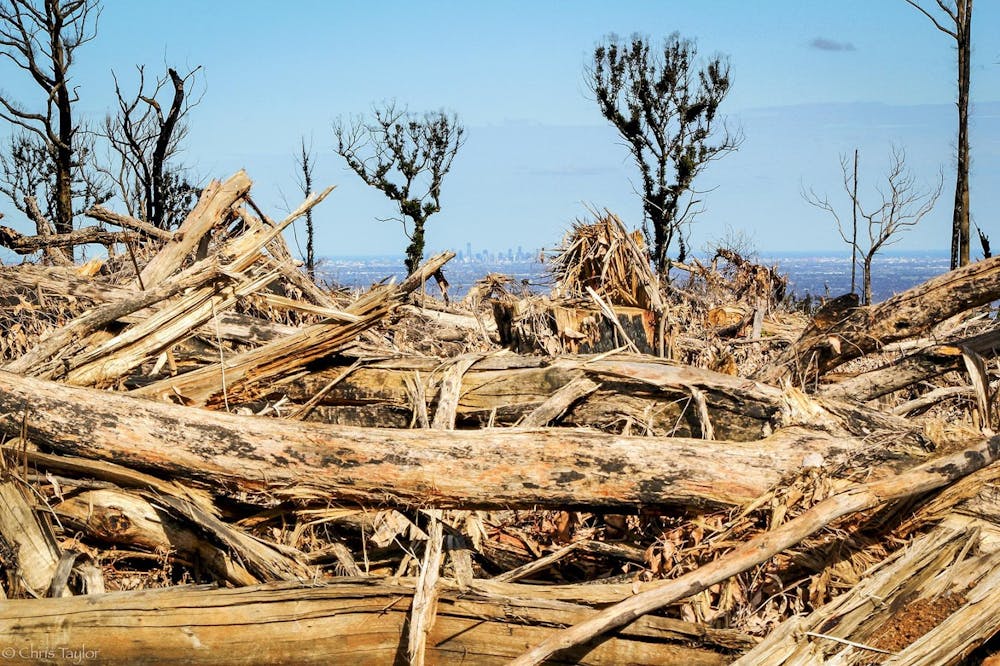 Large volumes of forest biomass are left on the ground following clearfell logging in the Mount Disappointment State Forest with the Melbourne City Skyline in the background, August 2010.
Photo. Chris Taylor., Author provided
Large volumes of forest biomass are left on the ground following clearfell logging in the Mount Disappointment State Forest with the Melbourne City Skyline in the background, August 2010.
Photo. Chris Taylor., Author provided
In the process of clearfell logging, understorey vegetation is usually pushed over. Along with tree heads and branches left behind after logging, large volumes of debris – known as “slash” – are created. This is partially removed by applying a high intensity burn across the coupe, which in turn establishes an ash seed bed for the next crop of trees to be established. Generally, around 90-100% of the coupe is burnt.
In contrast, planned burns to reduce bushfire risk (otherwise referred to as fuel reduction burns) are less intense. They mostly target “fine fuels” (vegetation less than 6mm in diameter) on the forest floor and in the understorey, which may average around 15 tonnes per hectare (t/ha). Burn coverage is usually 50-70% of the site.
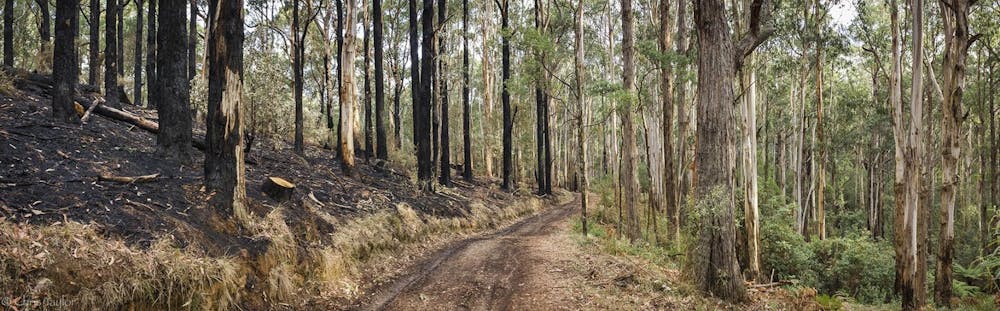 Surface and understorey ‘fine fuels’ targeted in a recent low intensity burn near Mt Dandenong in April 2018.
Photo: Chris Taylor, Author provided
Surface and understorey ‘fine fuels’ targeted in a recent low intensity burn near Mt Dandenong in April 2018.
Photo: Chris Taylor, Author provided
Clearfell logging burns consume much larger volumes of vegetation biomass in the form of tree heads, branches, bark and downed understorey vegetation. According to a report completed for the National Carbon Accounting System, clearfell logging burns consume, on average, 130 t/ha of slash in mixed-species forest and 140 t/ha of slash in Mountain Ash forests. This means that, while clearfell logging burns cover much less ground than fuel reduction burns, they burn far more biomass per hectare – generating far more smoke.
The list of planned burns on Forest Fire Management Victoria’s website showed that, at the beginning of May, 77 of the 119 burns either lit or planned to be lit across the Central Highlands of Victoria and surrounding areas were on logging coupes.
Read more: After the firestorm: the health implications of returning to a bushfire zone
These burns were individually lit over a period of weeks, with some days predominantly logging burns, others fuel reduction burns. An example when logging burns were prominent occurred on April 20 this year, where 10 out of 12 planned burns were observed as occurring on logging coupes. Using a simple calculation based on average biomass consumption, fuel loads and burn coverage for logging and fuel reduction burns, we estimate that up to 99% of biomass burnt most likely occurred on logging coupes. The following day, the Environmental Protection Authority observed “poor” air quality at multiple air monitoring stations across Melbourne due to smoke.
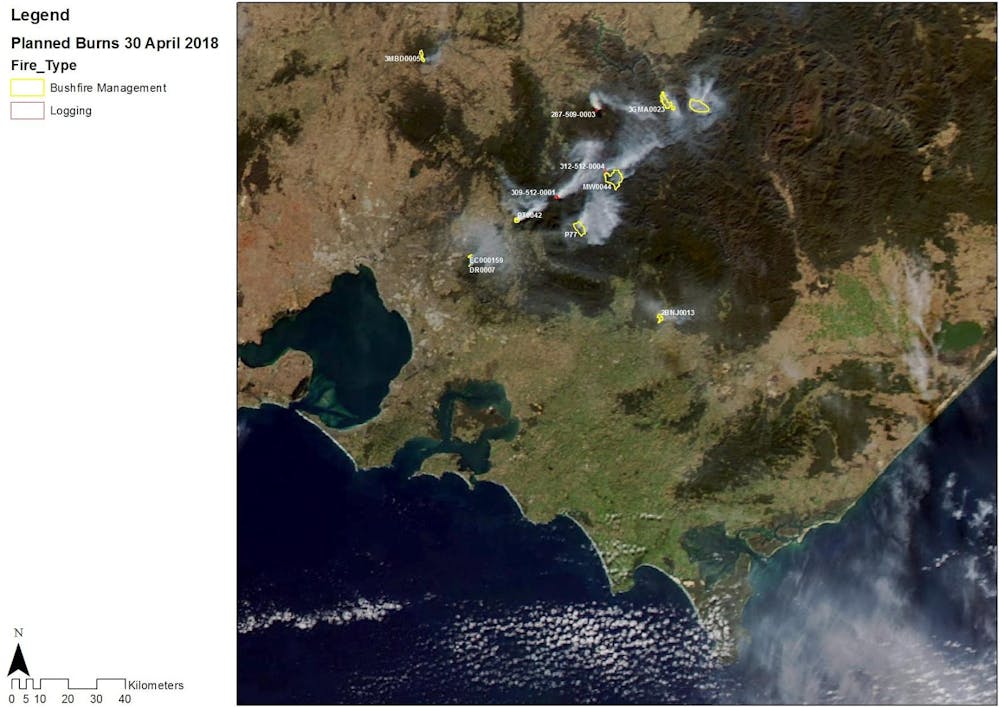 MODIS Rapid Response Terra Satellite image taken 20 April 2018 showing the smoke intensity of the logging burns.
NASA 2018
MODIS Rapid Response Terra Satellite image taken 20 April 2018 showing the smoke intensity of the logging burns.
NASA 2018
Even on days when the majority of burns lit were for fuel reduction, planned logging burns still contributed a proportion of biomass burned. For example, on April 30, only three out of 12 planned burns were observed as occurring on logging coupes, but they may have contributed to around one-third of the total biomass burned.
Read more: Future bushfires will be worse: we need to adapt now
Likewise, on the following day, the Environmental Protection Authority observed “very poor” air quality across multiple air monitoring stations. While multiple planned burns contributed to this pollution event, we contend that logging burns increased the levels of pollution in addition to the smoke originating from fuel reduction burns.
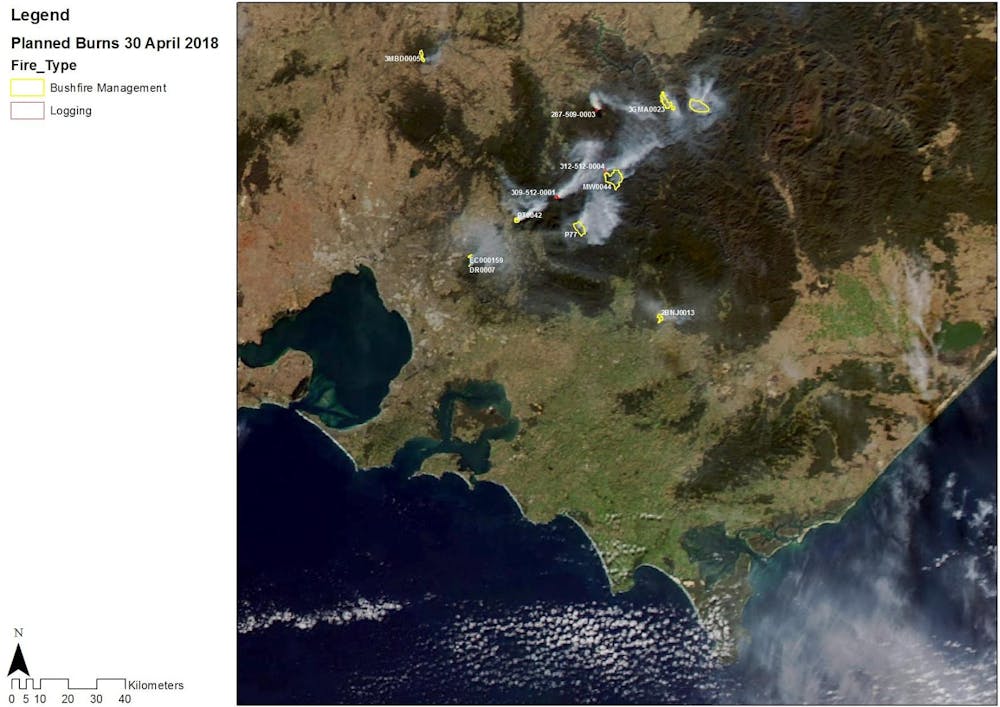 MODIS Rapid Response Terra Satellite image taken 30 April 2018 showing the smoke intensity of the planned burns.
NASA 2018
MODIS Rapid Response Terra Satellite image taken 30 April 2018 showing the smoke intensity of the planned burns.
NASA 2018
The key issue here is that not all “planned burns” are equivalent. Fuel reduction burns are intended to reduce the bushfire risk to lives and property. Indeed, work led by The Australian National University shows that regular fuel reduction burns can reduce risk to properties if carried out within close proximity.
In contrast, clearfell logging burns are part of an industrial process that extracts pulp logs and sawlogs for commercial sale to private enterprise. They play no part in reducing bushfire risk to life and property. Actually, the reverse is true: logging makes forests more prone to subsequent high-severity crown-consuming fires with associated risks to communities.
Read more: Victoria's logged landscapes are at increased risk of bushfire
Given that a substantial proportion of the recent smoke over Melbourne and surrounding regional Victoria likely originated from logging burns, could that smoke be deemed industrial pollution? This is a valid question, given the serious health impacts associated with smoke pollution.
Logging burns would not be needed (and a substantial amount of associated smoke not generated) if the forest had not been logged in the first place. It is imperative that government departments inform the public about the smoke pollution coming from logging operations, whose purpose is for private commercial gain.
Authors: Chris Taylor, Researcher, University of Melbourne


 Daily Bulletin


