

how the Shanghai AFL game might strengthen Australia-China relations
- Written by: Damien Spry, Honorary Associate, University of Sydney
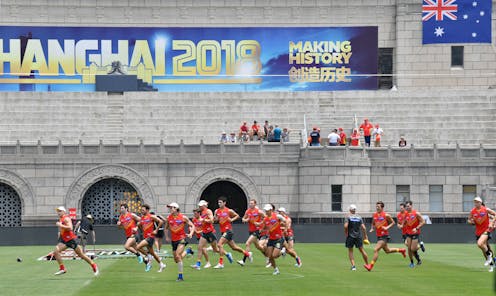
One of us, a Crows fan, will this weekend be supporting Port Power (sorry, Mum). The other follows the Gold Coast Suns, their opponents in Shanghai on Saturday. While we disagree on who will be victorious on the pitch, both of us are certain that sports diplomacy will be the winner.
This game, a repeat of last year’s contest, is the only AFL premiership match played (twice) outside Australasia (two were played in New Zealand). It is a key aspect of the AFL’s designs to grow the game internationally. Port’s China Strategy is arguably the most advanced.
This is more than just a game of footy. The fixture aims to develop interest in “Australia’s game” in a potentially massive overseas market, and create opportunities for trade and investment via parallel business networking events.
Most importantly, and building on the warm relationship established between Prime Minister Malcolm Turnbull and Chinese premier Li Keqiang during a 2017 Port game, there are hopes that such informal events could ease strains on the formal China-Australia diplomatic relationship.
Read more: Australians working in China should expect fallout over questions of political interference
The widely reported recent tensions between Australia and its major economic partner spring from concerns about excessive Chinese interference in Australia’s domestic politics. These include influence on local Chinese language media and in Australian universities, as well as tensions around Chinese activity in the South China Sea.
Turnbull’s mention of China when introducing laws targeting foreign interference, and speeches by the PM and Foreign Minister Julie Bishop in defence of international law and opposing aggression in the region, prompted sharp rebukes in official Chinese press. They also sparked reports in the Australian press (refuted by DFAT) that China had delayed or denied visas for Australian officials.
The event in Shanghai presents a chance to move on, which is why Trade and Tourism Minister Steve Ciobo is heading to Shanghai. Hailing from the Gold Coast, he’ll no doubt be backing the Suns while seeking to ease tensions and support Australian exporters. This is the first visit by an Australian minister in eight months – signs of a thaw, perhaps.
Three related questions arise out of the AFL, Port and the Suns’ outreach to China: Can the AFL gain a foothold in China? Can sports diplomacy further Australia’s foreign policy goals? Can footy diplomacy thaw frosty Australia-China relations?
At first blush, convincing China to embrace Australian rules football seems fanciful. The crowds in Shanghai are modest. However, the airing of Port Adelaide games on Chinese state broadcaster CCTV reached about 3 million Chinese viewers in 2017. That figure eclipses the 2017 AFL grand final’s audience of 2.7 million, itself the largest TV audience in Australia last year. AFL will never be the biggest sport in China, but it could have a sizeable fan base there.
Second, this isn’t the first time sport has been a bridge between Australia and China. In the lead-up to the 2008 Beijing Olympics, Australia’s “Olympic Army” – including security consultants, games planners, architects (an Australian firm devised the bubbles on the outside of the famous Watercube stadium) – was heavily involved.
This idea fits with the Australian Government’s Sports Diplomacy Strategy 2015-2018, which aims to use our sporting prowess to increase Australia’s brand, reputation and soft power in the region.
Research into the coverage of the Asian Football Cup, for example, provides tantalising evidence of the efficacy of sport as a foreign policy tool. It also highlights the risks of inadvertent damage to the national brand when sporting representatives behave poorly (we’ll be hearing about ball tampering from cricket-mad India for a while, we suspect).
The footy strategy also supports cultural diplomacy. Port hosts Chinese international students at home matches in Adelaide and sends elite players and teams – including, with DFAT assistance, its Aboriginal Academy team – to China, developing ties and gaining media coverage.
As well as engaging Chinese as potential AFL fans, the game has apparently piqued Port Adelaide fans’ interest in China. Over half of those surveyed reported their understanding of the Australia-China relationship had increased due to their club’s involvement, and nearly all of them thought a positive relationship was good for Australia.
More tangibly, Australian foreign policy goals include promotion of Australian businesses and investments. Port chairman David Koch’s breakthrough occurred in 2015: he hosted Shanghai CRED Real Estate Stock founder and billionaire Gui Guojie, who became the first major supporter of the club’s “Open to the World” strategy and a driving force behind the game in Shanghai.
The South Australian and Victorian governments also support the China venture, recognising its potential promotional value, as does Tourism Australia, the University of Adelaide and many other non-state sporting actors. The China Power Club operates as a business matching venture for Australian and Chinese firms. Prospects look good.
Read more: When it comes to China's influence on Australia, beware of sweeping statements and conflated ideas
Finally, can diplomatic tensions be resolved via sport? Let’s be clear: there is little prospect that disagreements over the South China Sea or new ports in Pacific Island Nations will be resolved over half-time meat pies (or pork buns).
But sport has a history of providing opportunities for détente, or at least discussion. It can ease tensions in stained relationships, generate pathways for dialogue away from staid settings, and demonstrate that although nations may be poles apart on some issues, they can still watch a game of sport together.
While conservatives, hard power junkies, and naysayers will no doubt continue to smirk at the concept of sports diplomacy, it has to be remembered that in the anarchic world of international relations, formal positions, agreements and policies are always preceded by informal discussions.
Authors: Damien Spry, Honorary Associate, University of Sydney


 Daily Bulletin


