

How to choose the right contraceptive pill for you
- Written by: Anita Phillips, Deputy Director of Clinical Studies, School of Medicine, Faculty of Health, Deakin University
ON THE PILL: In this seven-part series we explore the history, myths, side-effects and alternatives of the pill, and why it’s the most popular form of contraception in Australia.
The combined oral contraceptive pill is the most popular contraception in Australia. It’s less invasive than implants or devices that need to be fitted in the arm or uterus, making it an attractive option for many women.
There are more than 30 types of oral contraceptive pills. Different types and brands of contraceptive pill contain different types and doses of synthetic oestrogen and progesterone.
But brand names such as Microgynon, Levlen, Yaz, Brenda and Norimin give little indication of the ingredients, dose or who should use them.
When looking for the right pill, women want to weigh up the cost, safety, efficacy and side effects of the pill. Some women might also be seeking non-contraceptive benefits, such as treatment for acne, pre-menstrual syndrome, heavy or painful periods, endometriosis, or polycystic ovarian syndrome.
Read more: Explainer: what are the options for birth control?
Cost
 A year of the pill costs anywhere between A$20 and A$360.
Areeya_ann/Shutterstock
A year of the pill costs anywhere between A$20 and A$360.
Areeya_ann/Shutterstock
Current guidelines recommend GPs prescribe pills that are subsidised on the Pharmaceutical Benefits Scheme (PBS) for women to trial first.
And at less than A$120 a year (A$20 a year for concession card holders), they are the cheapest.
The newer and more expensive pills claim to be superior in reducing acne, PMS or menstrual bleeding, which is why they end up being prescribed. But all contraceptive pills have these advantages, and the evidence for supporting one over the other is limited or conflicting.
You’ll pay up to A$360 per year for non-PBS prescriptions.
Safety
Healthy women often take the pill for many years, so its safety profile needs to be excellent. The risk of breast cancer is slightly increased while on the pill, resulting in an extra 1.5 women per 10,000 women getting breast cancer. But the pill actually protects against endometrial and ovarian cancer.
Taking the pill doubles the risk of venous thromboembolism (or VTE, where clots develop in the brain, legs or lungs), but it’s still less than the risk of developing VTE in late pregnancy.
Read more: Don't panic about the pill – it's safer than driving to work
The higher the oestrogen dose, the higher the risk of VTE, which is why pills with 50 micrograms of oestrogen (Microgynon 50 and Norinyl-1) are very rarely prescribed.
Pills with newer generation progesterones potentially double the risk of venous thromboembolism. Yaz Flex – commonly prescribed for its convenient dosing dispenser (Clyk) and its reportedly low risk of weight gain and mood swings – contains one of these newer progesterones. It’s therefore not recommended as a “first use pill”.
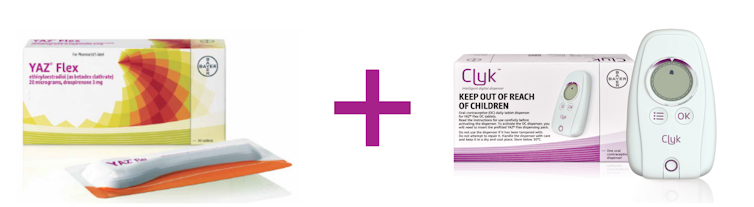 The Clyk dispenser releases the daily pill via machine rather than the traditional blister pack.
Yaz screenshot
The Clyk dispenser releases the daily pill via machine rather than the traditional blister pack.
Yaz screenshot
The oestrogen dose in the pill is also responsible for the very slightly increased risk of strokes and heart attacks.
The risks of VTE, strokes and heart attacks are also affected by a woman’s background risk of these conditions. Women may not be able to take the pill if they have a history of heart disease, breast cancer, liver disease, VTE or migraines with aura; are over 50 or over 35 and smoke; have a BMI over 35; or have a family history of VTE.
Efficacy
The pill’s failure rate of 9% is high compared to long-acting reversible (LARC) forms of contraception, such as IUDs and arm implants. This means nine out of 100 women becoming pregnant after a year on the pill, compared with less than one women with an IUD or arm implant.
Read more: Few Australian women use long-acting contraceptives, despite their advantages
If taken perfectly, the pill should work 99.7% of the time. But fewer than 20% of pill takers in one study were able to do that every month. And if you do miss a pill, the complicated rules surrounding missed pills are difficult to remember and understand.
Decreasing the risk of unwanted pregnancy is best addressed by extending whatever regime you pick. This means that rather than taking 21 active pills and seven inactive (sugar) pills to mimic a menstrual bleed, you take 84 active pills, followed by seven inactive pills and have a “withdrawal” bleed once every three months.
By running the pill packs together, you reduce the risk of ovulating if a pill is accidentally missed.
Side effects
The unwanted side effects of the pill include breakthrough bleeding, mood changes, weight gain, sore breasts and acne.
 The pill usually reduces acne, but some women may experience it as a side effect.
Yurakrasil/Shutterstock
The pill usually reduces acne, but some women may experience it as a side effect.
Yurakrasil/Shutterstock
After a three month trial, if you experience any of these unwanted effects, but want to stick with the pill as a form of contraception, it might be helpful to change types or doses of hormones. For example:
headaches can be addressed by reducing the dose of oestrogen or changing to the newer oestradiol in Qlaira
nausea can be alleviated by taking the pill at night or reducing the oestrogen dose
breast tenderness and bloating can be treated by reducing the oestrogen or changing the progesterone to drospirenone, which acts as a mild diuretic.
breakthrough bleeding can be addressed by remembering to take the pill at the same time each day. If that isn’t the problem, changing the progesterone type may work, particularly to norethisterone, which is in Brevinor and Norimin.
Non-contraceptive benefits
Heavy or painful menstrual bleeding
All hormonal contraception will change women’s menstrual bleeding patterns, generally to make it lighter or non-existent. And because you can skip the sugar pills, you can pick when and how often you bleed.
Most women experience irregular bleeding when starting on the pill, but this generally decreases over the first three months.
Pills containing higher doses of oestrogen are better at reducing break through or irregular bleeding. Loette or Microgynon 20, which have the lowest dose of oestrogen on the market – 20mcg of ethinyl oestradiol – won’t be as good if heavy and irregular bleeding is your problem.
Pills with the progesterone norethisterone, which is found in Brevinor and Norimin, are generally considered to reduce bleeding more than the progesterone called levonorgestral (which is found in pills such as Monofeme, Levlen and Microgynon).
 The pill usually reduces bleeding.
Shinja jang/Shutterstock
The pill usually reduces bleeding.
Shinja jang/Shutterstock
Endometriosis
The pill can be an effective way to treat endometriosis by suppressing the menstrual cycle. A continuous regime, skipping periods, is used to slow endometrial growth.
Acne
Reducing the acne-causing androgen hormones can help treat acne, alongside topical or antibiotic treatments. All pills will do this.
The progesterone cyproterone acetate is used by itself for acne and is found in pills such as Brenda-35ED and Diane-35ED, which are marketed for use in people with severe acne. However, there’s little evidence they’re more effective than other pills at treating acne.
Premenstrual syndrome
Premenstrual syndrome (PMS) is a common condition that causes cramps, irritability, mood swings and tender breasts before a period. It can be debilitating in its more severe form of premenstrual dysphoric disorder (PMDD).
Read more: Chemical messengers: how hormones affect our mood
Suppressing the hormonal fluctuations during the menstrual cycle using the contraceptive pill can help alleviate symptoms.
If pills listed on the PBS such as Levlen are ineffective, your GP might recommend the combination of low-dose oestrogen and a type of progesterone called drospirenone, found in Yaz.
Polycystic ovarian syndrome
Women with polycystic ovarian syndrome (PCOS) can suffer from acne, irregular periods and excess hair. The pill is one way to treating these symptoms, along with lifestyle changes.
Breastfeeding
The mini pill is a progesterone only pill, used mainly by breastfeeding mothers and those who can’t have oestrogen.
Users have a three-hour window to take their daily dose, otherwise it becomes ineffective. This dosing makes it difficult for most people to take effectively.
 Breastfeeding women on the pill need to take it at the same time every day.
Tomsickova Tatyana/Shutterstock
Breastfeeding women on the pill need to take it at the same time every day.
Tomsickova Tatyana/Shutterstock
Given the contraceptive implant hormonal IUD can be used in breastfeeding women and those who can’t have oestrogen, and more reliably prevents pregnancy, the mini pill has few benefits.
Find what is best for you
The combined oral contraceptive pill has some great non-contraceptive benefits but some serious side effects. Given the number of pills on the market to choose from, unwanted effects don’t need to be tolerated. You don’t need to commit the detail above to memory; your GP will guide you through the process of finding the right pill for you.
If the failure rate of the pill is an issue, or if changing your pill hasn’t alleviated your side effects, talk to your GP about reversible contraceptive options, including non-hormonal IUDs, which further reduce the risk of pregnancy and last five to ten years.
Authors: Anita Phillips, Deputy Director of Clinical Studies, School of Medicine, Faculty of Health, Deakin University
Read more http://theconversation.com/how-to-choose-the-right-contraceptive-pill-for-you-87614


 Daily Bulletin


