

Sandpaper figs make food, fire, medicine and a cosy home for wasps
- Written by: Danica-Lea Larcombe, PhD Candidate in Biodiversity and Human Health, Edith Cowan University
Welcome to Beating Around the Bush, a series that profiles native plants: part gardening column, part dispatches from country, entirely Australian. Read more about the series here or get in touch to pitch a plant at batb@theconversation.edu.au.
Australia has about 42 native species of Ficus, that include vines, plants that grow on other plants (epiphytes), and woody trees.
In this article we will explore the unique features of the Sandpaper Figs, named so because of the rough texture of their leaves. From finishing tools, as the name suggests, to curing ringworm and making fire, these excellent trees do it all.
 CC BY-ND
Can you grow it?
There are three species of sandpaper fig native to the South East Queensland area, although sandpaper figs grow all along the east coast and top end of Australia in gullies and rainforest. They are rarely found in southern Australia. Similar species with sandpaper-like leaves are found in other parts of the world such as Kenya, Africa and in Papua New Guinea.
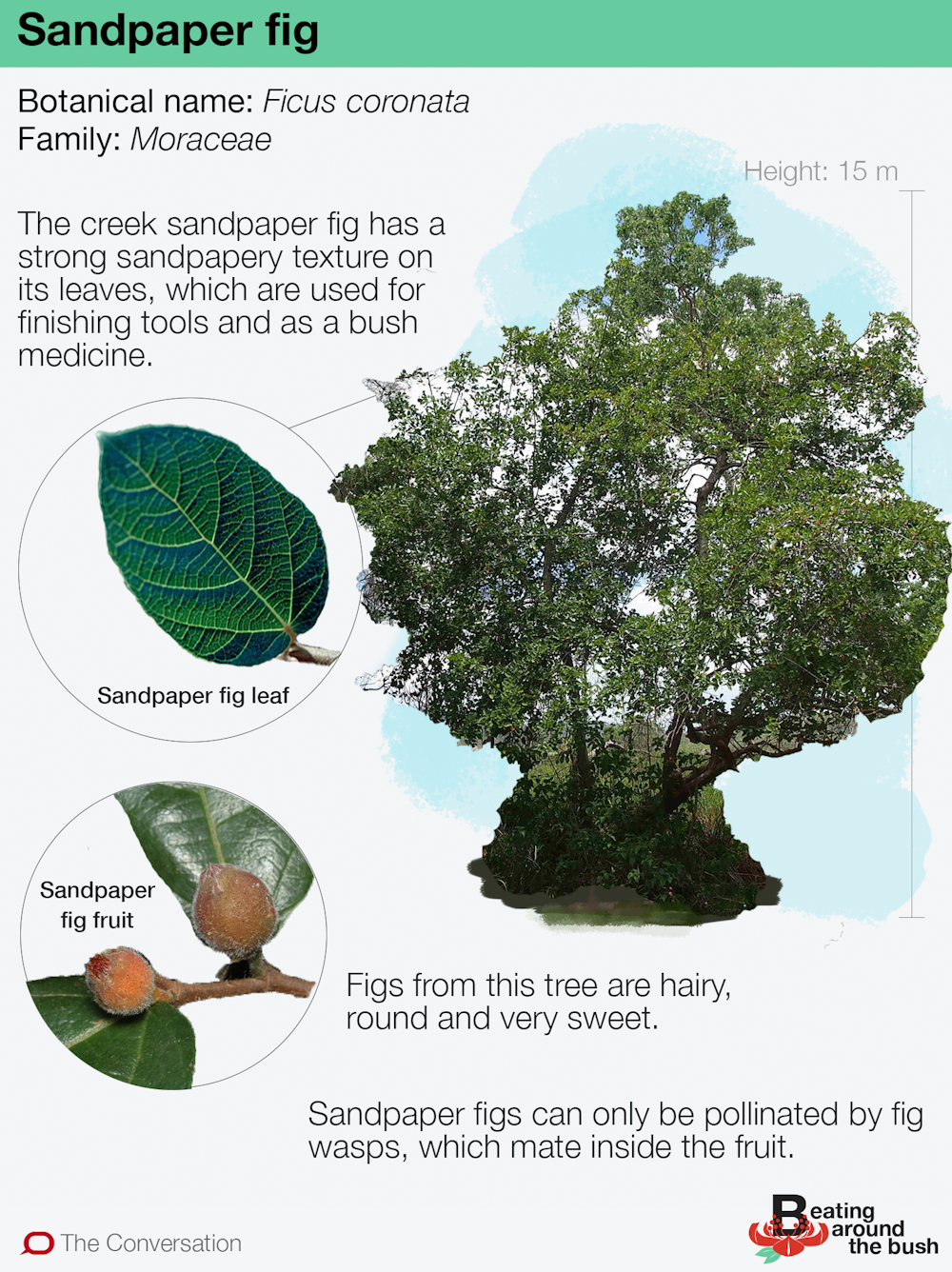
The most common variation is the creek sandpaper fig, Ficus coronata. It has hairy, round, very sweet figs, turning purple to black as they ripen in the months of January to June, and a strong sandpapery texture on its leaves.
Less common is the sweet sandpaper fig, Ficus opposita. It grows squat-shaped, smooth, sweet figs (always in pairs) for the majority of the year, and knobbly branches, and the underside of its leaves have a hairy or velvety texture.
Lastly is the shiny sandpaper fig, Ficus fraseri. Its natural habitat is the rainforest, and also has a sandpaper texture, but more so on its branches than leaves. Its figs are egg-shaped, with a yellow-orange phase from June to November.
The immature, straggly Ficus coronata has a dark brown trunk and oval or elliptical leaves. It uses aerial roots that grow down from the branches to the ground while taking in nutrients and moisture from the air. These roots evolved so that the tree could germinate and grow in wet areas, barren soils and rocky outcrops. Once the roots have travelled to the ground, they expand to support the tree’s branches, creating some unusual shapes. The mature tree can grow up to 15 metres tall.
In your garden a sandpaper fig will attract birds, and is hardy and easy to grow. They prefer lots of light and moisture, free from frosts. As with all Ficus species that have large root systems, you must plant them well away from houses, ideally in a larger block (although they are relatively small compared to fig trees such as the Moreton Bay). They can tolerate heavy pruning so may be used as a hedge. Regular fertilising and addition of organic matter will ensure a healthy tree and production of fruit.
Don’t despair if you have a small block or are in a frost zone – you can try growing a Ficus in a large pot outdoors, a pot indoors or even create a bonsai tree.
CC BY-ND
Can you grow it?
There are three species of sandpaper fig native to the South East Queensland area, although sandpaper figs grow all along the east coast and top end of Australia in gullies and rainforest. They are rarely found in southern Australia. Similar species with sandpaper-like leaves are found in other parts of the world such as Kenya, Africa and in Papua New Guinea.
The most common variation is the creek sandpaper fig, Ficus coronata. It has hairy, round, very sweet figs, turning purple to black as they ripen in the months of January to June, and a strong sandpapery texture on its leaves.
Less common is the sweet sandpaper fig, Ficus opposita. It grows squat-shaped, smooth, sweet figs (always in pairs) for the majority of the year, and knobbly branches, and the underside of its leaves have a hairy or velvety texture.
Lastly is the shiny sandpaper fig, Ficus fraseri. Its natural habitat is the rainforest, and also has a sandpaper texture, but more so on its branches than leaves. Its figs are egg-shaped, with a yellow-orange phase from June to November.
The immature, straggly Ficus coronata has a dark brown trunk and oval or elliptical leaves. It uses aerial roots that grow down from the branches to the ground while taking in nutrients and moisture from the air. These roots evolved so that the tree could germinate and grow in wet areas, barren soils and rocky outcrops. Once the roots have travelled to the ground, they expand to support the tree’s branches, creating some unusual shapes. The mature tree can grow up to 15 metres tall.
In your garden a sandpaper fig will attract birds, and is hardy and easy to grow. They prefer lots of light and moisture, free from frosts. As with all Ficus species that have large root systems, you must plant them well away from houses, ideally in a larger block (although they are relatively small compared to fig trees such as the Moreton Bay). They can tolerate heavy pruning so may be used as a hedge. Regular fertilising and addition of organic matter will ensure a healthy tree and production of fruit.
Don’t despair if you have a small block or are in a frost zone – you can try growing a Ficus in a large pot outdoors, a pot indoors or even create a bonsai tree.
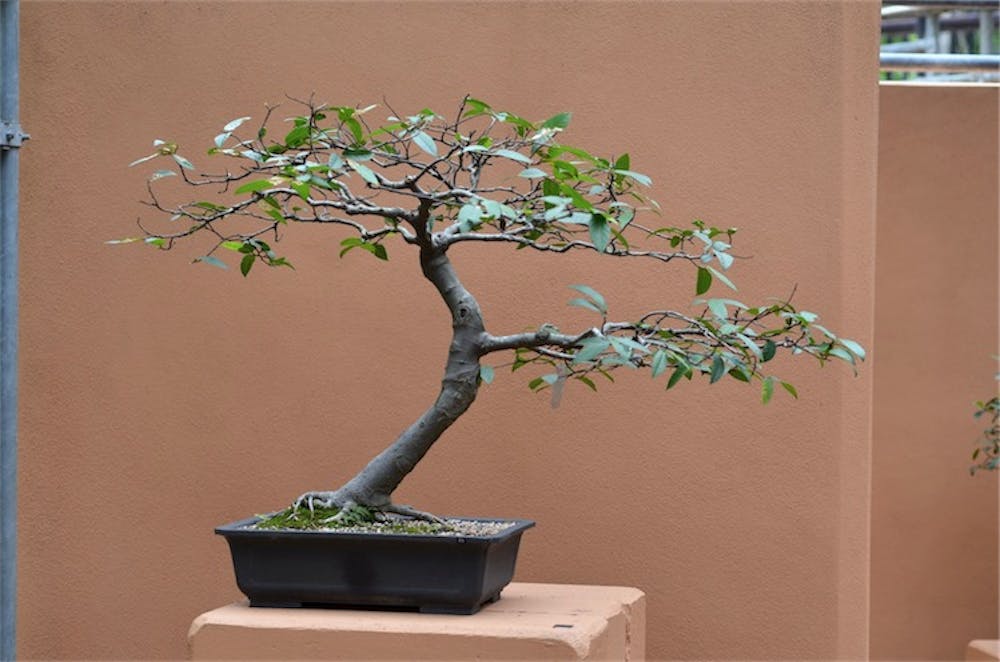 A bonsai ficus at the Brisbane Botanic Gardens.
Fagg, M/Australian Plant Image Index (APII)- Photo No. : dig.28304
Wasp’s my name
The fig tree is unique because its flower, made up of hundreds of tiny florets, is wrapped inside the fruit. You might then wonder how the flower can be pollinated. An amazing symbiotic feat of nature created the aptly names fig wasp to pollinate the figs, and in return the wasp can only mate inside the fig flower.
A female fig wasp recognises the special scent of the exact species of fig tree where she was born, and returns only to that species. She enters the fig by squeezing through a tiny hole near the top of the fruit (an ostiole), losing her wings and some of her antennae as she enters. She then dies inside the fruit after laying her eggs.
Male offspring are born without wings 20-100 days later, mate with the female offspring, and then die shortly after boring a hole through the fruit to make their escape. Only then can the female offspring collect the now ripe pollen and carry it to another fig tree of the same species.
The fruit gets the signal to ripen after the wasps have bored a hole and the carbon dioxide level inside has dropped, producing tasty sweet figs.
Indigenous use
Historically many groups of indigenous people from mainland Australia ate these figs. Some were eaten raw and others were beaten to make a paste and then mixed with honey and water.
In bush medicine the sandpaper fig leaves were used in conjunction with stinking passion flower to relieve insect bites. The rough texture of the leaves would be used to rub the skin until it bled, and then the passion flower would be applied. The leaves of the Sandpaper Fig were also used as a cure for ringworm infections. The skin would again be rubbed raw with the leaves and the milky sap applied. This sap was additionally useful for treating wounds.
Indigenous people used the rough sandpapery texture of the leaves to finish off their tools and polish their wooden boomerangs and spears. Straight branches were used for fire starter sticks and string could also be made from the bark .
It provides food, medicine, fire and tools: a wonderful all-rounder in the Australian plant pantheon.
A bonsai ficus at the Brisbane Botanic Gardens.
Fagg, M/Australian Plant Image Index (APII)- Photo No. : dig.28304
Wasp’s my name
The fig tree is unique because its flower, made up of hundreds of tiny florets, is wrapped inside the fruit. You might then wonder how the flower can be pollinated. An amazing symbiotic feat of nature created the aptly names fig wasp to pollinate the figs, and in return the wasp can only mate inside the fig flower.
A female fig wasp recognises the special scent of the exact species of fig tree where she was born, and returns only to that species. She enters the fig by squeezing through a tiny hole near the top of the fruit (an ostiole), losing her wings and some of her antennae as she enters. She then dies inside the fruit after laying her eggs.
Male offspring are born without wings 20-100 days later, mate with the female offspring, and then die shortly after boring a hole through the fruit to make their escape. Only then can the female offspring collect the now ripe pollen and carry it to another fig tree of the same species.
The fruit gets the signal to ripen after the wasps have bored a hole and the carbon dioxide level inside has dropped, producing tasty sweet figs.
Indigenous use
Historically many groups of indigenous people from mainland Australia ate these figs. Some were eaten raw and others were beaten to make a paste and then mixed with honey and water.
In bush medicine the sandpaper fig leaves were used in conjunction with stinking passion flower to relieve insect bites. The rough texture of the leaves would be used to rub the skin until it bled, and then the passion flower would be applied. The leaves of the Sandpaper Fig were also used as a cure for ringworm infections. The skin would again be rubbed raw with the leaves and the milky sap applied. This sap was additionally useful for treating wounds.
Indigenous people used the rough sandpapery texture of the leaves to finish off their tools and polish their wooden boomerangs and spears. Straight branches were used for fire starter sticks and string could also be made from the bark .
It provides food, medicine, fire and tools: a wonderful all-rounder in the Australian plant pantheon.
Authors: Danica-Lea Larcombe, PhD Candidate in Biodiversity and Human Health, Edith Cowan University
Read more http://theconversation.com/sandpaper-figs-make-food-fire-medicine-and-a-cosy-home-for-wasps-96404


 Daily Bulletin


