

How a trip to Antarctica became a real-life experiment in decision-making
- Written by: Sarah Hamylton, Senior Lecturer, School of Earth and Environmental Sciences, University of Wollongong
This adventurous tale is part of our occasional long read series Zoom Out. Enjoy!
We were part of a group of 77 women travelling by ship to an Antarctic research station when our route was blocked by icebergs. We had to make a decision. Should we detour into rough open ocean to reach the target site, or abandon plans to visit Rothera Research Station and settle instead for a few days of exploring Antarctica’s calmer, protected waters?
This is the story of “Rothera-gate”, a leadership development experience on the largest all-female expedition to Antarctica. The 2018 expedition was the culmination of a year-long strategic leadership initiative for women scientists called Homeward Bound.
Men typically hold the leadership positions in STEMM (Science, Technology, Engineering, Mathematics and Medicine). In recognition of this, the Homeward Bound initiative works with women in science to enhance their opportunity to take up leadership roles globally, and contribute proactively to a sustainable world.
Headed for Rothera
Our experience took place while travelling down the Antarctic Peninsula to Rothera, a British research station at 67° south, just inside the Antarctic Circle. This was intended to be the southernmost point of our journey.
While our group was largely women, several men were on board, including the captain of the ship (in charge from a legal perspective), the expedition leader and members of the Homeward Bound “Faculty” (a group of ten experts coordinating, organising and delivering the formal scientific leadership program throughout the voyage).
Our presence in Rothera would be a special occasion, as not many Antarctic ships make it that far south – only two ship visits are permitted each year. Ours was to be a final visit before the base closed for a two-year refurbishment.
On day 13 of our voyage, within 75km of Rothera, we passed between Adelaide Island and the Antarctic Peninsula into a narrow passage known as The Gullet. Wind and waves had blown icebergs into the passage, blocking our way south. Our expedition leader announced that a difficult decision had to be made: should we or should we not continue to Rothera?
To go, we would need to double back and around the outside of Adelaide Island, a potentially difficult 24-hour return detour. This foray into rough open ocean would likely lead to seasickness for some. Alternatively, we could remain and explore the calm protected waters of Crystal Sound for a couple of days.
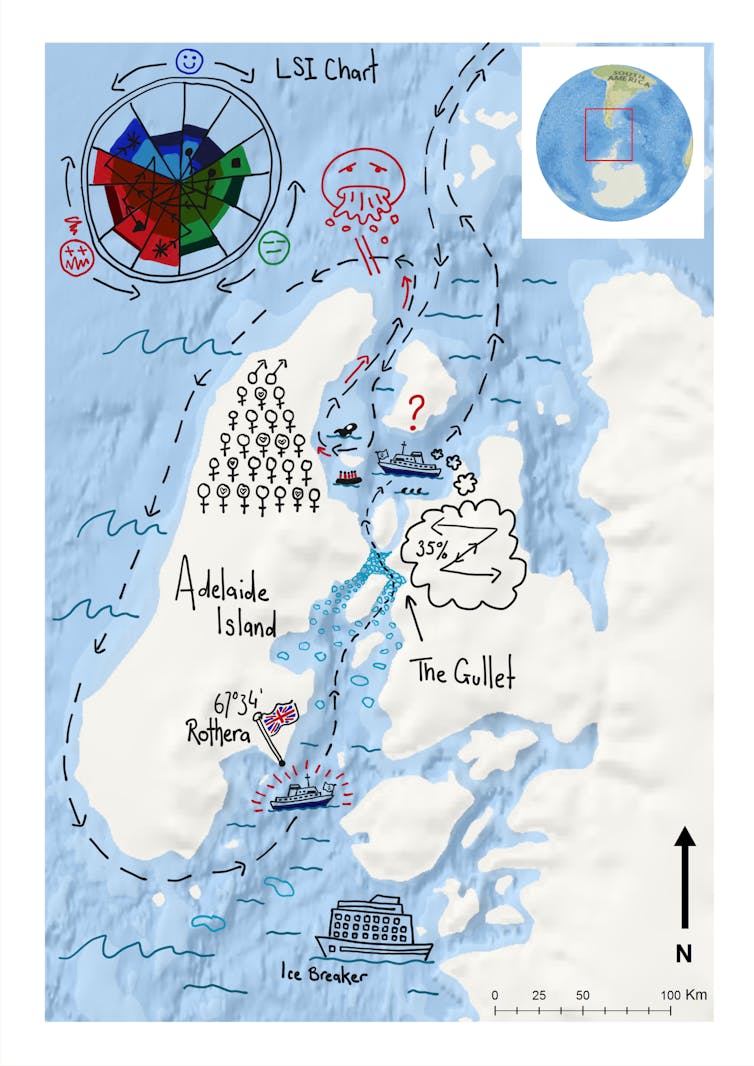 The options: re-route with risk of vomiting, or stay in calm waters?
Rachelle Balez, Author provided
The options: re-route with risk of vomiting, or stay in calm waters?
Rachelle Balez, Author provided
Under other circumstances, such as a tourist passenger cruise, a unilateral decision would be taken by the captain and expedition leader. However, given the different and unique aims of our journey, this decision was handed over to the Homeward Bound organisational team (the “faculty”) who, in turn, consulted the participants.
An inclusive and supportive discussion among the 77 women assembled in the lounge of the ship followed, before a “closed eye” vote was taken. This allowed partipants to express their preference for either staying put, or pushing on to Rothera, without being influenced by the views of those around them – with the overall outcome noted by the observing faculty.
We voted overwhelmingly to venture outside Adelaide Island and push on south to Rothera.
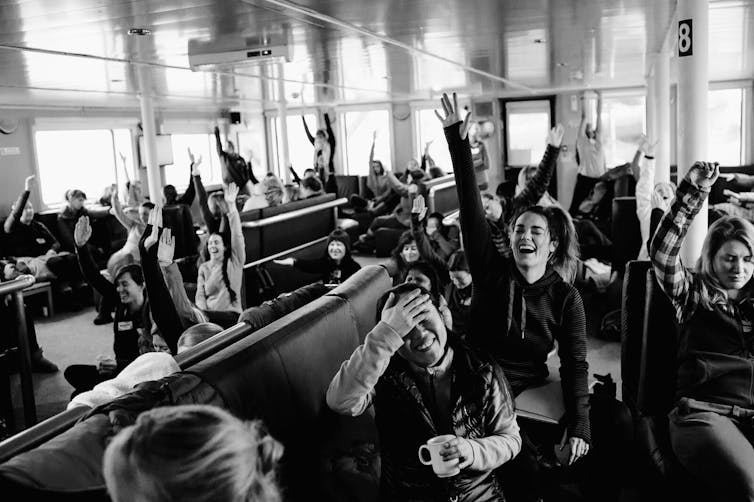 Lots of hands up in the voting with closed eyes.
Oli Samson, Author provided
Lots of hands up in the voting with closed eyes.
Oli Samson, Author provided
Plan B – and then Plan A again
To our surprise, a decision was subsequently taken by the faculty not to press on south. Some of us were surprised that our collective vote was not itself the deciding factor; others were surprised that the decision made was not in line with the majority vote.
Many of us were severely disappointed, despite being reassured that the well-being of individuals had been prioritised.
The following morning, we cruised across Crystal Sound in zodiac inflatable boats while pods of orcas criss-crossed the bay in searched of prey. Our disappointment at not reaching Rothera evaporated as we laughed and scrambled with our cameras among icebergs.
Upon returning to the ship, our captain and expedition leader let us know that the swell had died down. Conditions were good to head around the outside of Adelaide Island to Rothera after all, and the ship was leaving imminently. We whooped for joy and wound our way south.
The visit to Rothera was a success. As we left the station a nearby icebreaker reported that a change in wind direction meant The Gullet was clearing of icebergs. It was now possible to use the strengthened hull of our ship to cut a path back north for the return voyage, revisiting the moving sheets of sea ice that had prevented our passage from the other direction.
The next 12 hours were spent slowly zig-zagging forward across a mosaic of sea ice interspersed with slushy, fragmented “frazzle” ice crystals. These crystals were a telltale sign that the ice was on the verge of freezing solid.
With each small amount of headway made, we watched the ice close in quickly behind us, wondering for how much longer our captain’s nerve would hold. The tension on the bridge was palpable.
While our safety was never in question, we came dangerously close to becoming a stuck ship and the object of a recovery operation. Recognising the power of nature as we finally broke free the following afternoon, we stood on the deck enjoying metaphors about breaking glass ceilings. This was undoubtedly the most adventurous moment of our voyage.
Leadership lessons
Our journey offered many opportunities for reflection and learning. Over the three days that our story unfolded, we talked over the dinner table, in small groups, as a collective group and even workshopped the event, looking for meaning in the twists and turns of what happened.
Although the majority of women in the room had voted to continue south to Rothera, enough people expressed discomfort with the idea to trigger our organisational “faculty” team to change the plan.
Informed versus participatory decision making
Our first lesson highlights the difference between informed and participatory decision-making. While the former accounts for the views of a group of people, the latter is more like a typical democracy, and it depends on those views.
Some decision-making tools – for example, the Myers Briggs Z tool – weigh the needs of individuals against those of the collective group. Conventionally, if 35% of people are unsure about an action, their needs must be accounted for before moving forward.
A tangled psychological web
We used the Life Styles Inventory (LSI) chart to reflect on our individual thoughts and feelings in the moment we had voted, standing on the corresponding constructive, passive and aggressive behavioural styles on a Twister-like mat. This helped us to see how our thoughts guided us towards a desired outcome.
A complex picture of multiple responses in individuals emerged. Scaled up across the 77 women in the room, these played out as a tangled psychological web, aptly captured by the tangle of bodies on the chart.
Achievement versus empathy
Many of us reported a swing away from “competitive” or “achievement” styles – which would underpin thoughts such as “I want to achieve the visit to Rothera Station!” – toward the seemingly contrasting humanistic and passive styles.
These would underpin empathetic thoughts such as “If I don’t go, I will be disappointed, but if we go, she will be miserable, uncomfortable and seasick, which is worse than disappointment”.
Once voiced, anxiety can be an influential and persuasive force among groups of women, who typically show greater empathy for emotions such as fear.
Even though they were widely reported afterwards, the competitive-achievement sentiments found little voice in the room at the time of the vote. They were largely eclipsed by empathy for the well-being of others.
An opportunity taken
It is ironic that the dramatic push to 67° south, and the adventurous return journey through the ice on our “largest all-female expedition to Antarctica” were ultimately determined unilaterally by two of the highest-ranking people on the ship.
They were experienced, gracious, brave and modest men. Given that they had been directing our movements for the entirety of the voyage up until this point, this begs the question, why didn’t they just make the decision to push forward to Rothera in the first place?
While a unilateral approach would undoubtedly have been more efficient, with the benefit of hindsight, such a directive would have meant that the women of Homeward Bound would have missed out on a key opportunity to come together.
At times, this was a messy and angst-ridden experience. But it allowed us to build a sense of cohesion and strength through adversity, while enjoying the excitement of orcas and the catharsis of breaking the ice.
This raises an important question about leaders who habitually rely purely on expert opinion and authority as a basis for a decision, and regularly get acceptance. Do these leaders miss the opportunity for true ownership, engagement and perhaps even a better overall outcome that a longer, more unwieldy but ultimately more consultative approach may generate?
Given the lack of female representation in STEMM leadership roles, is this opportunity currently being missed in key decision-making forums on sustainability?
The value of diversity in decision-making
Perhaps the most important lesson from our story is the value of diversity in the decision-making process. Compared with their male counterparts, research suggests that women together are a little more collaborative and inclined towards participatory decision-making.
This was reflected in the purpose, consensus and empathy for the discomfort of others as 77 women consulted to make a collective decision. It was then followed up by a more directive decision based on the expertise and authority of our captain and expedition leader.
The two decisions together meant that we could have our cake and eat it: we empathised, we bonded over orcas, we reached Rothera Station, and we smashed the ice on the way home for good measure!
In a world of pressing scientific agendas, perhaps the best gains are made when different leadership styles come together.
The authors would like to acknowledge the contribution of Marshall Cowley, Senior Leadership Consultant at Dattner Grant, for his insight, expertise and help in preparing this article.
Authors: Sarah Hamylton, Senior Lecturer, School of Earth and Environmental Sciences, University of Wollongong


 Daily Bulletin


