

University funding debates should be broadened to reflect their democratic purpose
- Written by: Dominic O'Sullivan, Associate Professor of Political Science, Charles Sturt University
In 2017, Murdoch University successfully applied to the Fair Work Commission to terminate its Enterprise Agreement. From the National Tertiary Education Union’s (NTEU) perspective this was an attack on staff salaries and conditions and showed industrial relations law was deeply one-sided.
For university management having the agreement terminated was a legitimate industrial strategy, justified by a need for flexibility and cost containment. The wider trade union movement supported the NTEU perspective. The Murdoch case contributed to the development of a much wider campaign: “Change the Rules”. Changing the rules of industrial relations for better pay, fairer conditions and job security. Reversing the trend towards high rates of casualisation and low wage growth.
But the rules of the game, as far as universities are concerned, are set in a wider context. The context of what universities are for and what they are intended to achieve. While their economic purpose is reasonably clear, contemporary Australian policy debates focus primarily on how and by whom their teaching is funded. This diminishes understanding of universities’ democratic purpose and wider social mission.
What is the university for?
The principal polarising point in the university funding debate is whether demand or central planning should determine the number of people taught. The second is the proportion of the cost that should be met by the state vis-à-vis the student.
Read more: Why our university funding debate wouldn't make sense to Germans
While a proportion of universities’ per student public funding must support research, the funding model’s general assumption is that universities are labour market production lines. Research policy debate is confined to the related ideal of “industry” purchasing university research to reduce the contributions government must make to the cost of university research. Universities have an incentive to see research as simply a fund-raising activity.
These rules need to change in the interests of stronger democracy. Higher education’s current policy focus understates the idea of universities as public institutions serving a public good. Universities have important and essential contributions to make to democracy’s better functioning. The idea that democracy requires an educated population is as old as democracy itself.
 Academic freedom is important because evidence and reason matter to the formation of public opinion.
Paul Miller/AAP
Academic freedom is important because evidence and reason matter to the formation of public opinion.
Paul Miller/AAP
Research to support economic prosperity is important, but so is research to support public understanding and capacity to contribute to policy debates. Australia’s research Engagement and Impact evaluation policy understates this by measuring engagement principally in terms of the economic value of relationships with research “end users”.
Academic freedom
The university’s most important strength is its intellectual independence, and the academic freedom that assures that independence. Research for government or for industry is not independent. This kind of consultancy work may be legitimate and important, but it ought not compromise the presumption that knowledge cannot fully advance, and the democratic system work as it should, unless research is ideologically independent. It must also be contestable and brought into the public domain for evaluation and debate, and to inform public opinion and decision-making.
There is a public good argument to fund knowledge creation for this democratic purpose, which means academic freedom must be defended at all costs. Yet the University of Melbourne, for example, took steps to weaken that essential characteristic of university research when it proposed removing from its Enterprise Agreement the commitment that its academics would “engage in critical enquiry, intellectual discourse and public controversy without fear or favour”. This suggests an institution willing to compromise its democratic mission.
Read more: As Melbourne University staff strike over academic freedom, it's time to take the issue seriously
Academic freedom is important because evidence and reason matter to the formation of public opinion. They matter to the analysis of “fake news”, to counter-balancing an increasingly partisan Australian private news media at the same time as financial support for the national public broadcaster is being reduced.
Research that is not independent, that is conducted with fear and favour, is unscholarly. It compromises intellectual integrity and ensures knowledge cannot be a public and democratic good. Research for public good and research sold for private benefit can co-exist, but the latter cannot override the public mission of a public institution.
Universities play an essential role in the development of vocational and professional skills for both the individual and the common good. But if this is all they do, if they are not independently and objectively discovering and disseminating new knowledge for the public good, a society is presuming ignorance as a substitute for robust democracy.
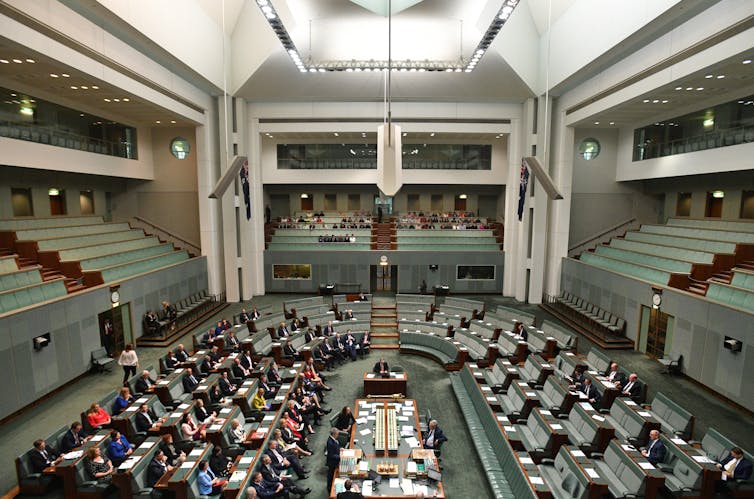 In a democracy, university graduates should leave with an understanding of power, where it comes from and why, who has it and why.
Mick Tsikas
In a democracy, university graduates should leave with an understanding of power, where it comes from and why, who has it and why.
Mick Tsikas
Understanding power
There is a public good argument for people to graduate from university with a well-developed understanding of power. Where it comes from and why, who has it and why, and how one influences it for society’s betterment. Highly developed critical thinking skills, the ability to write clearly and present well-informed and reasoned arguments are essential to influencing power. They ought not be the skills of an elite who have the money to buy the time to read, think and deliberate.
This is partly an argument for raising the status and availability of a liberal arts education, either on its own or in conjunction with a professional or vocational degree so that the social imperative to ‘be’ something when you grow up is still satisfied: an idea inculcated in children even before they start school.
One may reasonably wish to be a nurse, a teacher or an accountant but one should also expect to be a citizen. A nurse should be able to contribute to health policy debate. A teacher ought to know more than what must be taught this week. An accountant should know the democratic and social context in which business operates.
Authors: Dominic O'Sullivan, Associate Professor of Political Science, Charles Sturt University


 Daily Bulletin


