

Caring for elderly Australians in a home-like setting can reduce hospital visits
- Written by: Suzanne Dyer, Senior Research Fellow, Flinders University
A new study out today has found residents with dementia in aged-care facilities that provide a home-like model of care have a better quality of life and fewer hospitalisations than those living in more standard facilities. We also found the benefits of a home-like model were provided without an increase in running costs.
Our study compared home-like models (which have up to 15 residents per unit and free access to outdoor areas) to more standard residential care, where a large number of people are housed in one building. In 2011, around half of all facilities in Australia had places for more than 60 residents, and the average size is growing.
The World Health Organisation has stated smaller home-like residential care settings “hold promise for older people, family members and volunteers who provide care and support”. But Australia is lagging behind other countries in offering alternative models of residential aged care.
Read more: There's no need to lock older people into nursing homes 'for their own safety'
What is a home-like model of care?
Most older people with dementia want to stay at home as long as they can. When this is no longer possible, they move into residential aged-care facilities, which become their homes.
These residential facilities, or nursing homes, frequently adopt a model of care that emphasises individuality. This is known as person-centred care. But delivering this model may require more staff or a different mix of staff, which may be difficult to deliver with current funding.
So standard aged-care facilities in Australia often have some similarities to health facilities, with designated staff areas and centralised kitchens. Access to outdoor areas, particularly for people with dementia, may depend on the availability of staff. Despite adhering to philosophies such as person-centred care, the scheduling of this care and of meals often lacks flexibility.
The problems are compounded when residential care is used for multiple purposes ranging from palliative care to providing care for people with dementia. The needs of these two groups are quite different and the lack of focus makes delivering quality care a challenge.
Evidence shows the physical design of the residential aged-care environment may play an important role in the well-being of residents, particularly those living with dementia. Internationally, there is a move towards providing care in facilities that feel more like a home and promote independence.
Such models of residential aged care generally have:
- flexibility in daily routines – for example, the time people get dressed and eat
- opportunity for residents to participate in domestic activities such as meal preparation
- access to outdoor spaces
- clusters of smaller living units (up to, say, 15 residents in each)
- care staff assigned to living units for continuity of care and development of relationships between staff and residents.
Read more: God’s waiting room? Life needs to be valued in nursing homes
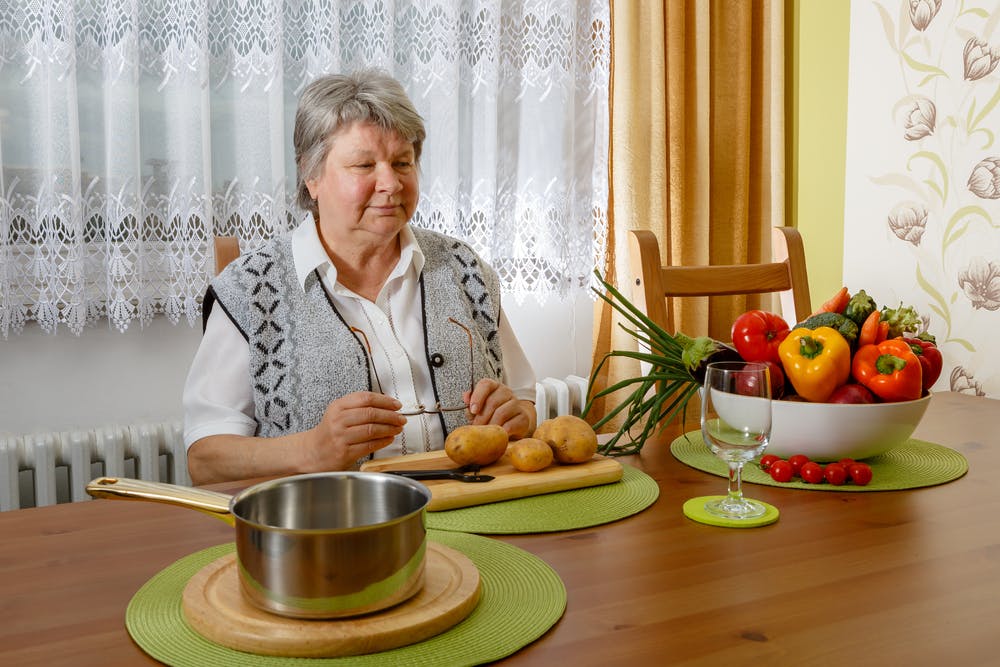 Being involved in simple tasks such as food preparation can improve quality of life.
from www.shutterstock.com
Being involved in simple tasks such as food preparation can improve quality of life.
from www.shutterstock.com
What we found
Our study was specifically designed to include people with dementia and their family members. People with dementia are not often included in research studies.
It included 541 participants from 17 not-for-profit residential aged-care facilities in four different states in Australia. They had been residents for a year or longer.
These facilities were all considered high quality. This means they had lower hospitalisation rates for potentially avoidable conditions than the national performance target. And more than 80% of residents in the standard care facilities indicated they felt as safe as they wanted and that their environment was as clean and comfortable as they wanted.
Around one-quarter of people in the study lived in a facility with a home-like model of care. All of them were living with dementia.
The study found residents in home-like models of care had a better quality of life, as rated by the residents themselves or their family members. They also had a 68% lower rate of being admitted to hospital and 73% lower rate of having an emergency department presentation.
We have previously shown residents who lived in a home-like model were 52% less likely to be exposed to potentially inappropriate medications. These are medications where the potential harms may outweigh the benefit, such as antipsychotics or relaxants, but are still often prescribed to older people in residential care.
The benefits for residents were provided with similar running costs for the home-like and the standard models of care. However, the costs excluded differences in the build of the facilities. Initial establishment costs are likely to be higher, due to the requirement for more space per resident.
Read more: There is extra funding for aged care in the budget, but not enough to meet demand
Rethinking models of care
Funding arrangements don’t incentivise Australian aged-care providers to offer variety in terms of models of care. Government funding is provided based on the assessed care needs of the residents, rather than the preferred model of care or resident outcomes.
Funding supplements are available to care providers for reasons such as residents’ financial hardship or risk of homelessness and to small, rural aged-care service providers, but none are available for offering an alternative model of care.
The Australian government plans to improve the aged-care system to offer “choice and flexibility”. This is crucial, but we also need to improve choice and variety in residential aged-care models.
Authors: Suzanne Dyer, Senior Research Fellow, Flinders University


 Daily Bulletin


